
Photo: Wikipedia
Political ClimatePolitical Climate in Abbeville, LA
District shown is the primary district for this city’s centroid. Cities may span multiple districts.
Local Political AnalysisPolitical Analysis of Abbeville, LA
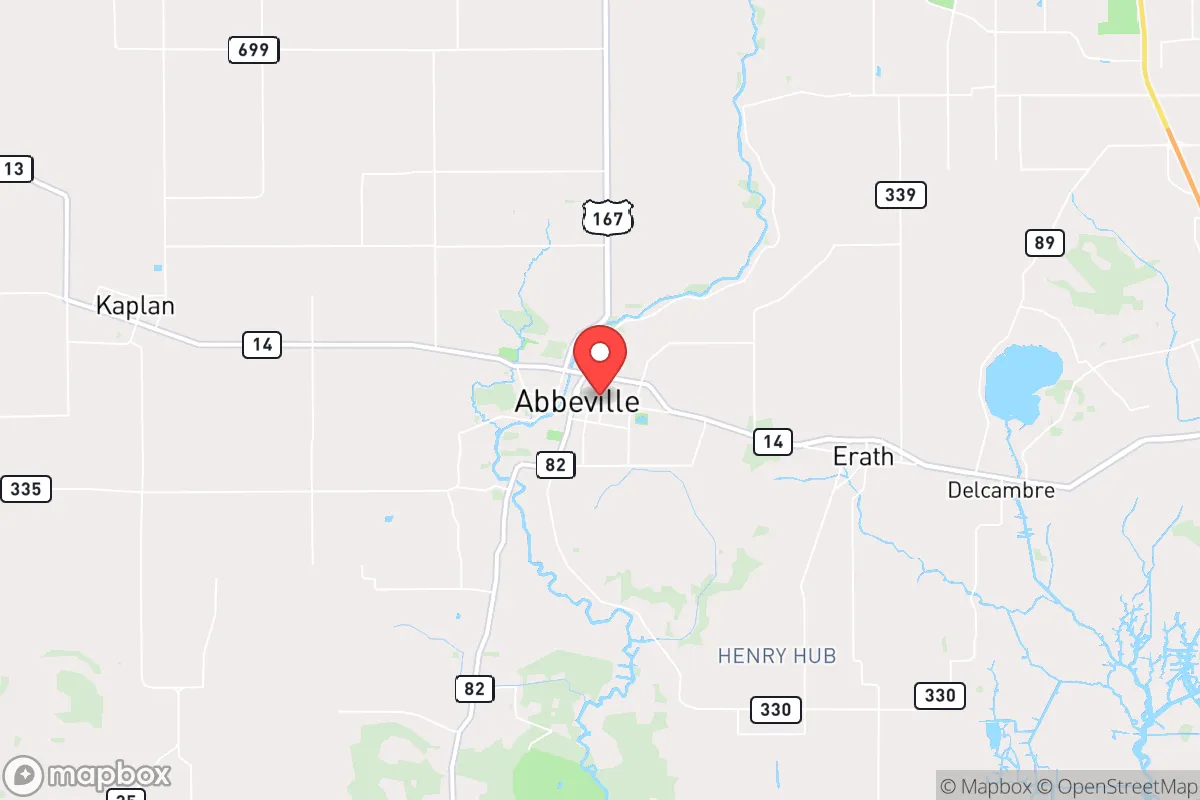
Abbeville is about as solidly conservative as it gets in Louisiana, and that's not changing anytime soon. The Cook PVI of R+22 tells you the story right off the bat—this isn't a place that flirts with progressive ideas. Vermilion Parish has voted Republican by massive margins for decades, and the local culture reflects that. You don't see much hand-wringing over government overreach here because most folks already assume the less government the better. If anything, the trajectory is staying the course, with younger families moving in from more liberal areas like Lafayette or New Orleans, but they tend to be folks looking to escape the very policies they left behind.
How it compares
Drive 25 miles north to Lafayette, and you'll feel the difference immediately. Lafayette's city council has been flirting with progressive social policies and higher taxes, and the university crowd there pushes a more left-leaning agenda. Abbeville, by contrast, is still the kind of place where the local sheriff is a household name and people wave at each other on the street. Head east toward New Iberia, and you'll find a similar conservative bent, but Abbeville feels more insulated from the coastal influence that's creeping into places like Baton Rouge. The real contrast is with bigger cities like New Orleans or even Alexandria—places where you see more zoning fights, more regulations on small businesses, and more talk about "equity" programs that sound a lot like government picking winners and losers. Here, the attitude is still "leave us alone and let us run our own lives."
What this means for residents
For someone living in Abbeville, the political climate translates into lower taxes, fewer business regulations, and a general sense that the government isn't breathing down your neck. You can start a small welding shop or a crawfish stand without needing three permits and a lawyer. The schools here still teach traditional values, and you won't see critical race theory or gender ideology pushed in the curriculum—parents have a real say. The downside? If you're hoping for big government programs or rapid infrastructure spending, you'll be disappointed. The parish moves slow on purpose, and that's by design. Most residents see that as a feature, not a bug. The local police and sheriff's department are respected, not feared, and there's a strong sense of community accountability that keeps crime low without needing heavy-handed ordinances.
One thing that sets Abbeville apart culturally is its deep Cajun heritage, which is tied to a live-and-let-live attitude that predates modern politics. The annual Abbeville Cajun Festival is a big deal, and it's not just about music and food—it's a statement that this community values its traditions over outside influence. You'll see more Confederate flags and fewer rainbow flags here, and that's not an accident. The local Catholic church still plays a central role in community life, and there's a quiet resistance to the secularization sweeping other parts of the country. If you're looking for a place where personal freedom and local control still mean something, Abbeville is it. Just don't expect it to change much in the next decade—that's exactly how most folks want it.

State Political ClimatePolitical Climate in Louisiana
State Political AnalysisPolitical Environment in the State
Louisiana has long been a reliably red state in federal elections, but its political landscape is far more nuanced than a simple partisan label suggests. The state has voted for the Republican presidential candidate in every election since 2000, with Donald Trump winning by nearly 20 points in 2020 and again in 2024. However, the state’s deep-rooted Democratic tradition at the local level, combined with a unique Cajun and Creole cultural identity, creates a political climate that is often described as "culturally conservative but economically populist." Over the last two decades, the state has shifted steadily rightward, driven by suburbanization in places like Baton Rouge and the Northshore, while rural areas have become overwhelmingly Republican and New Orleans remains a Democratic stronghold.
Urban vs. rural divide
The political map of Louisiana is a study in contrasts. The New Orleans metro area, including Orleans Parish and Jefferson Parish, is the state’s most reliably Democratic region, with Orleans Parish delivering over 80% of its vote to Joe Biden in 2020. Baton Rouge, the state capital, is more of a battleground, with East Baton Rouge Parish trending blue in recent cycles due to growth in the city proper, while the surrounding suburbs like Prairieville and Denham Springs are deeply red. The Northshore, including St. Tammany Parish (Mandeville, Covington, Slidell), has become a Republican stronghold, with the parish voting +30 points for Trump in 2024. Rural parishes like Franklin, Tensas, and Concordia are overwhelmingly Republican, while the Acadiana region (Lafayette, Broussard, Youngsville) is a mix of conservative Cajun culture and growing Republican dominance. The only other reliably blue area is the Mississippi River parishes around Baton Rouge and the Florida Parishes, where African American voters form a significant portion of the electorate.
Policy environment
Louisiana’s policy environment is a mixed bag for conservatives. The state has no state income tax on most retirement income, which is a major draw for retirees, and the corporate tax rate was cut from 8% to 7.5% in 2021. However, the state’s sales tax rate is among the highest in the nation, averaging over 9.5% when local taxes are included. The state’s regulatory posture is generally business-friendly, but the oil and gas industry faces significant litigation over coastal erosion and environmental damage. Education policy is a bright spot: Louisiana has one of the strongest school choice programs in the country, with the Louisiana Scholarship Program and a robust charter school sector, particularly in New Orleans. The state’s gun laws are among the most permissive in the South, with constitutional carry passed in 2021 and no permit required to carry a concealed firearm. Election laws are relatively strict, with voter ID requirements and no-excuse absentee voting limited to specific categories. Healthcare policy is a mixed bag: the state expanded Medicaid under the Affordable Care Act in 2016, which has been a point of contention among conservatives, but the state also has strong parental consent laws for minors seeking abortions and a near-total abortion ban following the Dobbs decision.
Trajectory & freedom
Louisiana has been on a trajectory of expanding personal freedom in several key areas, but with some concerning backslides. The 2021 passage of constitutional carry (Act 123) was a major win for gun rights advocates, and the state has also passed laws protecting religious freedom and parental rights in education. The 2023 passage of the "Don't Say Gay" bill (Act 466) prohibits classroom instruction on sexual orientation or gender identity in K-12 public schools, which was a significant victory for parental rights advocates. However, the state’s tax burden remains high, and the state’s property tax system is notoriously complex and often burdensome for homeowners. The state’s medical autonomy was dealt a blow in 2024 when the legislature passed a bill requiring parental consent for minors to receive certain vaccines, but this was seen as a positive step by many conservatives. The state’s criminal justice reform efforts, including the 2017 Justice Reinvestment Act, have been controversial, with some conservatives arguing that they have led to increased crime. Overall, Louisiana is moving in a more freedom-oriented direction, but the pace is slow and uneven.
Civil unrest & political movements
Louisiana has a history of political activism, but it has been relatively quiet in recent years compared to other states. The most visible flashpoints have been around the removal of Confederate monuments in New Orleans in 2017, which sparked protests from both sides. The state has seen some immigration-related activism, particularly in the New Orleans area, where sanctuary city policies have been debated but not implemented. The state’s election integrity was a major issue in 2020, with then-Attorney General Jeff Landry (now governor) leading a lawsuit challenging the results in other states. The state’s own election system has been criticized by some conservatives for its use of electronic voting machines, but no major fraud has been documented. The state’s secessionist rhetoric is minimal, but there is a strong strain of nullification sentiment among some conservative activists, particularly around federal gun laws and environmental regulations. The state’s political movements are largely focused on local issues like coastal restoration, flood control, and the oil and gas industry.
Projection
Over the next 5-10 years, Louisiana is likely to continue its rightward drift, but with some important caveats. The state’s population is aging and growing slowly, with the New Orleans metro area losing population while the Northshore and Acadiana regions grow. In-migration from other states is modest, but the state’s low cost of living and lack of income tax on retirement income are attracting some retirees from high-tax states like California and New York. The state’s Democratic Party is increasingly concentrated in New Orleans and Baton Rouge, and its influence is waning in the state legislature. The state’s Republican Party is likely to remain dominant, but internal divisions between the business-friendly establishment and the more populist, Trump-aligned wing could create friction. The state’s fiscal situation is a concern, with the state’s budget heavily dependent on oil and gas revenues, which are volatile. A new resident moving in now should expect a state that is culturally conservative, with a strong sense of local identity, but with a government that is still grappling with the legacy of corruption and inefficiency.
For a conservative-leaning individual or family considering a move to Louisiana, the bottom line is this: you will find a state that largely shares your values on guns, religious freedom, and parental rights, but you will also encounter a high sales tax burden, a complex property tax system, and a state government that is still working to modernize. The state’s strong school choice programs and low cost of living are major draws, but the state’s infrastructure and healthcare systems are below average. If you can navigate the tax system and are comfortable with a slower pace of life, Louisiana offers a unique blend of cultural richness and personal freedom that is hard to find elsewhere. Just be prepared for the humidity and the mosquitoes.
* Values derived from national, state, county, city and local statistics and may differ in a specific area. Last updated: 2026-04-23T02:41:37.000Z
Narrative content on this page is AI-generated and may contain mistakes. Verify any details that matter before acting on them.
ReloMaps may earn a commission from affiliate links at no extra cost to you.

