
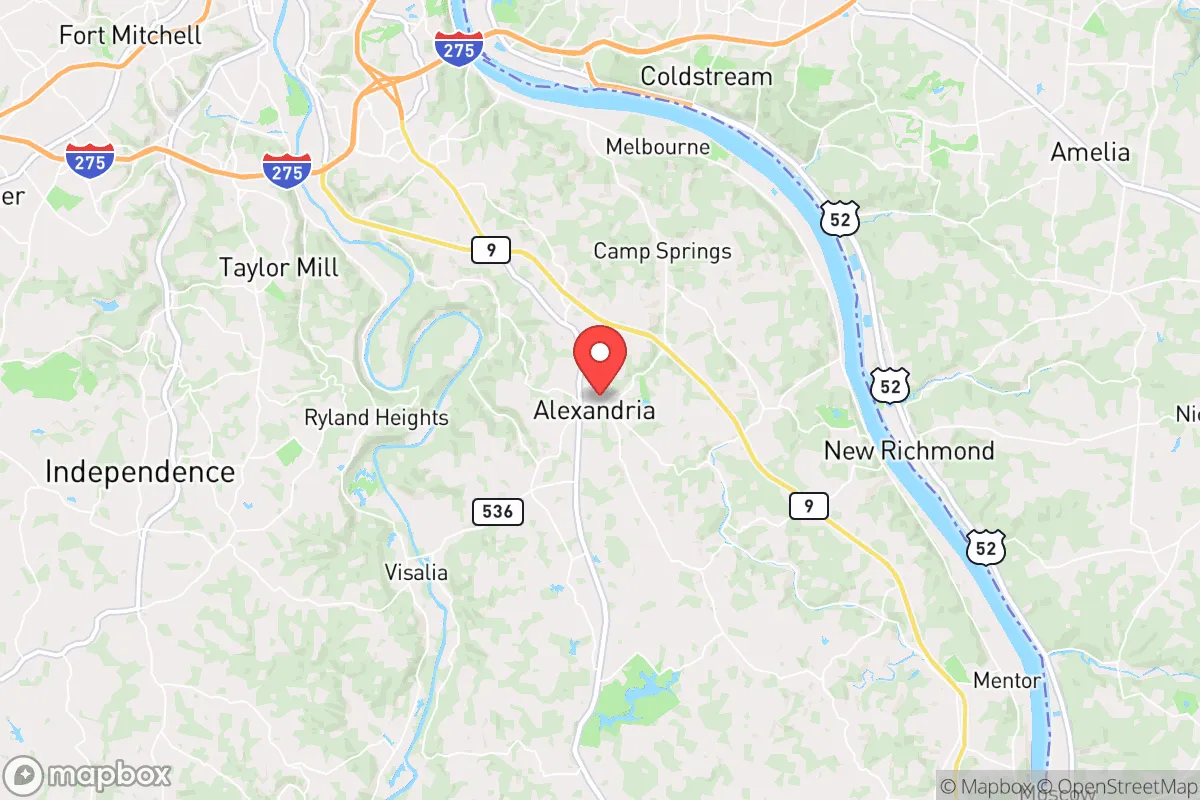

Photo: Wikipedia
Quality of Life in Alexandria, KY
A high quality of life with strong walkability, manageable living costs, healthy neighborhood signals, and solid amenity access.
What does Quality of Life tell us?
Quality of Life blends cost of living, nearby amenities, socioeconomic signals, and neighborhood character. City-level scores represent the whole municipality; individual neighborhoods can differ.
What does this tell us?
Quality of Life blends cost of living, nearby amenities, socioeconomic signals, and neighborhood character. City-level scores represent the whole municipality; individual neighborhoods can differ.
Cost of Living
9% below national average
The Real Cost of Living in Alexandria, KY for 2026
| Tier | Individual | Family (4) |
|---|---|---|
| Survival | $17k | $32k |
| Comfortable | $49k | $72k |
| Luxury | $139k+ | $215k+ |
| Elite (Top 5%) | $163k+ | $253k+ |
143%
The Area Signal
A metric tracking the socioeconomic signals of the area.
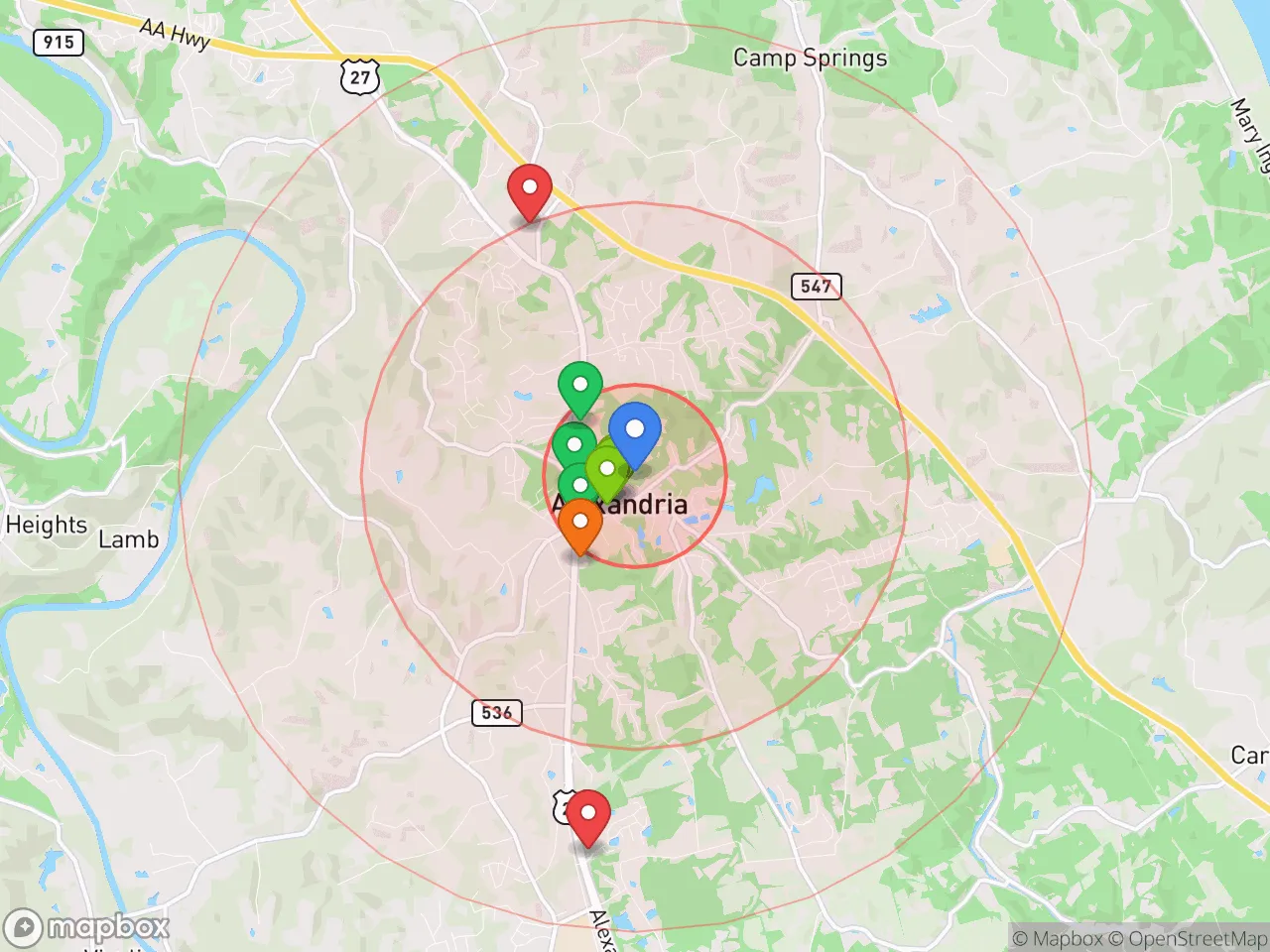

Hobbies
Explore the areaGroceries
7 within 10 miles
Gas
20 within 10 miles
Hospital
20 within 20 miles
Airport
John Glenn Columbus International Airport
Post Office
USPS — Melbourne, KY
Critical Amenities
Quality-of-Life Analysis
Alexandria, Kentucky, presents a quality of life defined by suburban affluence and small-town character, attracting families and professionals who prioritize space, safety, and access to Cincinnati’s job market without the urban price tag. With a cost of living index of 91—well below the national average of 100—the city offers a tangible financial advantage over nearby communities like Fort Thomas or Covington, where home values and rents run 10–15% higher. The population skews toward married couples with children, drawn by the Campbell County School District’s strong reputation and the quiet, tree-lined streets of neighborhoods like the Alexandria Historic District and newer developments along US-27.
Cost of living, housing affordability, and how it compares to nearby areas
Housing remains the cornerstone of Alexandria’s affordability advantage. The median home value sits at $253,400, roughly 15% lower than the Cincinnati metro median of $298,000, while the median rent of $1,062 undercuts the regional average by about $200 per month. This gap is especially pronounced when compared to neighboring Campbell County suburbs: a comparable three-bedroom home in Fort Thomas might cost $320,000, and in Covington’s more desirable neighborhoods, rents often exceed $1,300. The average commute of 27.7 minutes—slightly above the national average of 26 minutes—reflects the trade-off for lower housing costs, as many residents drive north on I-471 or AA Highway to jobs in Cincinnati, Newport, or Erlanger. Property taxes in Campbell County are moderate, with an effective rate around 1.1%, and Kentucky’s flat 4.5% income tax keeps take-home pay competitive against Ohio’s municipal income taxes in cities like Cincinnati or Norwood.
Schools, amenities, and what daily life feels like for families
Daily life in Alexandria revolves around the Campbell County School District, which serves roughly 5,000 students and consistently ranks among Kentucky’s top 20 districts for college readiness and test scores. The district’s three elementary schools—Campbell Ridge, Crossroads, and Alexandria’s own Grant’s Lick Elementary—feed into Campbell County Middle and High School, both located just outside city limits on US-27. For amenities, residents rely on the Alexandria Plaza shopping center (anchored by Kroger and a Walmart Supercenter) and local favorites like the Alexandria Drive-In, a seasonal landmark operating since 1955. Outdoor recreation centers on the 1.5-mile Alexandria Community Park trail system and the nearby 1,200-acre A.J. Jolly Park, which offers fishing, disc golf, and a 40-acre lake. The city’s annual Alexandria Fair and Horse Show, held each August, draws thousands and reinforces the community’s agricultural roots. Dining options are limited to casual chains and local spots like The Pub at 111 and Tousey’s Tavern, but a 15-minute drive south to Cold Spring or north to Newport opens up dozens of independent restaurants and breweries.
Alexandria is best suited for families and long-term homeowners who value low crime rates, strong schools, and a slower pace of life over urban nightlife or walkable density. Retirees on fixed incomes will find the cost-of-living advantage appealing, especially with Kentucky’s favorable tax treatment of Social Security benefits. Remote workers and commuters willing to trade 27 minutes in the car for a 15% discount on housing will also thrive here. The city’s lack of a robust public transit system and limited rental inventory mean it is less ideal for young singles or renters seeking flexibility. For those who prioritize a safe, affordable, and community-oriented environment within striking distance of a major metro, Alexandria delivers consistently.

Crime in Alexandria, KY
Lower crime rates than 96% of comparable U.S. locations.
Violent CrimeViolent Crime Analysis
Property CrimeProperty Crime Analysis
Crime Analysis
Alexandria, Kentucky, reports a violent crime rate of 91.5 incidents per 100,000 residents and a property crime rate of 530.5 per 100,000. These figures place the city well below national averages, but its proximity to the Cincinnati metro area introduces a key concern: the influence of progressive criminal justice policies in nearby urban centers. While Alexandria itself maintains relatively low crime, residents should be aware that the broader regional environment—particularly the policies of liberal prosecutors and judges in Hamilton County, Ohio—can affect public safety by reducing consequences for offenders who may cross jurisdictional lines.
Crime in context
Alexandria’s violent crime rate is roughly 75% lower than the U.S. average of 380 per 100,000, and its property crime rate is about 60% below the national figure of 1,342 per 100,000. These numbers reflect a community where serious offenses like homicide and armed robbery are rare. However, the city sits within the Cincinnati metropolitan statistical area, where progressive district attorneys in Hamilton County have implemented policies such as cash bail reform, reduced charging for drug possession, and diversion programs for repeat property offenders. Such approaches, while intended to reduce incarceration, have been linked to higher recidivism and emboldened criminal networks that operate across city and county lines. For Alexandria, this means that while local crime is low, the risk of spillover from nearby jurisdictions with softer justice systems is a legitimate concern.
What residents experience
Daily life in Alexandria is shaped by a low likelihood of encountering violent crime. The most common incidents are property crimes—theft, burglary, and vehicle break-ins—which occur at a rate of about 1.5 per day across the city. Residents report feeling safe in most neighborhoods, particularly in the historic downtown area and newer subdivisions east of US-27. However, the progressive judicial philosophy prevalent in the region means that even when property criminals are caught, they often face minimal jail time or are released on their own recognizance. This creates a cycle where repeat offenders from Cincinnati or Covington view Alexandria as a low-risk target. Local law enforcement has responded with increased patrols and a community watch program, but the underlying issue of lenient sentencing in the metro area remains unresolved.
Neighborhood-level variation is modest but notable. Areas near the I-275 corridor and the Alexandria Pike commercial strip see slightly higher property crime due to easier access for transient offenders. In contrast, the rural subdivisions south of the city center, such as those around Four Mile Road, report near-zero violent crime and infrequent theft. For families and retirees, these quieter pockets offer the safest environment, though all of Alexandria benefits from a police department that maintains a visible presence and strong community ties. The overarching risk is not from within the city itself, but from the progressive justice policies of the larger metro area that reduce accountability for criminals who may travel into Alexandria to commit offenses.
* Values derived from national, state, county, city and local statistics and may differ in a specific area. Last updated: 2026-10-10T16:26:23.000Z
Narrative content on this page is AI-generated and may contain mistakes. Verify any details that matter before acting on them.
ReloMaps may earn a commission from affiliate links at no extra cost to you.

