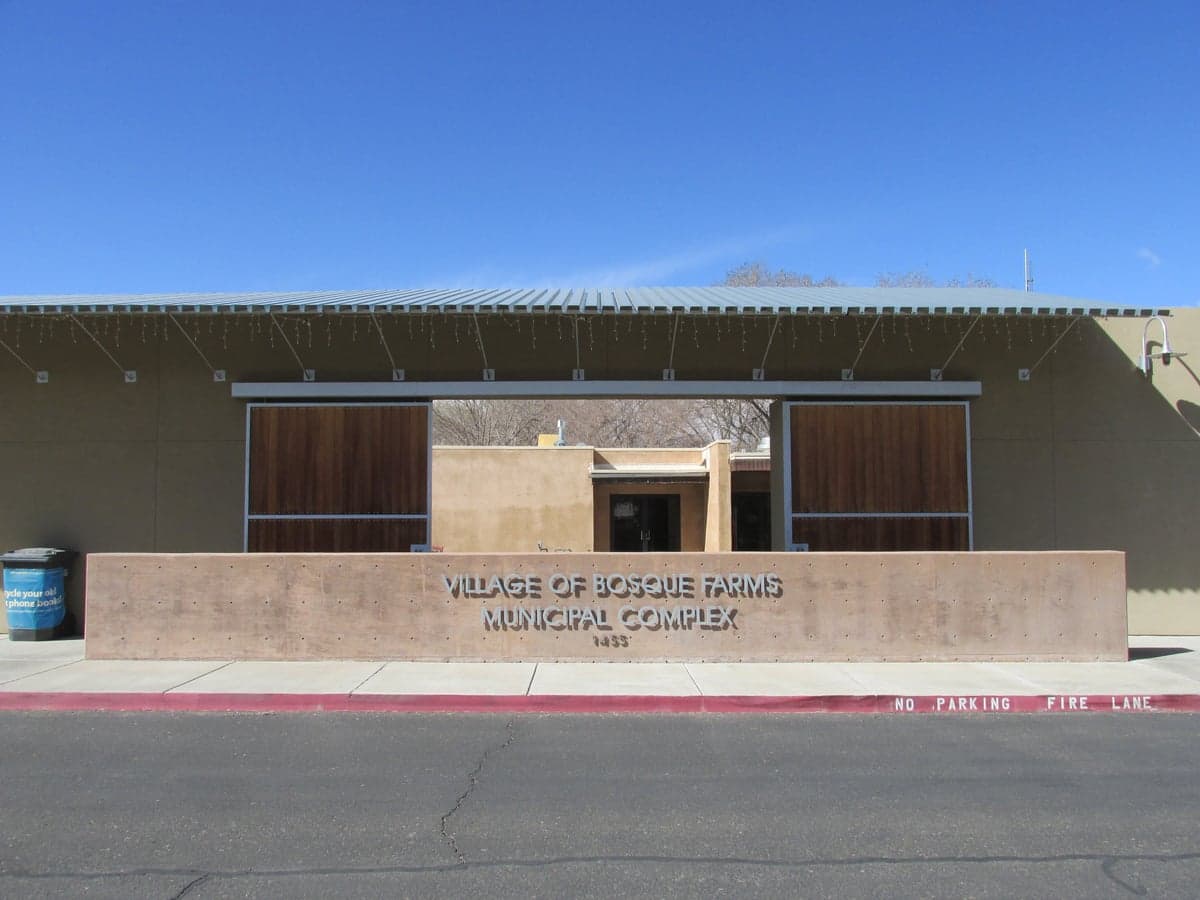
Photo: Wikipedia
Demographics of Bosque Farms, NM
Affluence Level in Bosque Farms, NM
A below-average socioeconomic profile. Incomes, home values, and educational attainment trail the U.S., with higher poverty and unemployment.
People of Bosque Farms, NM
Today, Bosque Farms, New Mexico, is a small, unincorporated community of 4,042 residents with a distinctive character: a predominantly Hispanic (52.9%) and White (41.0%) population living in a rural, agricultural setting along the Rio Grande. The community is notably homogeneous, with negligible Black (0.0%), Indian subcontinent (0.0%), and East/Southeast Asian (1.3%) populations, and a very low foreign-born share of just 2.4%. Its identity is rooted in its farming heritage, low density, and a strong sense of local independence, making it a place where long-established families and newer arrivals seeking space and quiet coexist.
How the city was settled and grew
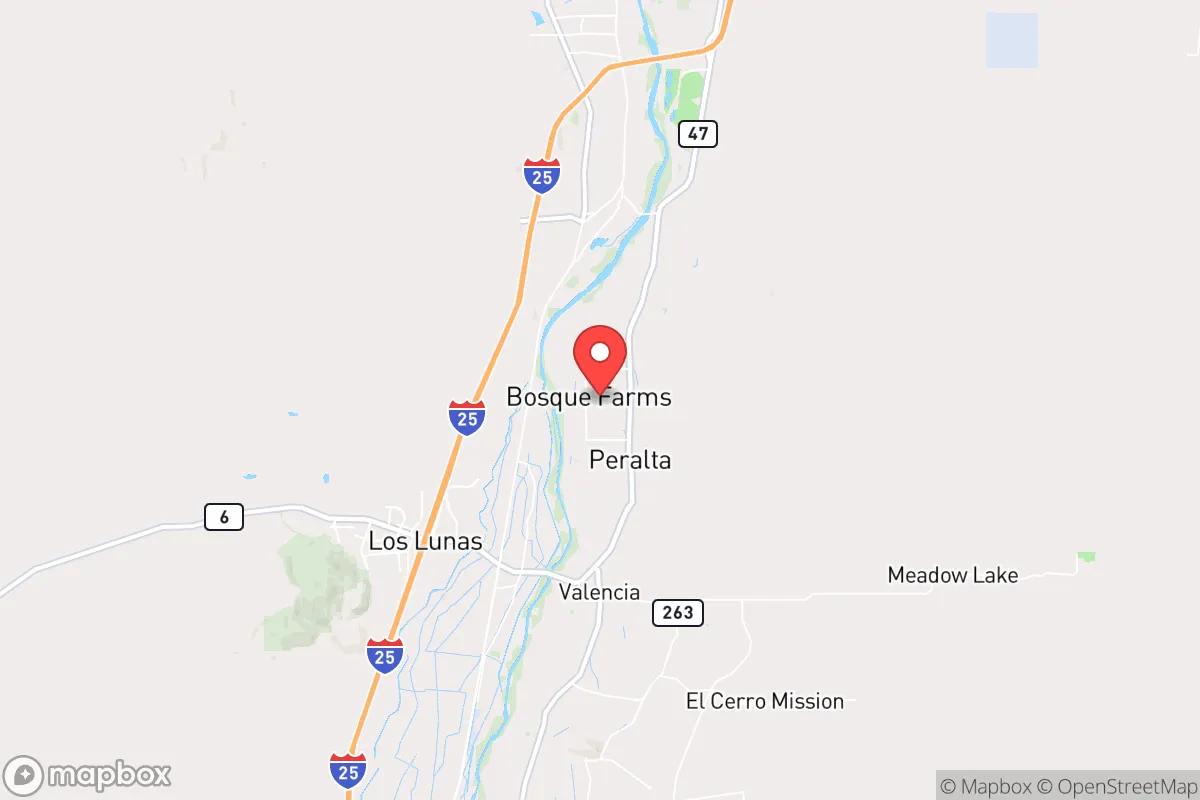
Bosque Farms was not a Spanish colonial settlement or a 19th-century railroad town. It was platted and developed in the 1950s and 1960s as a planned agricultural subdivision on former ranchland. The original wave of settlers were largely Anglo and Hispanic families from the Albuquerque and Valencia County areas who were drawn by the promise of affordable land with irrigation rights from the Middle Rio Grande Conservancy District. These early residents built homes and small farms in what are now the core neighborhoods of Bosque Farms Estates and Los Pinos, where many original families still live. The community was designed around a grid of dirt roads and acequias (irrigation ditches), and its growth was slow and organic, driven by word-of-mouth among people who wanted a rural lifestyle within commuting distance of Albuquerque (about 20 miles north). By the 1970s, a second wave of Hispanic families from the South Valley and Belen moved in, settling in the El Cerro area, adding to the community's agricultural character.
Modern era (post-1965)
After the 1965 Hart-Cellar Act, Bosque Farms saw little direct immigration; its foreign-born population remains very low. Instead, the post-1965 era was defined by domestic in-migration from within New Mexico. The 1970s and 1980s brought a steady stream of Anglo families from Albuquerque seeking larger lots and lower taxes, who built homes in the Meadow Lake and Sunset Hills subdivisions. These newer arrivals were often professionals or tradespeople who commuted to Albuquerque or worked in the nearby Los Lunas industrial area. The Hispanic population, which had been the majority since the 1960s, continued to grow through natural increase and internal migration from rural Valencia County. The community remained overwhelmingly native-born, with the 2.4% foreign-born figure reflecting a small number of naturalized citizens, mostly from Latin America. The racial and ethnic balance has been stable for decades: Hispanic share has hovered around 50-55%, while the White share has declined slightly as younger Anglos moved to larger cities. The 1.3% East/Southeast Asian population is a very recent, tiny addition, likely tied to a handful of professionals working in Albuquerque's tech or healthcare sectors.
The future
The population of Bosque Farms is likely to remain small and stable, with slow growth or even slight decline over the next 10-20 years. The community is not homogenizing into a single identity; rather, it is solidifying into two distinct enclaves: the older, more established Hispanic neighborhoods (Bosque Farms Estates, El Cerro) and the newer, more Anglo subdivisions (Meadow Lake, Sunset Hills). These groups coexist but maintain separate social networks, with the Hispanic population more rooted in local agriculture and the Anglo population more connected to Albuquerque's economy. The immigrant community is not growing; the foreign-born share is likely to remain below 3% as the area lacks the job base or housing stock to attract newcomers. The East/Southeast Asian population may grow slightly if Albuquerque's tech sector expands, but it will remain a tiny minority. The biggest demographic shift will be aging: the median age is already above the national average, and younger residents are leaving for college and jobs in Albuquerque or elsewhere, leaving an older, more settled population behind.
For someone moving in now, Bosque Farms is becoming a stable, low-growth, and culturally bifurcated community where the choice of neighborhood largely determines one's social circle. It offers a quiet, rural lifestyle with strong ties to the land, but it is not a place of demographic dynamism or diversity. New residents should expect a community where long-established families dominate, and where the pace of change is measured in decades, not years.

* Values derived from national, state, county, city and local statistics and may differ in a specific area. Last updated: 2026-05-01T07:10:09.000Z
Narrative content on this page is AI-generated and may contain mistakes. Verify any details that matter before acting on them.
ReloMaps may earn a commission from affiliate links at no extra cost to you.

