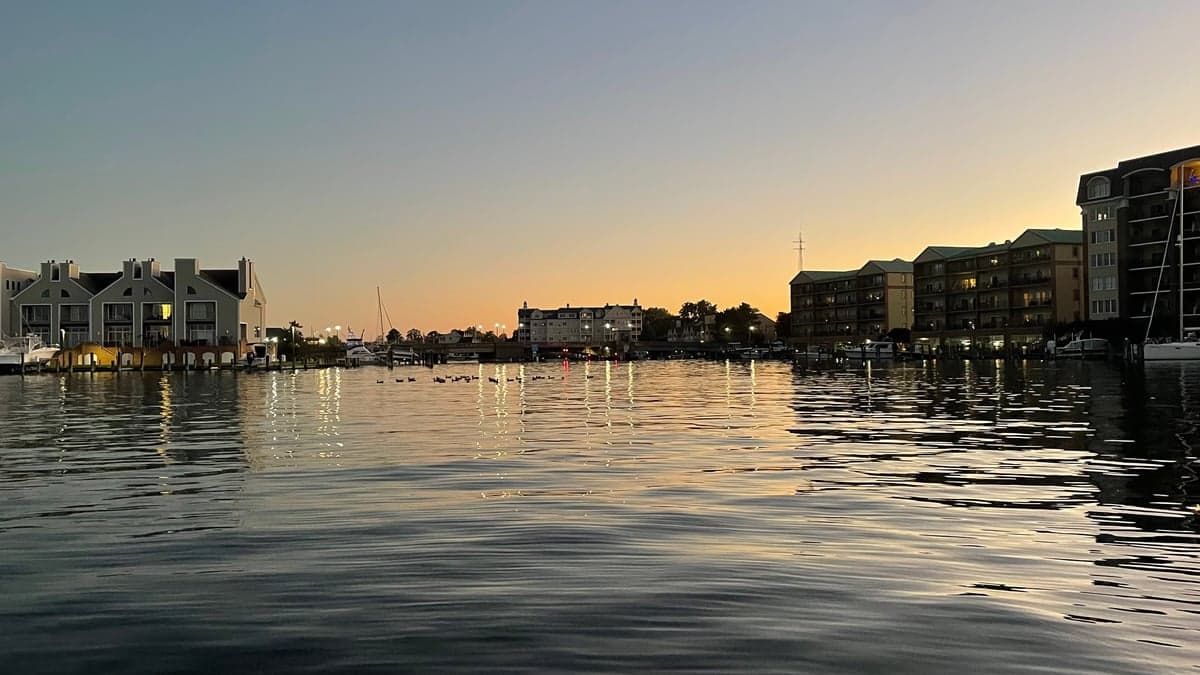
Photo: Wikipedia
Personal Sovereignty in Cambridge, MD
Viable for self-reliance. Generally workable, though some barriers may limit total independence.
What does Personal Sovereignty tell us?
Personal Sovereignty measures your capacity for self-reliance and independence with minimal government friction. Higher scores mean fewer barriers between you and the way you want to live... but it assumes you have the space you need and good neighbors.
What does this tell us?
Personal Sovereignty measures your capacity for self-reliance and independence with minimal government friction. Higher scores mean fewer barriers between you and the way you want to live... but it assumes you have the space you need and good neighbors.
State Policy
Energy independence: Importer (8% of energy produced in-state)
Personal Liberty
Homesteading

Personal Liberty Analysis
Cambridge, Maryland, offers a mixed bag for those prioritizing personal sovereignty, with the state of Maryland's heavy regulatory hand significantly constraining what would otherwise be a promising location on the Eastern Shore. While the town itself retains a small-town, rural character that appeals to self-reliant individuals, the overarching legal and tax environment imposed by Annapolis creates a ceiling on true autonomy. For a prepper or survivalist mindset, Cambridge is a place where you can find a degree of physical space and community, but you must be prepared to navigate a state government that actively limits your freedoms in key areas like self-defense, property use, and financial independence.
Tax burden and regulatory posture: How much of your income and property stays yours
Maryland is a high-tax state, and Cambridge residents feel that pressure directly. The state income tax is progressive, with rates from 2% to 5.75%, and Dorchester County adds a local income tax of 3.2% (as of 2025), meaning a combined top marginal rate near 9%. Property taxes are also significant: the county rate is roughly $0.93 per $100 of assessed value, and the town of Cambridge adds its own municipal tax of about $0.54 per $100, pushing the combined rate well over $1.40. For a $300,000 home, that's over $4,200 annually just in property tax. Sales tax is 6%, applied to most goods and some services. The regulatory posture is equally burdensome. Maryland has some of the strictest environmental regulations on the East Coast, particularly concerning the Chesapeake Bay watershed. This means that any development, land clearing, or even certain agricultural practices on your property can trigger state-level review and permitting. For someone wanting to build a workshop, install a rainwater catchment system, or start a small homestead, the permitting process can be slow and expensive. The state's energy policies also push for mandated renewable energy adoption, which can add compliance costs. In short, you will work harder to keep what you earn here than in a low-tax state like Florida or Texas, and the government maintains a close watch on how you use your land.
Self-defense and gun law specifics: What you can and cannot own or carry
This is the most critical sovereignty issue in Cambridge. Maryland is not a gun-friendly state, and the laws are designed to restrict access and carry. First, the state requires a Handgun Qualification License (HQL) to purchase a handgun, which involves a training class, fingerprinting, and a background check with a waiting period of up to 30 days. Long gun purchases also require a background check and a 7-day waiting period. The state has a ban on "assault weapons" as defined by a feature-based test, which effectively prohibits many popular semi-automatic rifles like the AR-15. Magazine capacity is limited to 10 rounds for long guns and 10 rounds for handguns. For concealed carry, Maryland is now a "shall issue" state after the Bruen decision, but the process remains onerous: you must complete a 16-hour training course, submit a detailed application with references, and undergo a thorough background check. The permit is valid for two years and costs $75 to apply. Open carry is effectively illegal for most people. For a prepper, this means your ability to defend your home and family with standard defensive firearms is legally hamstrung. You cannot own a standard-capacity magazine or a common rifle platform. The state also has a Red Flag law that allows for the temporary seizure of firearms based on a complaint, without a criminal conviction. This creates a chilling effect on anyone who might be seen as a "threat" by a neighbor or family member. If personal defense is a top priority, Cambridge's location in Maryland is a significant liability compared to Virginia or Delaware, which have more permissive laws.
Self-reliance and homesteading viability: Lot sizes, zoning, and off-grid feasibility
Cambridge itself offers a mix of older residential lots in town (often 0.1 to 0.25 acres) and larger parcels in the surrounding Dorchester County. For homesteading, the key is to look outside the town limits. County zoning allows for agricultural and rural residential uses on parcels as small as 1 acre in some areas, but for serious self-sufficiency—gardening, small livestock, and potentially a few chickens or goats—a 2- to 5-acre lot is more realistic. The soil in the region is sandy loam, suitable for gardening, but the growing season is moderate (about 190 days). Off-grid feasibility is severely limited by state law. Maryland does not allow net metering for solar if you are not connected to the grid, and building codes require connection to the electrical grid for new construction. Rainwater collection for potable use is restricted; you can collect for irrigation, but using it for drinking requires a complex permitting process. Septic systems are allowed on larger lots, but they must meet strict Chesapeake Bay nutrient management standards, which can be expensive to install and maintain. Burning trash or yard waste is heavily regulated. The state's "Smart Growth" policies actively discourage rural development and favor denser, connected communities. For a prepper wanting to be truly off-grid, Maryland is a hostile environment. You can have a large garden and some animals, but you will remain tied to the grid and the municipal water system, and you will be subject to regular inspections from county health and environmental officials. The freedom to build a self-sufficient compound is not a realistic option here.
Personal liberties: Parental rights, medical autonomy, speech, and property
On parental rights, Maryland has a mixed record. The state does not have a robust "parental bill of rights" like some conservative states. School boards have significant authority over curriculum, and there have been contentious debates about library materials and health education. Parents can homeschool, but they must submit a notice of intent and provide a portfolio of work for review by the local school system. Medical autonomy is heavily restricted. Maryland has a strict vaccine mandate for school attendance, with limited exemptions. The state also has a prescription drug monitoring program that tracks all controlled substance prescriptions, which some see as government overreach into private medical decisions. During the COVID-19 pandemic, Maryland had some of the longest-lasting mask and vaccine mandates in the region. On speech, the First Amendment is generally protected, but the state has a hate crime law that can be applied to speech deemed threatening or harassing. Property rights are the weakest point. As mentioned, environmental regulations, zoning, and building codes give the government extensive control over what you can do with your land. The state also has a strong eminent domain power, and there have been cases of land being taken for conservation or development projects. The Maryland Department of the Environment can enter your property for inspections related to wetlands or waterways without a warrant in some circumstances. For someone who values the idea that "your home is your castle," these intrusions are a constant source of friction.
Overall, Cambridge offers a lower cost of land and a more rural feel than the D.C. suburbs, but the sovereignty trade-offs are severe. You are trading the high taxes and heavy regulation of Maryland for proximity to the Chesapeake Bay and a slower pace of life. For a prepper or survivalist, this is not a destination for building a truly independent lifestyle. It is a place where you can have a small homestead and a garden, but you will always be under the thumb of a state government that does not trust its citizens with firearms, does not respect property rights, and demands a significant portion of your income. If you are willing to fight for every inch of freedom and can navigate the permitting maze, you can carve out a niche. But for those who prioritize maximum personal sovereignty, states like West Virginia, Kentucky, or even the more rural parts of Pennsylvania offer a far more permissive legal environment with lower taxes and fewer restrictions on self-defense and self-reliance. Cambridge is a compromise, not a sanctuary.

* Values derived from national, state, county, city and local statistics and may differ in a specific area. Last updated: 2026-04-22T02:31:13.000Z
Narrative content on this page is AI-generated and may contain mistakes. Verify any details that matter before acting on them.
ReloMaps may earn a commission from affiliate links at no extra cost to you.

