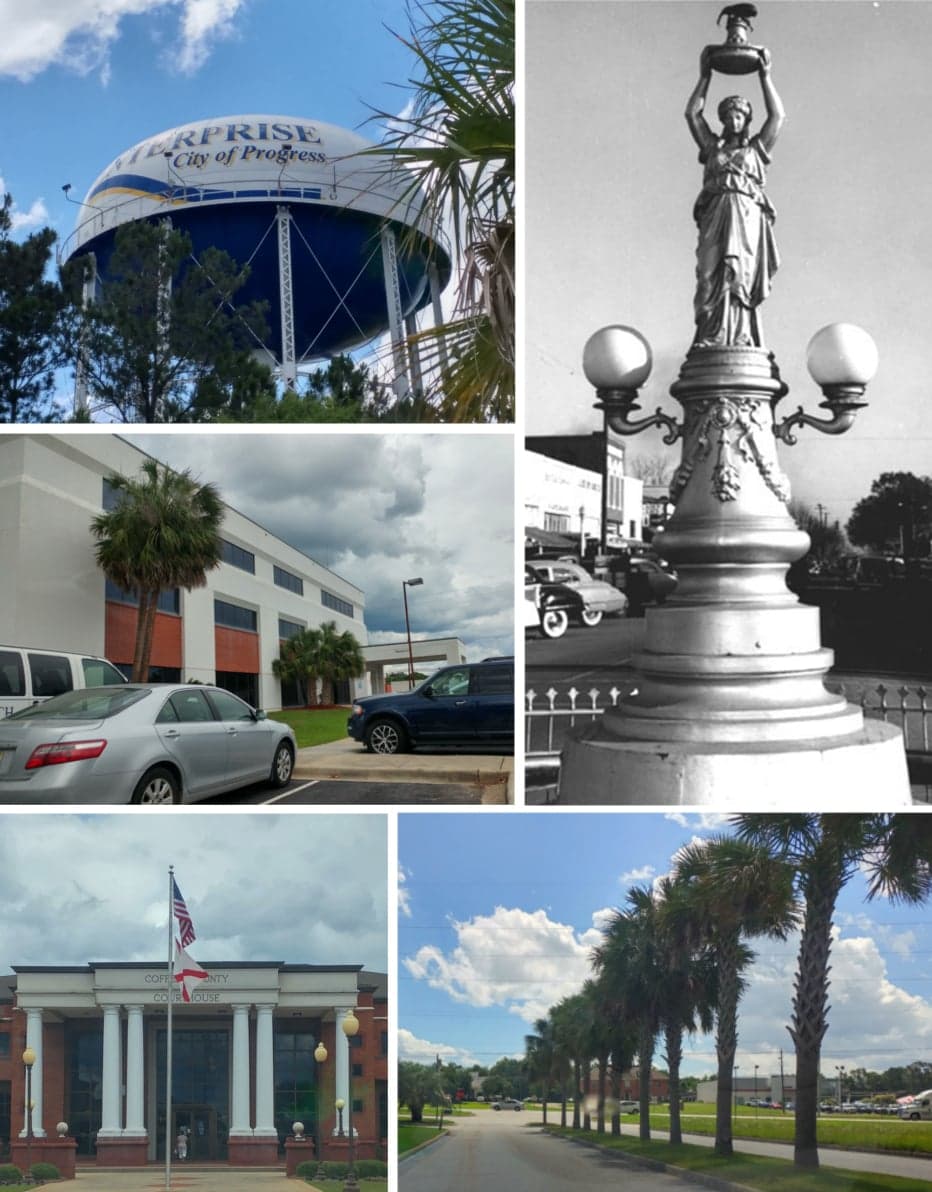
Photo: Wikipedia
Demographics of Enterprise, AL
Affluence Level in Enterprise, AL
A middle-class area roughly in line with national averages across income, home values, education, and employment.
People of Enterprise, AL
The people of Enterprise, Alabama today form a community of roughly 28,990 residents that is notably more diverse than much of rural southeast Alabama, yet retains a distinctly Southern, family-oriented character. The city’s identity is shaped by its military and agricultural roots, with a population that is 61.2% white, 20.1% Black, 11.0% Hispanic, and 1.2% East/Southeast Asian, alongside a small Indian-subcontinent community at 0.1% and a foreign-born share of 3.5%. Enterprise is a place where a relatively young median age, a strong public school system, and a robust housing market attract both military families from nearby Fort Novosel and civilians seeking a lower cost of living, creating a blend of transient and deeply rooted residents.
How the city was settled and grew
Enterprise was founded in 1896 as a railroad town, a latecomer compared to older Alabama settlements, and its early growth was driven entirely by agriculture—specifically cotton and later peanuts. The original white settlers were mostly Anglo-American farmers from Georgia and the Carolinas who established homesteads in what is now the Historic Downtown district, building the commercial core around the railroad depot. By the early 1900s, a significant Black population had arrived to work the cotton fields and later the peanut farms, settling in the Westside neighborhood (roughly west of Main Street) and the Ruddel Heights area, where historically Black churches and schools anchored the community. The city’s population remained small—under 5,000—until the 1940s, when the establishment of Camp Rucker (now Fort Novosel) during World War II brought a wave of military personnel and support workers, many of whom stayed after the war. This military influx spurred the development of the Boll Weevil Circle area (the city’s main commercial corridor) and the Edwin Oaks subdivision, which became a middle-class white neighborhood in the 1950s and 1960s.
Modern era (post-1965)
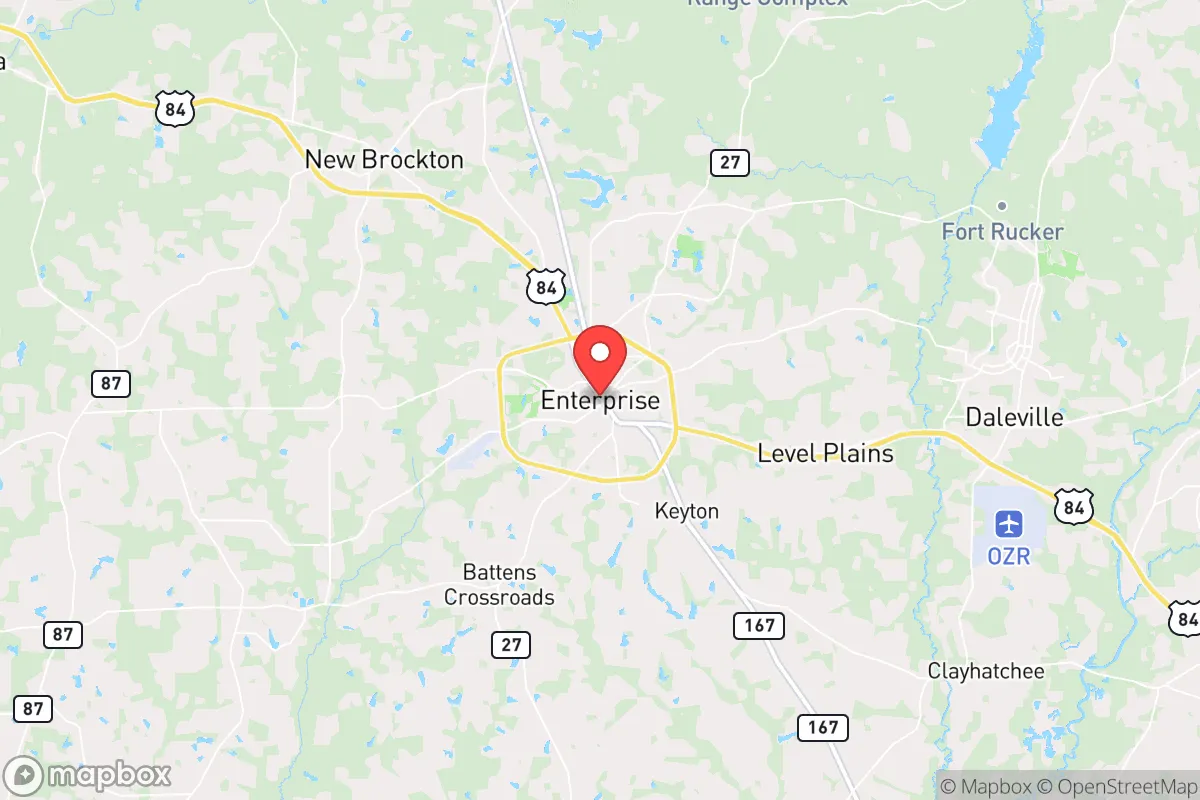
After the 1965 Hart-Cellar Act, Enterprise saw a modest but notable increase in Hispanic and Asian immigration, primarily tied to the agricultural sector and the military. Hispanic workers, many from Mexico and Central America, began arriving in the 1970s to work in the peanut and poultry industries, settling in the Eastside neighborhood near the industrial parks and along Highway 84. By 2020, the Hispanic share had grown to 11.0%, making it the fastest-growing demographic segment. The Asian population (1.2%), largely Filipino and Vietnamese, is almost entirely connected to Fort Novosel, with many families living in the Fort Novosel housing areas and the Hillcrest subdivision, a newer development near the base’s main gate. The Black population, which had been historically concentrated in Westside and Ruddel Heights, began suburbanizing in the 1990s and 2000s, moving into the Northside area and newer subdivisions like Deer Run, though Westside remains a culturally significant hub with historic churches and community centers. The white population, while still the majority at 61.2%, has seen a relative decline as the city diversifies, with many long-term white families remaining in the Boll Weevil Circle and Edwin Oaks areas, while newer white arrivals—often military retirees or remote workers—gravitate toward the Hillcrest and Chancellor Hills subdivisions.
The future
Enterprise’s population is trending toward greater diversity, but not toward the tribalized enclaves seen in larger cities. The Hispanic community is growing steadily and is expected to reach 15-18% of the population by 2040, driven by both natural increase and continued agricultural labor demand, though there is evidence of assimilation into the broader community, with many second-generation Hispanic residents attending local colleges and entering white-collar jobs. The Black population is stable at around 20%, with no major out-migration, and is increasingly dispersed across the city rather than concentrated in historic neighborhoods. The East/Southeast Asian community, tied to the military, is likely to remain small and transient, with families rotating in and out every 3-5 years. The Indian-subcontinent population (0.1%) is negligible and not expected to grow significantly. The white population will continue its slow relative decline, but Enterprise is not homogenizing—rather, it is becoming a moderately diverse, middle-class Southern city where neighborhoods are more defined by income and housing age than by race. The Boll Weevil Circle area will remain the commercial and civic center, while newer subdivisions on the city’s northern and eastern edges will absorb most future growth.
For someone moving in now, Enterprise is a stable, family-oriented city with a growing Hispanic presence and a strong military influence, where the population is becoming more diverse but remains culturally conservative and community-focused. The city is not experiencing the rapid, divisive demographic shifts seen in larger metros; instead, it is gradually absorbing new groups into its existing social fabric, making it a relatively low-risk relocation choice for those seeking a predictable, safe environment with good schools and a reasonable cost of living.

* Values derived from national, state, county, city and local statistics and may differ in a specific area. Last updated: 2026-04-19T18:49:16.000Z
Narrative content on this page is AI-generated and may contain mistakes. Verify any details that matter before acting on them.
ReloMaps may earn a commission from affiliate links at no extra cost to you.

