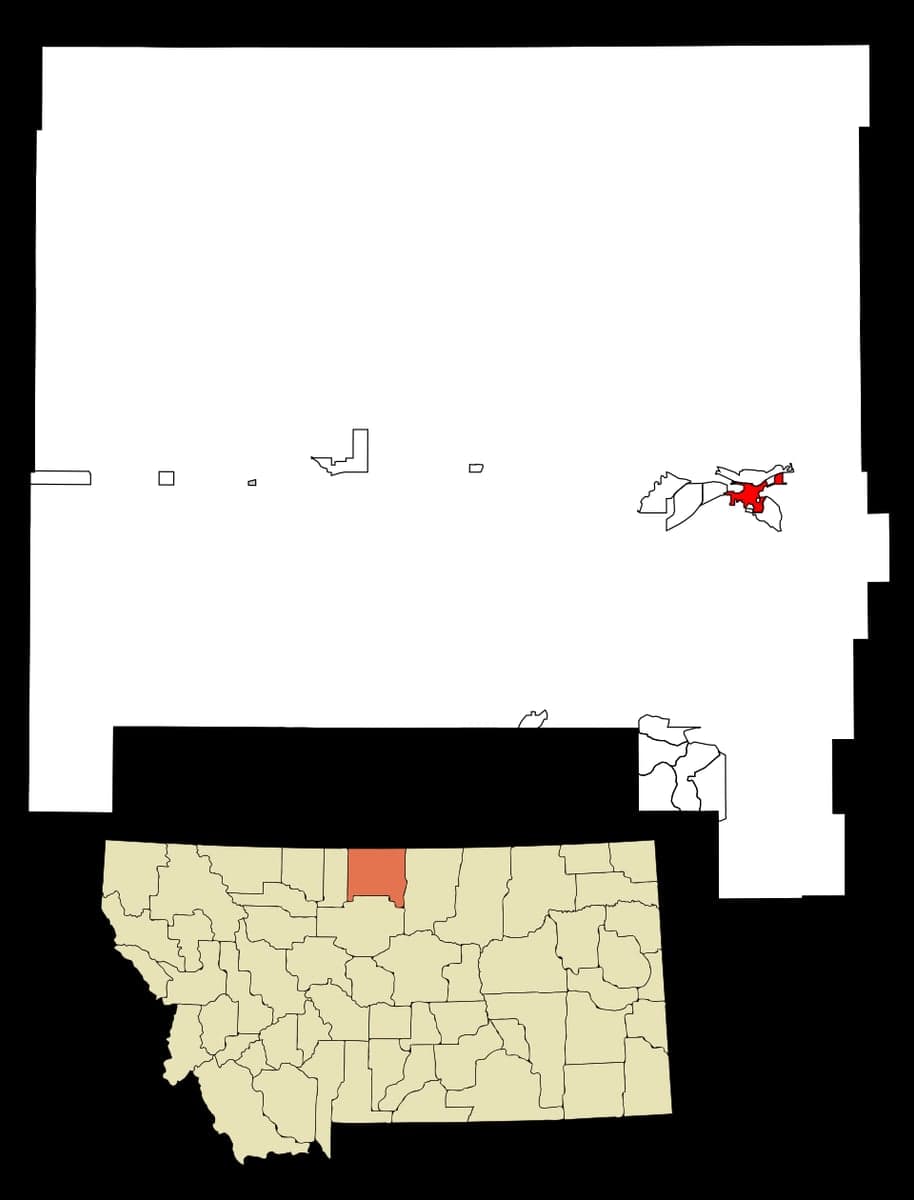
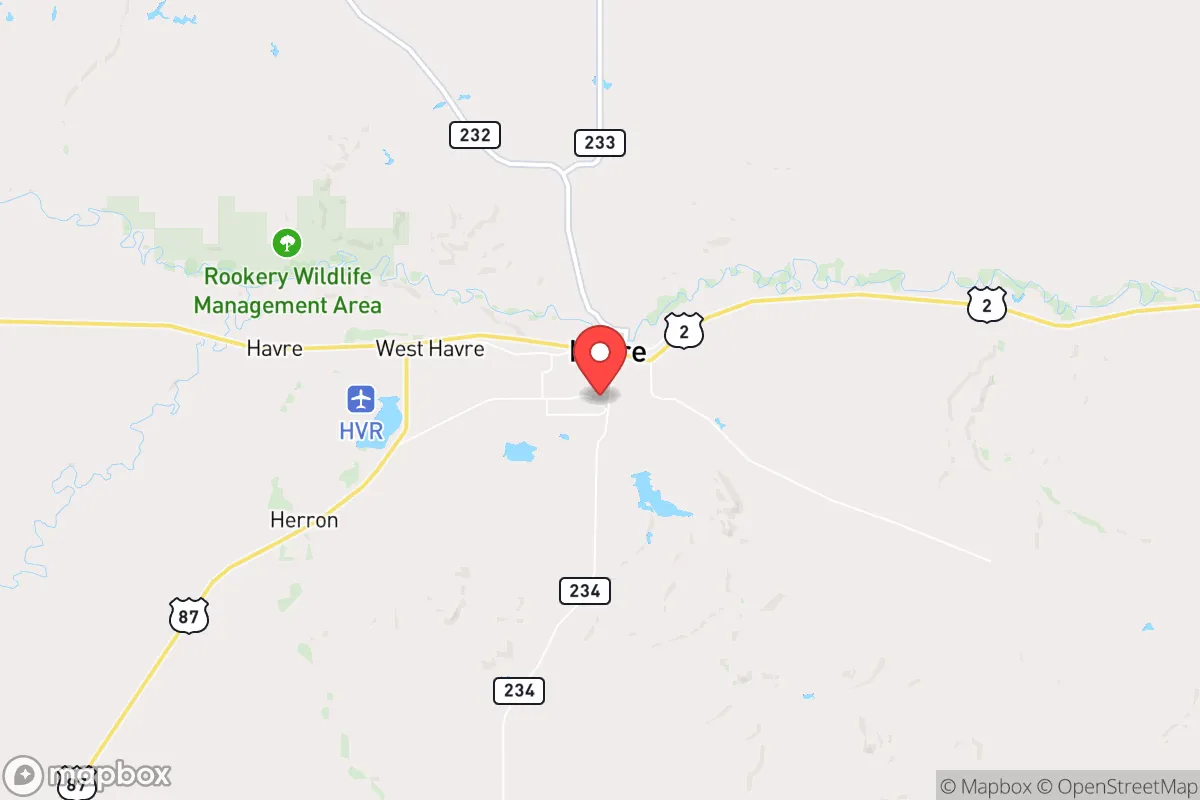
Photo: Wikipedia
Demographics of Havre, MT
Affluence Level in Havre, MT
A below-average socioeconomic profile. Incomes, home values, and educational attainment trail the U.S., with higher poverty and unemployment.
People of Havre, MT
The people of Havre, Montana, today number 9,333, forming a compact, working-class community that is overwhelmingly white (77.6%) with a very small foreign-born population (0.5%). The city’s identity is rooted in its railroad and agricultural heritage, giving it a distinctive blend of northern plains stoicism and small-town neighborliness. Havre is notably less diverse than Montana as a whole, with a Hispanic share of 3.9% and negligible Black (0.4%), East/Southeast Asian (0.3%), and Indian subcontinent (0.0%) populations. For a conservative-leaning audience, Havre represents a stable, culturally homogeneous environment where traditional values and self-reliance remain the norm.
How the city was settled and grew
Havre’s founding and early growth were driven entirely by the railroad. Established in 1887 as a division point on the Great Northern Railway, the town was originally a tent city for railroad workers. The first major wave of settlers were Irish and German track layers and shop workers, who built the original downtown core along 1st Street and the adjacent “Railroad District” near the depot. By the 1890s, a second wave of Scandinavian immigrants—Swedes, Norwegians, and Danes—arrived to work the rail yards and the surrounding wheat farms. These families settled in the North Side neighborhood, where modest wood-frame houses still line the streets. A smaller but notable group of Chinese laborers, who had helped build the transcontinental railroad, established a short-lived enclave in what was then called “Chinatown” near the tracks, though this community had largely dispersed by 1910. The city’s population peaked at roughly 10,000 in the 1920s, fueled by railroad expansion and the opening of the nearby Fort Assinniboine military post. The South Side neighborhood, developed in the 1910s and 1920s, became home to middle-class railroad supervisors and merchants, with larger homes and tree-lined streets that still distinguish it today.
Modern era (post-1965)
After the 1965 Hart-Cellar Act, Havre saw virtually no new immigration. The city’s foreign-born share has remained below 1% for decades, and the small Hispanic population (3.9%) is largely composed of multi-generational families who arrived in the 1970s and 1980s to work in agriculture and the local meatpacking plant. These families concentrated in the West End neighborhood, near the industrial zone along U.S. Highway 2. Domestic in-migration has been modest and mostly from other parts of Montana and the northern Plains. The Hillcrest subdivision, developed in the 1990s, attracted younger families and professionals employed at Northern Montana Hospital and Montana State University–Northern. The city’s racial composition has remained remarkably stable: the white share has declined only slightly from 82% in 1990 to 77.6% today, while the Hispanic share has grown from 1.5% to 3.9% over the same period. The Black and East/Southeast Asian populations have never exceeded 1% each. There is no evidence of significant suburbanization; Havre’s city limits have expanded only modestly, and the surrounding Hill County remains sparsely populated.
The future
Havre’s population is slowly aging and shrinking, with a median age of 38.7 and a slight net out-migration of young adults seeking opportunities in larger Montana cities like Billings or Missoula. The Hispanic community is the only demographic segment showing growth, driven by higher birth rates and continued recruitment for agricultural labor, but it remains a small minority. The city is not tribalizing into distinct ethnic enclaves; instead, it is slowly homogenizing as the older white population ages in place and younger families move away. The East/Southeast Asian and Indian subcontinent populations are essentially nonexistent and unlikely to grow given the lack of economic pull factors. Over the next 10–20 years, Havre will likely become slightly older, slightly more Hispanic, and slightly less white, but the pace of change will be glacial. The city’s character as a tight-knit, railroad-and-agriculture community will persist, with the Downtown and North Side neighborhoods retaining their historic working-class feel while the West End and Hillcrest areas absorb most new residential development.
For someone moving to Havre today, the city offers a stable, culturally cohesive environment where change comes slowly and community ties run deep. The population is overwhelmingly native-born, white, and conservative-leaning, with a small but growing Hispanic presence that has integrated without friction. The lack of diversity is not a recent trend but a century-long constant, making Havre one of the most demographically consistent small cities in the northern Rockies. New residents should expect a place where neighbors know each other, local politics lean right, and the pace of life is dictated by the seasons and the railroad schedule rather than by demographic upheaval.

* Values derived from national, state, county, city and local statistics and may differ in a specific area. Last updated: 2026-04-29T21:49:15.000Z
Narrative content on this page is AI-generated and may contain mistakes. Verify any details that matter before acting on them.
ReloMaps may earn a commission from affiliate links at no extra cost to you.

