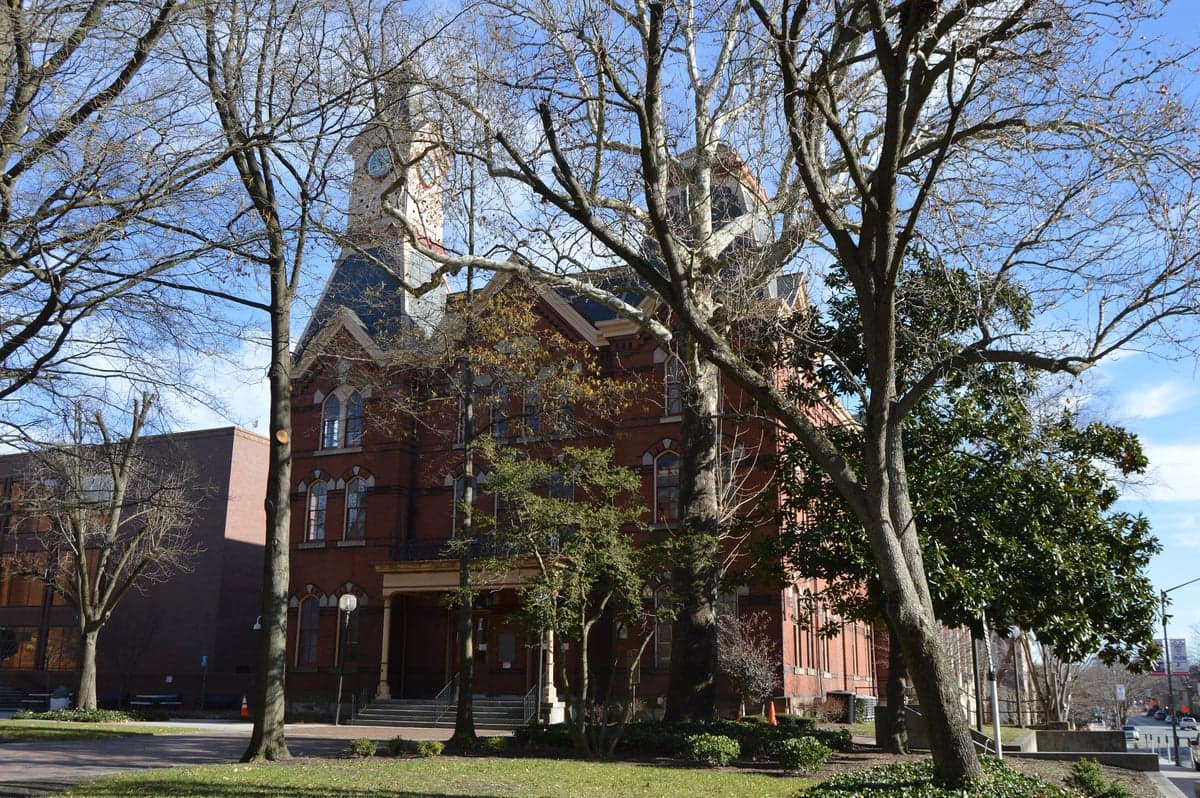
Photo: Wikipedia
Demographics of Wicomico County
Affluence Level in Wicomico County
A middle-class area roughly in line with national averages across income, home values, education, and employment.
People of Wicomico County
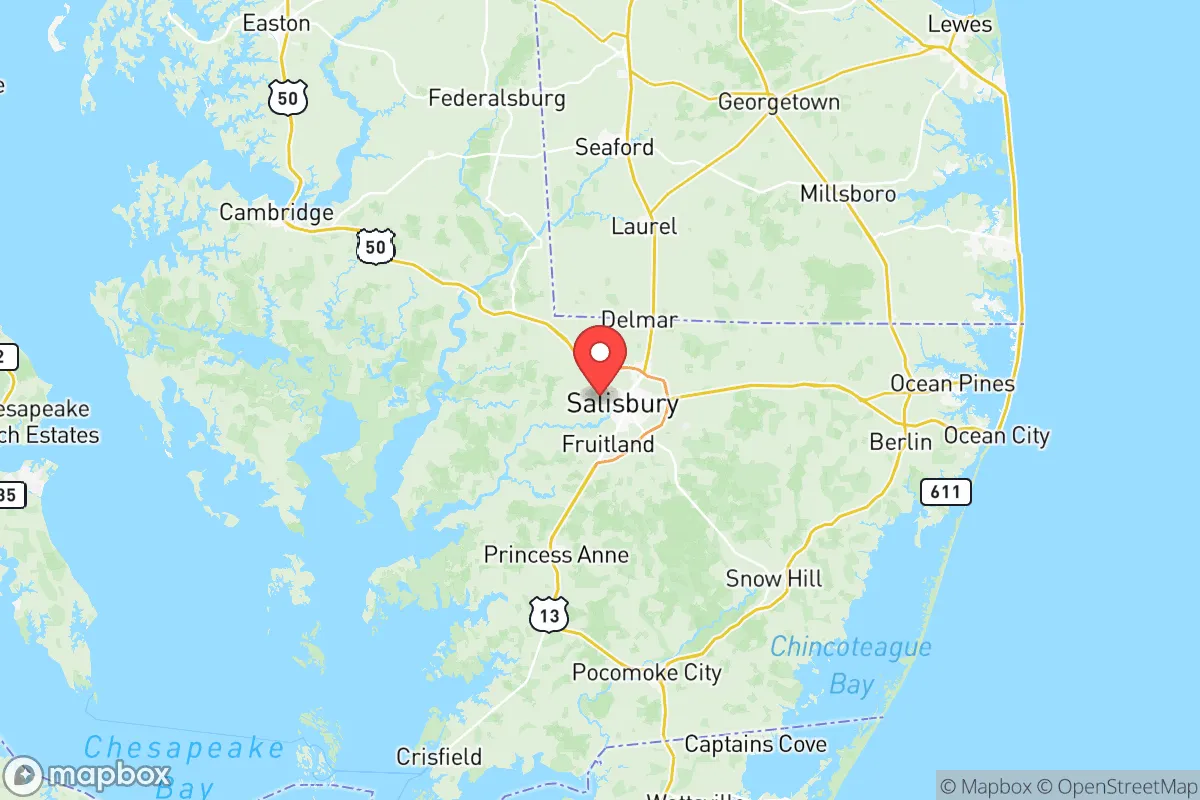
Wicomico County, Maryland, is home to 104,117 residents, a population shaped by centuries of agricultural settlement, maritime commerce, and steady suburban expansion around the city of Salisbury. The county’s character today is distinctly Mid-Atlantic and rural-suburban, with a majority-white population (59.1%) alongside a significant Black community (26.2%) and growing Hispanic (6.9%) and East/Southeast Asian (1.9%) enclaves. Its people are rooted in a history of tobacco farming, poultry processing, and the institutional anchor of Salisbury University, creating a pragmatic, family-oriented culture that leans conservative but is increasingly diverse.
Settlement & growth (pre-1960)
Long before European arrival, the land now called Wicomico County was inhabited by the Nanticoke and Assateague peoples, Algonquian-speaking tribes who fished the Chesapeake Bay tributaries and farmed the fertile river valleys. The name "Wicomico" itself derives from an Algonquian word meaning "place where houses are built," reflecting the area’s early role as a seasonal settlement. By the early 1700s, English colonists from the Tidewater region of Virginia and Maryland’s Eastern Shore had pushed into the area, establishing tobacco plantations along the Wicomico River. These early settlers were primarily of English and Scots-Irish stock, drawn by land grants from the Calvert family, the Catholic proprietors of Maryland. The town of Salisbury, founded in 1732 as a port on the Wicomico River, became the county’s commercial and political hub, its wharves shipping tobacco, grain, and lumber to Baltimore and beyond.
The 19th century brought a second wave: enslaved Africans and their descendants, who formed the backbone of the plantation economy. By 1860, roughly 40% of Wicomico County’s population was enslaved, a proportion that shaped the region’s social and political landscape for generations. After the Civil War, freedmen established communities such as Quantico and Whitehaven, small hamlets along the river where they farmed, fished, and built churches and schools. The post-Reconstruction era saw the rise of a Black landowning class, though segregation and Jim Crow laws confined most to separate neighborhoods and limited economic opportunities.
The late 1800s and early 1900s brought a third wave: German and Irish immigrants, who arrived to work on the expanding railroad lines and in the canneries that processed the region’s tomatoes, peaches, and oysters. Towns like Delmar (straddling the Maryland-Delaware line) and Fruitland grew as railroad stops and agricultural service centers, attracting these new arrivals. The poultry industry, which would come to define Wicomico’s economy, began in earnest in the 1920s, with small farms raising chickens for the growing urban markets of the Northeast. This industry drew additional workers, including a small number of Italian and Polish families who settled in Salisbury’s west side.
World War II and the postwar boom accelerated suburbanization. Salisbury’s population doubled between 1940 and 1960, fueled by the expansion of the poultry industry (Perdue Farms was founded in Salisbury in 1920) and the establishment of what is now Salisbury University (then a state teachers college) in 1925. New subdivisions spread east and west of the city, while rural communities like Hebron and Parsonsburg remained small farming crossroads. The county’s white population grew steadily, while many Black residents, facing limited opportunities under segregation, began migrating to Baltimore and other northern cities during the Great Migration.
Modern era (post-1965)
The 1965 Hart-Cellar Act reshaped Wicomico County’s demographics, though more gradually than in urban areas. The county’s foreign-born population today stands at just 5.6%, below the national average, but the composition has shifted notably. The most significant change has been the growth of the Hispanic community, which now makes up 6.9% of the population. This wave began in the 1990s, driven by labor demand in the poultry processing plants that dominate the county’s industrial base. Plants in Salisbury and Delmar recruited workers from Mexico and Central America, and a small but growing enclave formed in the city’s north end, near the industrial parks along Route 13. Today, Hispanic residents are also visible in Fruitland, where affordable housing and proximity to processing plants have drawn families.
The East/Southeast Asian community, at 1.9% of the population, is a more recent arrival, largely post-2000. This group includes Vietnamese and Filipino families, many of whom came for professional opportunities at Salisbury University, Peninsula Regional Medical Center (now TidalHealth), and the region’s growing healthcare sector. They are concentrated in Salisbury’s newer subdivisions near the university and the hospital, with smaller clusters in Delmar. The Indian-subcontinent population (0.7%) is similarly small and professional, with many working as physicians, engineers, or university faculty; they tend to live in the same Salisbury neighborhoods as East/Southeast Asian families.
Domestic migration has also reshaped the county. Since the 1980s, Wicomico has attracted retirees and remote workers from the Washington, D.C., and Baltimore metropolitan areas, drawn by lower housing costs and a slower pace of life. This influx has been predominantly white and middle-class, settling in new subdivisions around Hebron and Mardela Springs, as well as in the rural areas west of Salisbury. At the same time, the county’s Black population has stabilized at 26.2%, with many families remaining in historic communities like Quantico and Whitehaven, while others have moved into Salisbury’s east-side neighborhoods. Suburbanization has blurred some old racial boundaries, but the county remains notably segregated by neighborhood and school district.
The future
Wicomico County’s population is projected to grow modestly over the next decade, driven by continued in-migration from the D.C.-Baltimore corridor and natural increase among Hispanic and Asian families. The county is not homogenizing; rather, it is tribalizing into distinct enclaves. The Hispanic community is likely to grow further, as poultry industry labor demand persists and family reunification continues. East/Southeast Asian and Indian communities will probably remain small but stable, tied to the healthcare and education sectors. The white population, while still a majority, is aging and declining slightly, as younger adults move to larger cities for career opportunities.
The cultural identity of the county is absorbing new influences but remains fundamentally rooted in its agricultural and conservative traditions. The influx of D.C.-area retirees has introduced more politically moderate voices, but the county’s voting patterns remain reliably Republican. For a newcomer, Wicomico offers a place where change is gradual, community ties are strong, and the cost of living is manageable—but where racial and economic divisions persist beneath the surface.
Wicomico County is becoming a more diverse, suburbanized version of its historic self: still anchored by poultry and education, still majority-white and conservative, but with growing Hispanic and Asian communities that are reshaping its schools, churches, and neighborhoods. For someone moving in now, the county offers a stable, family-oriented environment where the past is never far from view, but the future is quietly arriving.

* Values derived from national, state, county, city and local statistics and may differ in a specific area. Last updated: 2026-05-08T21:35:29.000Z
Narrative content on this page is AI-generated and may contain mistakes. Verify any details that matter before acting on them.
ReloMaps may earn a commission from affiliate links at no extra cost to you.

