
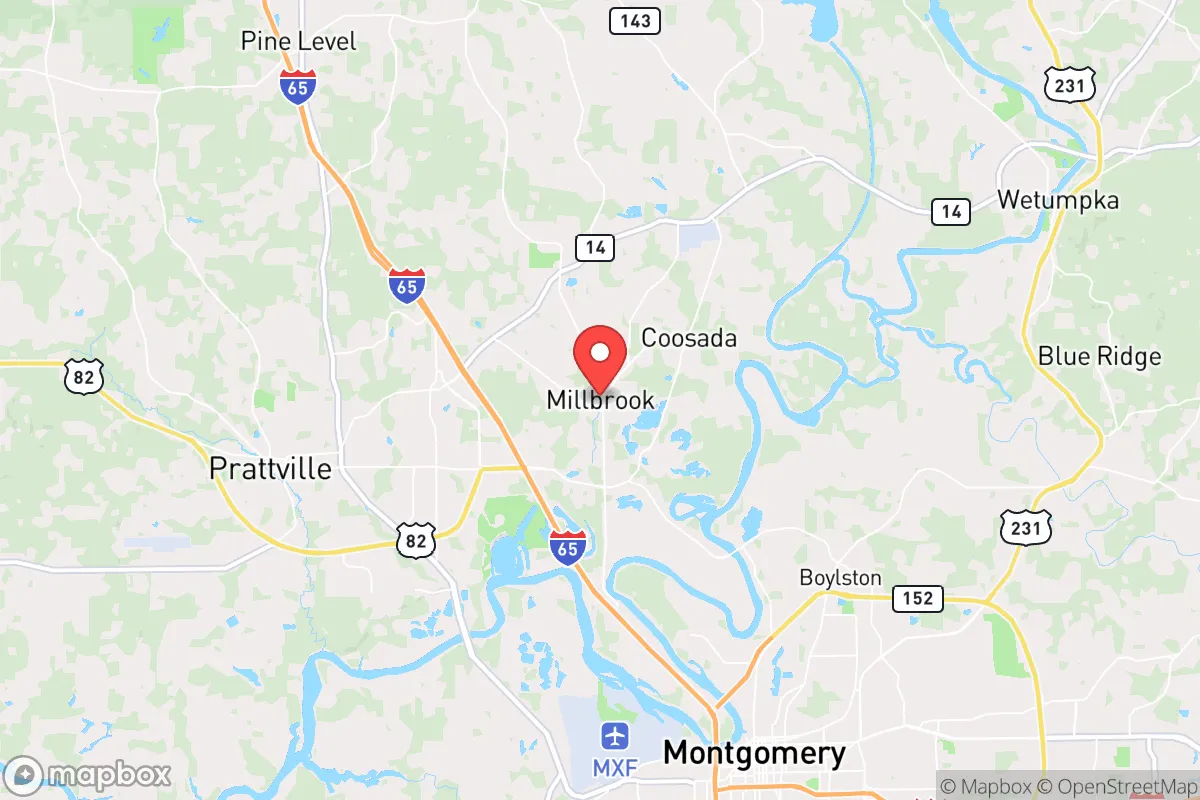
Photo: Wikipedia
Demographics of Millbrook, AL
Affluence Level in Millbrook, AL
A middle-class area roughly in line with national averages across income, home values, education, and employment.
People of Millbrook, AL
Millbrook, Alabama, is a predominantly White (64.7%) and Black (26.0%) city of 16,923 residents, characterized by a low foreign-born population (1.0%) and a modest college attainment rate (32.5%). The city’s identity is rooted in its role as a stable, family-oriented suburb of Montgomery, with a population that is overwhelmingly native-born and largely shaped by domestic migration from rural Alabama and the broader Southeast. Distinct neighborhoods reflect the city’s layered settlement history, from its early railroad-era core to its modern subdivisions.
How the city was settled and grew
Millbrook’s human history begins not with colonial settlement but with the arrival of the railroad in the late 19th century. The city was officially incorporated in 1976, making it a genuinely post-1900 Sun Belt suburb. The original population was drawn by the Louisville and Nashville Railroad, which established a depot and a small commercial hub around what is now Main Street and the historic Millbrook Depot district. Early residents were predominantly White farmers, railroad workers, and small business owners from surrounding Autauga and Elmore counties. A small Black community also formed during this period, concentrated in the East Millbrook area near the railroad tracks, where many worked as laborers and domestic servants for White households. The city remained a tiny crossroads hamlet through the 1950s, with fewer than 1,000 residents, its growth limited by its proximity to larger Montgomery.
Modern era (post-1965)
The post-1965 era transformed Millbrook from a rural stop into a bedroom suburb. The Immigration and Nationality Act of 1965 had minimal direct impact here—the city’s foreign-born share remains just 1.0%—but the broader Sun Belt migration reshaped the population. From the 1970s onward, White families from Montgomery and rural Alabama moved into newly built subdivisions such as Village Green and Park Place, drawn by lower taxes, newer schools, and a perceived safer environment. Black in-migration accelerated after 1990, with many Black families settling in the Coosa River Estates and Highland Ridge neighborhoods, often moving from Montgomery’s older inner-city areas. The Hispanic population grew modestly to 3.5%, with families concentrated in the South Boulevard corridor near the interstate, working in construction and service industries. East/Southeast Asian residents (1.4%) are a small but visible presence, with families typically settling in newer subdivisions like Ridgewood near the high school. The Indian-subcontinent population is effectively zero (0.0%), and Arab communities are negligible. The city’s racial composition has remained relatively stable since 2000, with White share declining slightly from about 70% to 64.7%, while Black share rose from 22% to 26.0%.
The future
Millbrook’s population trajectory points toward slow, steady growth and modest diversification. The city is not homogenizing into a single identity but is tribalizing into distinct enclaves: older White residents remain in the historic Main Street and Village Green areas, while Black families increasingly concentrate in Coosa River Estates and newer subdivisions east of Highway 14. The Hispanic community is growing slowly, likely reaching 5-6% by 2035, but remains largely assimilated into the broader working-class fabric. East/Southeast Asian families are expected to remain a small, stable niche. The foreign-born population will likely stay below 2%, as Millbrook lacks the industrial or agricultural draw that attracts immigrants to other Alabama cities. The college-educated share (32.5%) is below the national average but rising slowly as professionals commute to Montgomery’s healthcare and government sectors. The city is becoming slightly more diverse but remains overwhelmingly native-born and family-oriented, with no signs of rapid demographic disruption.
For a conservative-leaning individual or parent considering relocation, Millbrook offers a stable, predominantly White and Black community with low immigration, strong family-oriented neighborhoods, and a predictable demographic future. The city is not a melting pot but a collection of distinct, stable enclaves where newcomers can find a clear sense of place. The key trade-off is modest diversity for high social stability and low demographic churn.

* Values derived from national, state, county, city and local statistics and may differ in a specific area. Last updated: 2026-04-19T18:57:17.000Z
Narrative content on this page is AI-generated and may contain mistakes. Verify any details that matter before acting on them.
ReloMaps may earn a commission from affiliate links at no extra cost to you.

