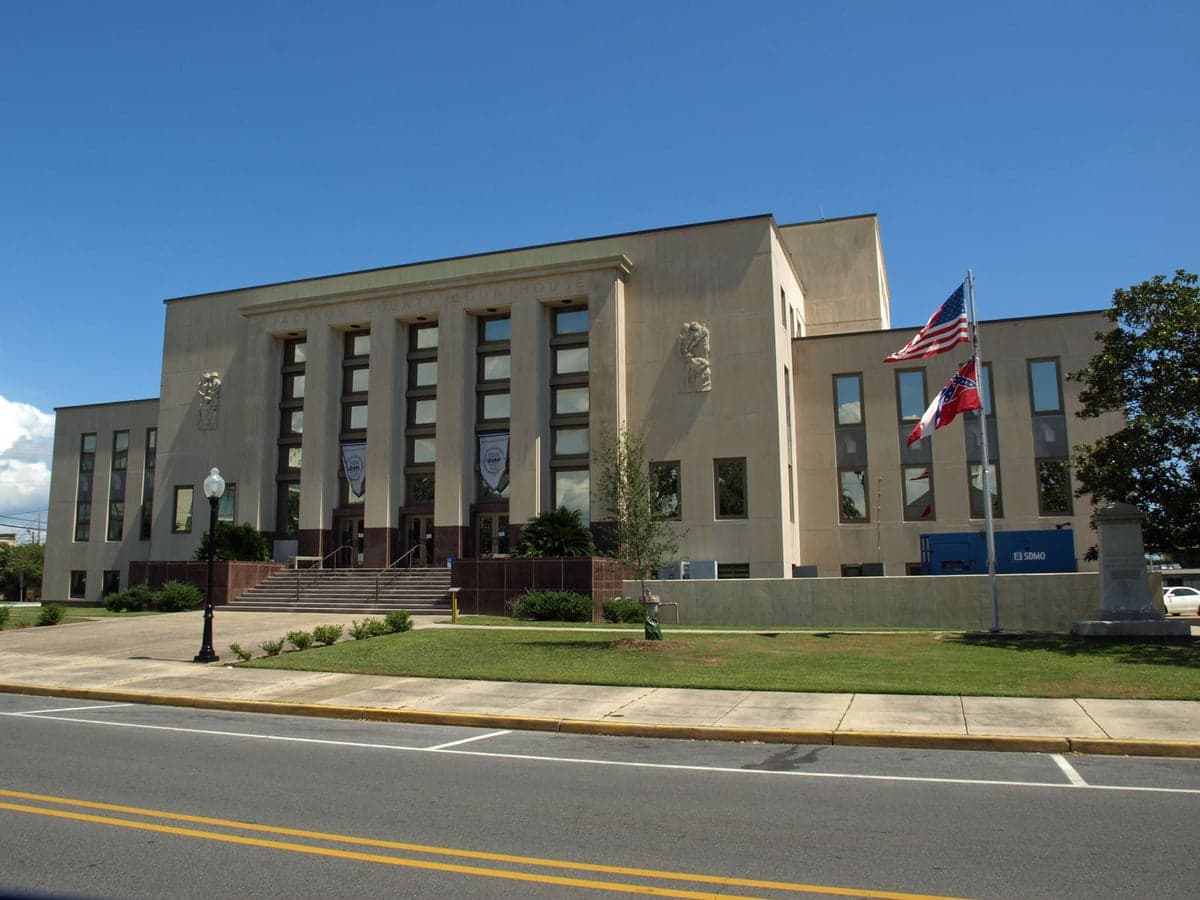
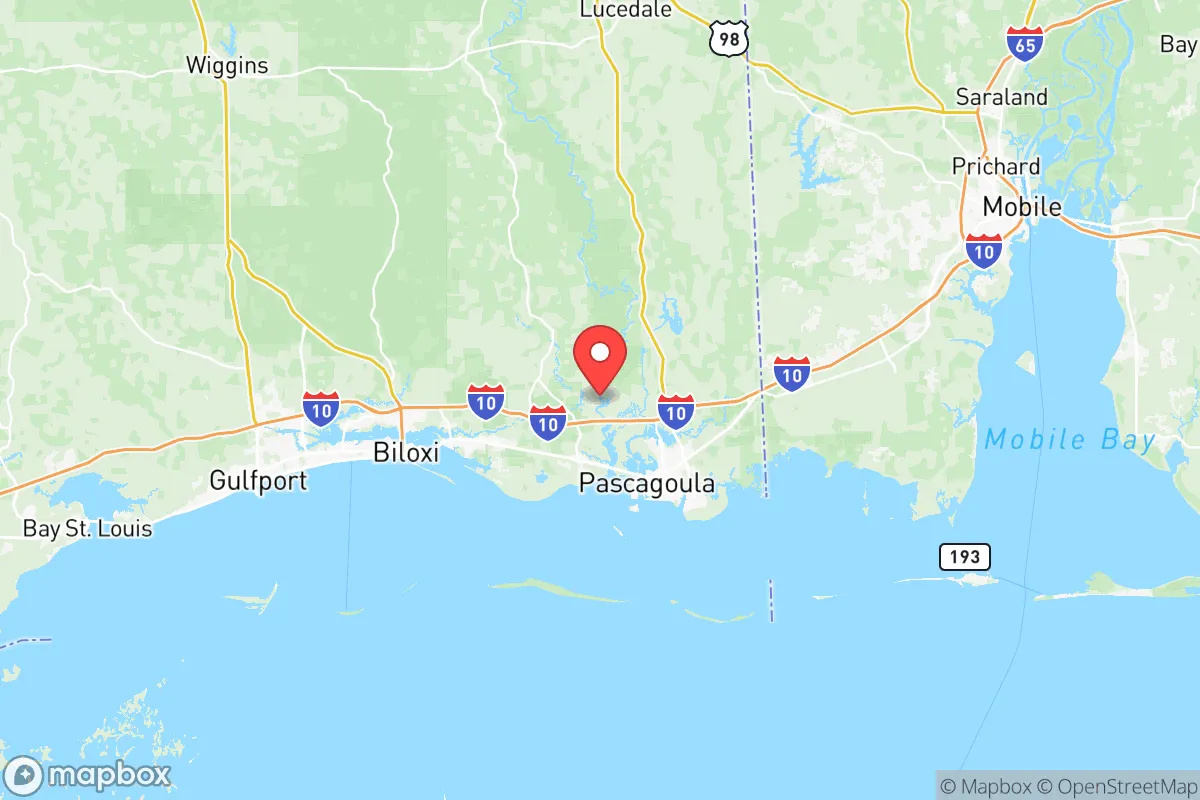
Photo: Wikipedia
Demographics of Jackson County
Affluence Level in Jackson County
A middle-class area roughly in line with national averages across income, home values, education, and employment.
People of Jackson County
The people of Jackson County, Mississippi, today form a predominantly native-born, family-oriented community of 144,437 residents, anchored by a strong military and industrial presence along the Gulf Coast. The county is notably less diverse than the national average, with a foreign-born population of just 1.4%, and its character is shaped by a blend of Deep South traditions, a robust blue-collar workforce, and a growing Hispanic minority. Distinctive markers include a heavy concentration of workers in shipbuilding and aerospace at Ingalls Shipbuilding in Pascagoula, a deep-rooted Catholic and Protestant heritage, and a population that is both older and less college-educated than the state average, with only 24.9% holding a bachelor's degree or higher.
Settlement & growth (pre-1960)
Long before European arrival, the area now known as Jackson County was inhabited by the Biloxi and Pascagoula Native American tribes, whose names still mark the coastline. French explorers, led by Pierre Le Moyne d'Iberville, established the first European settlement in the region in 1699 at Fort Maurepas in present-day Ocean Springs, making this one of the oldest continuous European settlements in the Mississippi Valley. The French colonial period was brief but left a lasting Catholic influence and a small Creole population, though the area remained sparsely populated for much of the 18th century.
The real settlement wave began after the United States acquired the region in the 1810 Treaty of Fort Jackson and subsequent statehood in 1817. Anglo-American settlers, primarily of Scots-Irish and English descent, moved in from the Carolinas, Georgia, and Tennessee, drawn by cheap land grants and the promise of cotton cultivation. These early settlers established the inland towns of Moss Point and Vancleave, where subsistence farming and timber extraction dominated the economy. By the 1830s, the forced removal of the remaining Native tribes under the Indian Removal Act cleared the way for a more rapid influx of white planters and their enslaved Black laborers, who formed the backbone of the antebellum cotton economy along the Pascagoula River.
The post-Civil War period saw a dramatic shift. Emancipated African Americans, who made up a significant portion of the county's population, remained in the area as sharecroppers and laborers, concentrating in rural communities like Big Point and the outskirts of Pascagoula. The late 19th and early 20th centuries brought a new wave of European immigrants, particularly from Italy and Lebanon, who settled in Pascagoula and Ocean Springs to work in the burgeoning seafood and lumber industries. These groups established small but distinct ethnic enclaves, with Italian families dominating the shrimp and oyster fleets and Lebanese families opening grocery stores and dry goods shops. The Great Migration of African Americans out of the rural South largely bypassed Jackson County, as the local industrial boom—spurred by the opening of the Pascagoula River shipyards in the 1910s and the construction of Ingalls Shipbuilding in 1938—kept many Black workers in the area for steady manufacturing jobs.
World War II and the subsequent Cold War transformed Jackson County into a military and industrial hub. The expansion of Ingalls Shipbuilding and the establishment of Keesler Air Force Base in neighboring Harrison County drew thousands of workers from across the South and Midwest. This period saw the first significant in-migration of non-Southern whites, including engineers and skilled tradesmen from Ohio, Indiana, and Pennsylvania, who settled in the newer suburbs of Gautier and St. Martin. By 1960, the county's population had grown to roughly 55,000, with a racial composition that was roughly 70% white and 30% Black, a ratio that would remain remarkably stable for decades.
Modern era (post-1965)
The 1965 Hart-Cellar Act, which dramatically reshaped U.S. immigration patterns, had a muted effect on Jackson County compared to coastal metropolitan areas. The county's foreign-born population remains exceptionally low at just 1.4%, far below the national average of roughly 14%. The primary demographic shift since 1965 has not been from new immigration but from domestic migration and natural growth. The most notable change has been the steady rise of the Hispanic population, which now stands at 7.3%. This growth is largely driven by Mexican and Central American workers recruited by the shipbuilding and construction industries, with a visible concentration in Pascagoula and Moss Point, where they have formed small but growing communities around Catholic parishes and Spanish-language services.
The Asian population, at 1.9%, is composed primarily of Filipino and Vietnamese families, many of whom arrived after the Vietnam War and found work in the seafood processing plants and shipyards. They are most concentrated in Ocean Springs and Gautier, where they have established a handful of ethnic grocery stores and churches. The Indian subcontinent population is negligible at 0.3%, with no distinct enclave. The Black population has remained relatively stable at 20.4%, though there has been some suburbanization from older neighborhoods in Pascagoula and Moss Point into newer subdivisions in Gautier and Vancleave. The white population, at 66.5%, has seen a slight decline in share due to Hispanic growth, but remains the dominant group, particularly in the more rural and affluent areas of Ocean Springs and St. Martin.
Suburbanization has been the defining geographic trend since the 1970s. The construction of Interstate 10 and the expansion of Highway 90 spurred the growth of Gautier and Ocean Springs as bedroom communities for workers at Ingalls and Keesler. These towns have attracted a mix of white and Black middle-class families seeking newer housing and better schools, while the older industrial cores of Pascagoula and Moss Point have experienced population stagnation and economic challenges. Hurricane Katrina in 2005 caused a temporary exodus of roughly 10% of the population, but most returned within two years, and rebuilding efforts reinforced the county's commitment to its industrial base.
The future
Jackson County's population is projected to grow slowly, likely reaching 150,000 by 2035, driven primarily by natural increase and continued Hispanic in-migration. The Hispanic share is expected to rise to 10-12% over the next decade, as younger families settle in and birth rates remain above the county average. This growth is unlikely to create distinct ethnic enclaves, however; instead, Hispanic families are dispersing across Gautier, Ocean Springs, and Pascagoula, assimilating into the broader working-class culture. The East/Southeast Asian community is plateauing, with little new immigration, and the Indian population will remain a statistical footnote.
The county is not tribalizing into distinct enclaves but rather homogenizing around a shared blue-collar identity, with the major fault line being between the more affluent, white-majority coastal towns (Ocean Springs, Gautier) and the older, more diverse industrial cities (Pascagoula, Moss Point). The white population is aging faster than the Hispanic and Black populations, which will gradually shift the county's median age downward. The cultural identity remains deeply Southern and conservative, with new arrivals—whether Hispanic or domestic migrants—largely absorbed into that framework rather than challenging it. For someone moving in now, Jackson County offers a stable, family-oriented environment with a strong sense of place, but little of the ethnic dynamism or cosmopolitanism found in larger Sun Belt metros.
Bottom-line: Jackson County is becoming slightly more diverse but remains a predominantly native-born, conservative, and industrial community where the shipyard and the military anchor both the economy and the social fabric. New residents will find a place that values continuity over change, with a population that is slowly graying and gradually incorporating a Hispanic minority, but without the rapid demographic transformation seen elsewhere in the South.

* Values derived from national, state, county, city and local statistics and may differ in a specific area. Last updated: 2026-05-12T02:49:46.000Z
Narrative content on this page is AI-generated and may contain mistakes. Verify any details that matter before acting on them.
ReloMaps may earn a commission from affiliate links at no extra cost to you.

