
Photo: Wikipedia
Demographics of Natchez, MS
Affluence Level in Natchez, MS
A below-average socioeconomic profile. Incomes, home values, and educational attainment trail the U.S., with higher poverty and unemployment.
People of Natchez, MS
The people of Natchez, Mississippi today number 14,207, forming a city that is predominantly Black (62.9%) with a significant White minority (33.1%) and a very small Hispanic (2.0%) and East/Southeast Asian (0.1%) presence. The foreign-born population is negligible at 0.5%, and just 25.9% of adults hold a college degree. This is a deeply rooted, historically layered community where family lineage and local identity carry exceptional weight, and where the population has been steadily declining for decades.
How the city was settled and grew
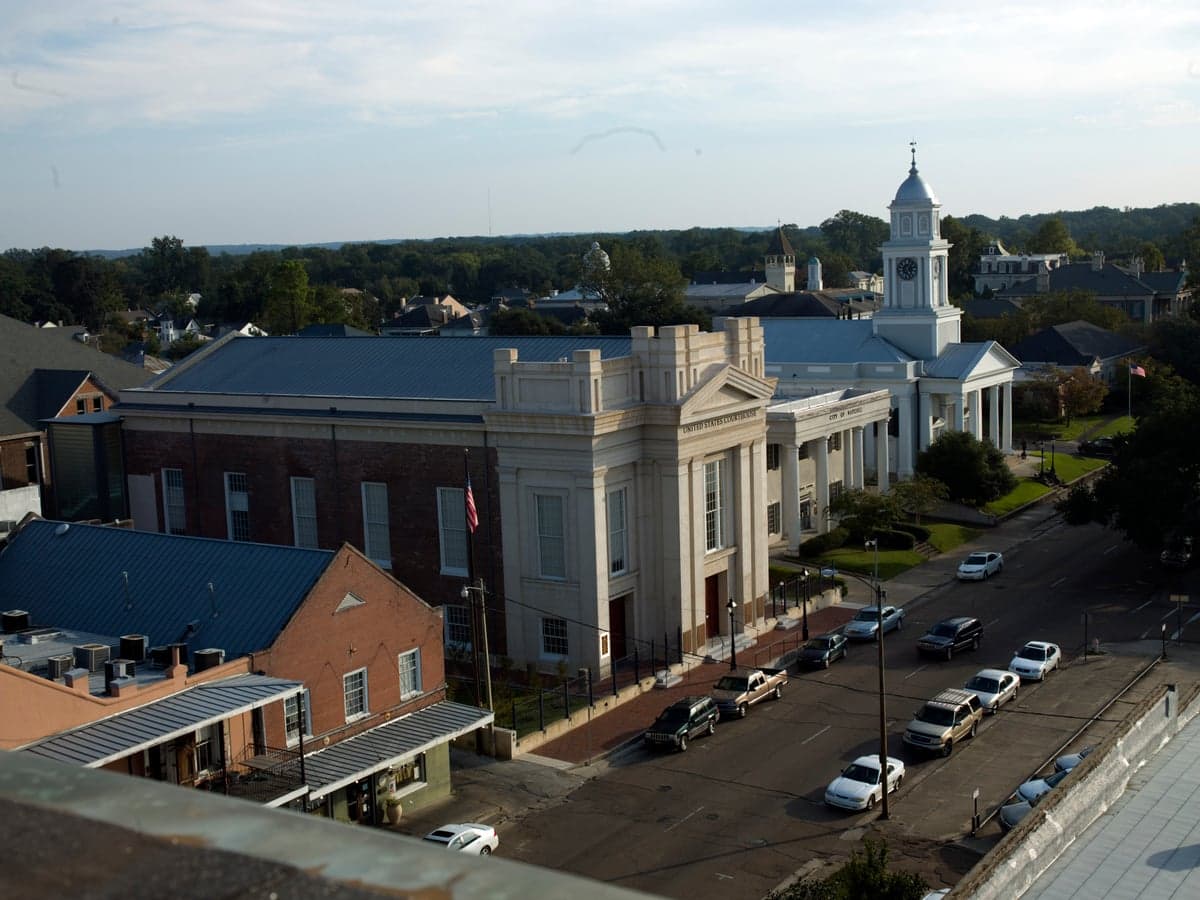
Natchez began as a French colonial settlement in 1716, built on the site of the Natchez Indian Grand Village. The original European population was a mix of French traders, soldiers, and enslaved Africans brought to clear land and build the fort. After the French ceded the territory to Britain in 1763, a wave of Anglo-American planters arrived, drawn by the rich alluvial soil of the Mississippi River bottomlands. These planters established cotton and sugar plantations, and by the early 1800s Natchez had become the wealthiest city per capita in the United States, built entirely on enslaved Black labor. The historic Natchez Under-the-Hill district, along the riverfront, became a rough-and-tumble port for riverboat crews, while the bluff-top Natchez On-the-Hill (today’s downtown) housed the planter elite in grand mansions. Enslaved people lived in quarters scattered across the plantations ringing the city, with many later forming the core of the North Natchez neighborhoods after emancipation. The post-Civil War era saw a small influx of Jewish merchants (mostly German and Eastern European) who settled in the downtown commercial district, and a handful of Chinese immigrants who opened grocery stores in Black neighborhoods. By 1900, the population was roughly 60% Black and 40% White, a ratio that held until the Great Migration.
Modern era (post-1965)
The 1965 Hart-Cellar Act had almost no effect on Natchez: the city’s foreign-born population remains below 1%, and no significant immigrant community formed. Instead, the major demographic shift of the modern era has been White flight and Black out-migration. Between 1960 and 2020, the city lost nearly half its population, from 23,791 to 14,207. The White population shrank from roughly 45% to 33%, as many White families moved to suburban areas like Kingston and Morgantown (unincorporated Adams County) or left the region entirely. Black residents also left in large numbers during the Great Migration, heading to Chicago, Detroit, and Los Angeles for industrial jobs. Those who remained concentrated in the North Natchez neighborhoods (roughly north of St. Catherine Street) and the Cloverdale area, while the historic Garden District and Linden Circle retained a mix of older White families and a growing number of Black professionals. The Hispanic population, now 2.0%, is a very recent arrival—mostly Mexican and Central American workers drawn to low-skill service and construction jobs—and is concentrated in the South Natchez area near the industrial park. The East/Southeast Asian community (0.1%) is tiny and consists of a handful of Vietnamese and Filipino families, mostly in the medical and hospitality sectors.
The future
The population trajectory is unmistakably downward. Natchez has lost residents every decade since 1960, and the current median age (40.5) is above the national average, indicating an aging population with limited natural increase. The Black share (62.9%) is likely to grow slowly as the White population continues to age out and younger White families leave for larger job markets. The Hispanic share may rise modestly—perhaps to 4-5% by 2040—as service-sector employers seek labor, but the foreign-born population will remain negligible. The city is not tribalizing into distinct ethnic enclaves; rather, it is homogenizing into a predominantly Black, low-income, low-education population, with a small White minority concentrated in the historic districts and a tiny Hispanic presence in the industrial zone. No significant immigrant or refugee resettlement is expected. The next 10-20 years will likely see continued population decline, with the city becoming older, poorer, and more uniformly Black.
For a single individual or parent considering a move to Natchez, the bottom line is this: you are moving into a small, shrinking, deeply Southern city with a clear Black majority and a White minority that is largely older and established. There is no growing immigrant community, no suburban boom, and no youthful influx. The city’s identity is rooted in its history, not its future. If you value quiet, low-cost living with a strong sense of place and are comfortable in a racially homogeneous environment, Natchez can work. If you seek demographic diversity, job growth, or a vibrant young population, you will likely look elsewhere.

* Values derived from national, state, county, city and local statistics and may differ in a specific area. Last updated: 2026-04-22T21:11:44.000Z
Narrative content on this page is AI-generated and may contain mistakes. Verify any details that matter before acting on them.
ReloMaps may earn a commission from affiliate links at no extra cost to you.

