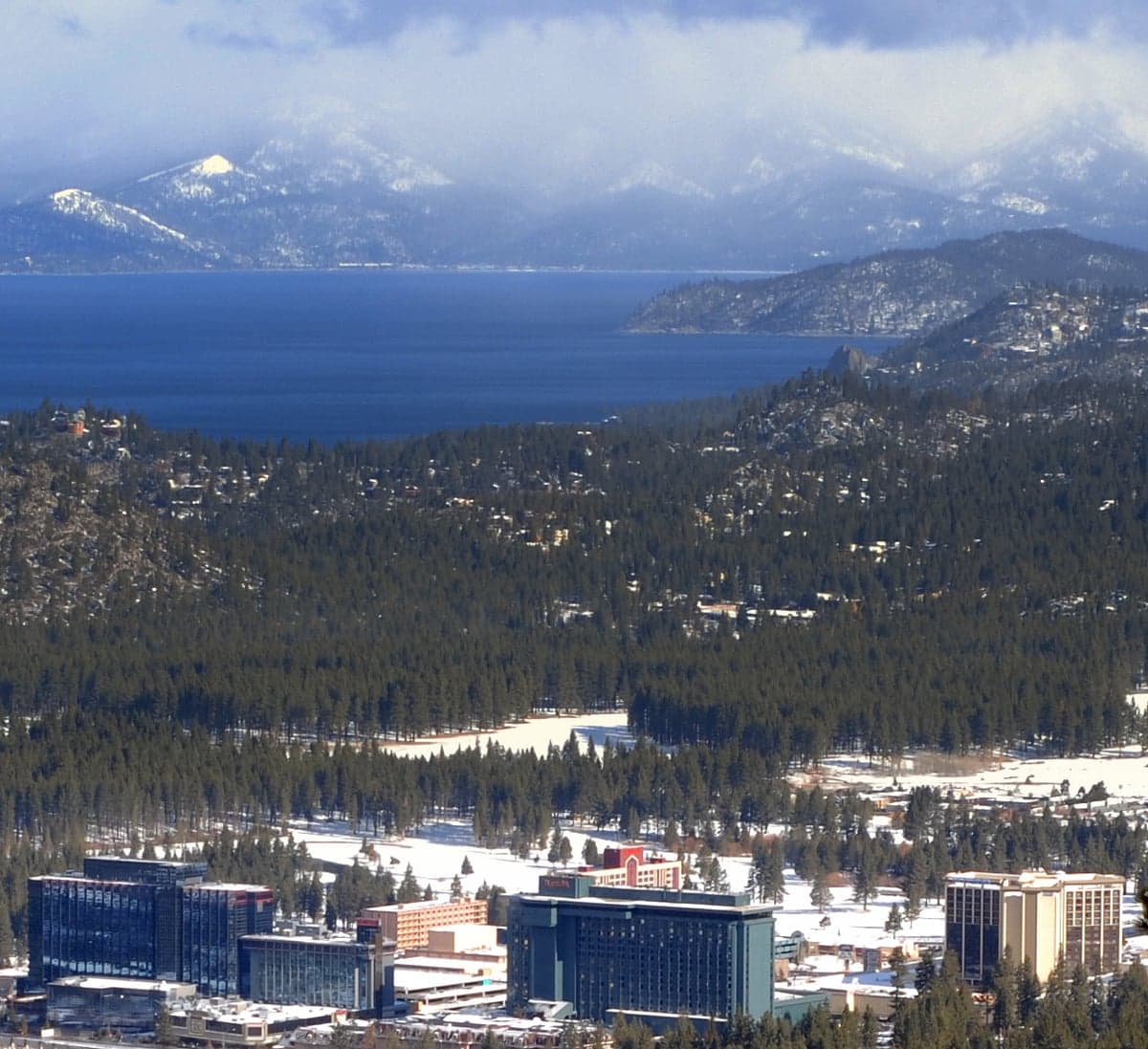
Photo: Wikipedia
Demographics of Douglas County
Affluence Level in Douglas County
An upper-middle-class area. Household wealth, education levels, and homeownership run ahead of national benchmarks.
People of Douglas County
The people of Douglas County, Nevada today form a predominantly white, politically conservative population of just under 50,000, concentrated along the eastern Sierra Nevada front and the Carson Valley floor. With a foreign-born share of only 2.0% — roughly one-fifth the national average — and a Hispanic population of 12.8%, the county remains one of Nevada's least ethnically diverse, yet its character is increasingly shaped by affluent in-migrants from California and the urban West. Distinctive markers include a strong ranching and outdoor-recreation identity, a notable absence of large-scale industry, and a civic culture that prizes low taxes, property rights, and small-town governance.
Settlement & growth (pre-1960)
Before Euro-American settlement, the Washoe people occupied the Carson Valley and the eastern Sierra slopes, including the area that is now Douglas County. The Washoe were a distinct Great Basin tribe, speaking a Hokan language unrelated to the Paiute or Shoshone, and they followed a seasonal round of fishing at Lake Tahoe, hunting in the pine forests, and gathering piñon nuts in the foothills. Their population in the region was never large — likely a few hundred at most — and their presence was largely displaced by the 1860s as Anglo settlers poured in.
The first permanent Euro-American settlers arrived in the early 1850s, drawn by the promise of fertile bottomland along the Carson River and the protection offered by the newly established Mormon Station (present-day Genoa). These were predominantly Anglo-American farmers from the Midwest and the Mississippi Valley — many of them Mormons from Utah, though the Mormon presence waned after the Utah War of 1857-58. The discovery of the Comstock Lode in 1859 at Virginia City, just over the county line in Storey County, transformed Douglas County from a quiet agricultural outpost into a supply hub. The towns of Genoa, founded in 1851 as Nevada's first permanent settlement, and Gardnerville, founded in 1879, became service centers for the ranching and timber industries that fed the Comstock mines. By 1880, the county's population had reached roughly 1,500, overwhelmingly native-born white Americans of British Isles and German ancestry.
Through the late 19th and early 20th centuries, Douglas County remained a ranching and farming economy, with little of the mining boom that reshaped neighboring counties. The Carson Valley's alfalfa fields and cattle ranches attracted a modest number of Basque immigrants — shepherds from the Pyrenees who arrived in the 1890s through the 1920s, many of whom settled in the Gardnerville and Minden areas. The Basque community, though never large, left a lasting imprint in the form of family-run hotels, boarding houses, and the annual Basque Festival. A small number of Italian and Swiss-Italian immigrants also arrived during this period, working as dairy farmers and vintners in the Carson Valley. By 1950, the county's population stood at just 2,836, making it one of the most sparsely populated counties in Nevada.
Modern era (post-1965)
The 1965 Hart-Cellar Act had minimal direct impact on Douglas County, as the region attracted almost no post-1965 immigration from Asia, Africa, or Latin America. The foreign-born share remained below 3% through the 1990s and stands at just 2.0% today — the lowest of any county in western Nevada. Instead, the county's modern demographic story is one of domestic in-migration, overwhelmingly from California and the urban West.
The first wave of modern in-migration began in the 1970s, as Californians seeking lower taxes, larger lots, and a slower pace of life discovered the Carson Valley. The construction of the Lake Tahoe casinos at Stateline — including Harvey's, Harrah's, and Caesars Tahoe — created a service-economy job base that drew workers from across the region. The town of Stateline, essentially a casino strip on the Nevada side of the state line, became the county's primary employment center, while Minden and Gardnerville grew as bedroom communities for casino workers and for commuters to Carson City and Reno. By 1990, the county's population had surged to 27,637, a tenfold increase from 1950.
The second wave, from the 1990s through the 2010s, was driven by retirees and telecommuters from the San Francisco Bay Area and Los Angeles, drawn by the absence of a state income tax, relatively affordable housing (compared to California), and the recreational amenities of the Sierra Nevada. This influx shifted the county's demographic profile: the population became older, wealthier, and more politically conservative, even as it absorbed a steady stream of former liberals. The Hispanic population grew from roughly 5% in 1990 to 12.8% today, driven largely by service-sector workers in the casino and construction industries, many of whom settled in Gardnerville and the Johnson Lane area. The East/Southeast Asian population, at 2.5%, is concentrated among casino and hospitality workers in Stateline and among a small number of professionals in Minden. The Black population remains negligible at 0.1%, and the Indian-subcontinent population at 0.1% is essentially nonexistent.
The future
Douglas County's population is projected to grow slowly but steadily, reaching roughly 55,000-60,000 by 2040, driven primarily by continued in-migration from California and the urban West. The county is not homogenizing into a single cultural bloc; rather, it is tribalizing into distinct enclaves. The Lake Tahoe basin, including Stateline and Zephyr Cove, is becoming more transient and service-oriented, with a younger, more diverse workforce tied to the tourism economy. The Carson Valley floor — Gardnerville, Minden, and the Topaz Ranch Estates area — is solidifying as a conservative, family-oriented, and increasingly affluent exurban corridor, with large-lot subdivisions and a strong ranching heritage. The Johnson Lane and Fish Springs areas are attracting a mix of retirees and remote workers, many of whom are culturally conservative but economically libertarian.
The Hispanic population is likely to grow modestly, reaching perhaps 15-18% by 2040, driven by natural increase and continued service-sector demand, but it is unlikely to form a large ethnic enclave. The East/Southeast Asian population may grow slightly as the casino industry diversifies, but it will remain small. The county's cultural identity is being reshaped by the California in-migration, but in a distinctive way: the newcomers are not liberalizing the county, but rather reinforcing its conservative character, as many are fleeing California precisely because of its politics. The result is a county that is becoming more affluent, more educated (32.1% college-educated, well above the Nevada average), and more politically engaged, but also more expensive and less accessible to working-class families.
For someone moving in now, Douglas County is becoming a place where the old ranching and Basque heritage is fading into a backdrop for a new exurban conservatism — a community that values low taxes, outdoor recreation, and small-town governance, but where the cost of entry is rising and the economy remains heavily dependent on the volatile Lake Tahoe tourism sector. The county's future is one of slow, selective growth, with a population that is increasingly homogeneous in its politics and lifestyle, even as it diversifies modestly in its ethnic makeup.

* Values derived from national, state, county, city and local statistics and may differ in a specific area. Last updated: 2026-05-16T23:18:43.000Z
Narrative content on this page is AI-generated and may contain mistakes. Verify any details that matter before acting on them.
ReloMaps may earn a commission from affiliate links at no extra cost to you.

