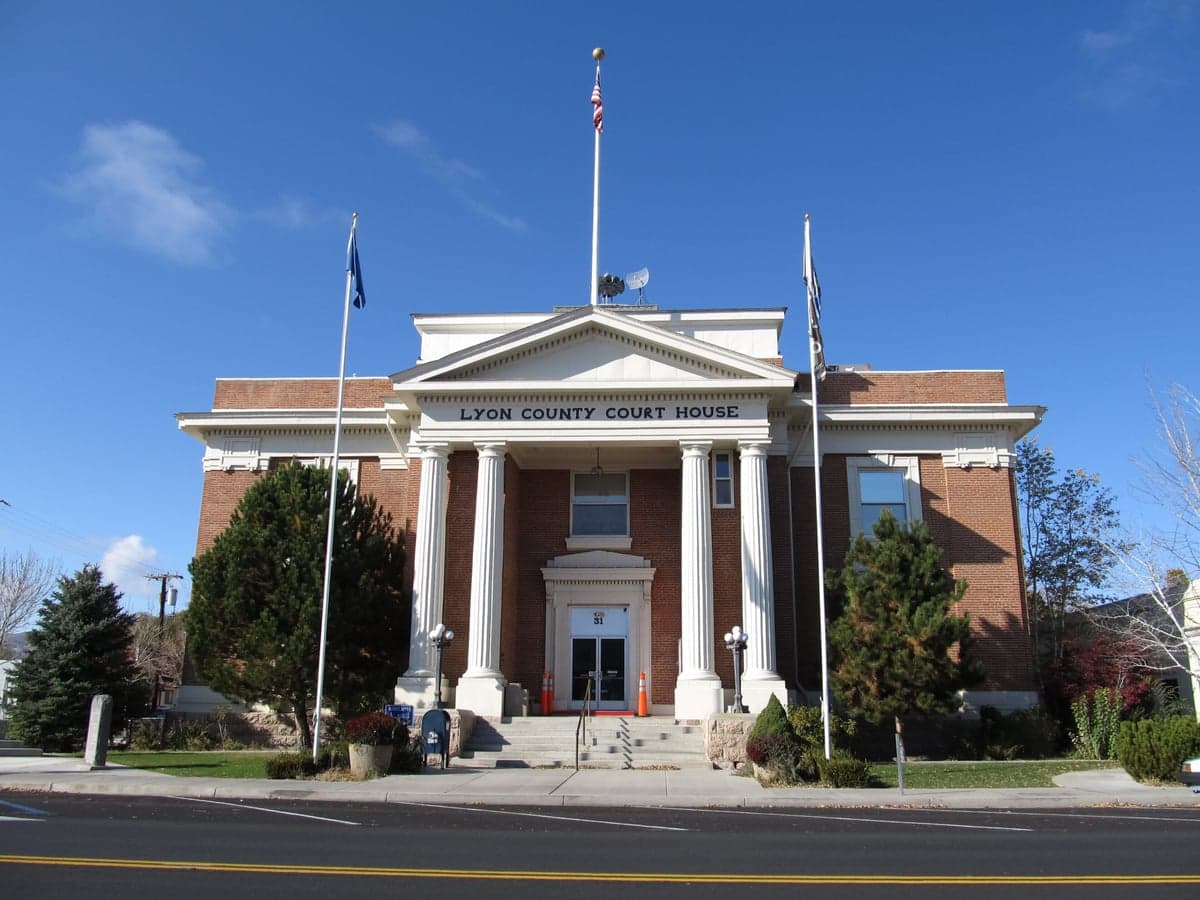
Photo: Wikipedia
Demographics of Lyon County
Affluence Level in Lyon County
A middle-class area roughly in line with national averages across income, home values, education, and employment.
People of Lyon County
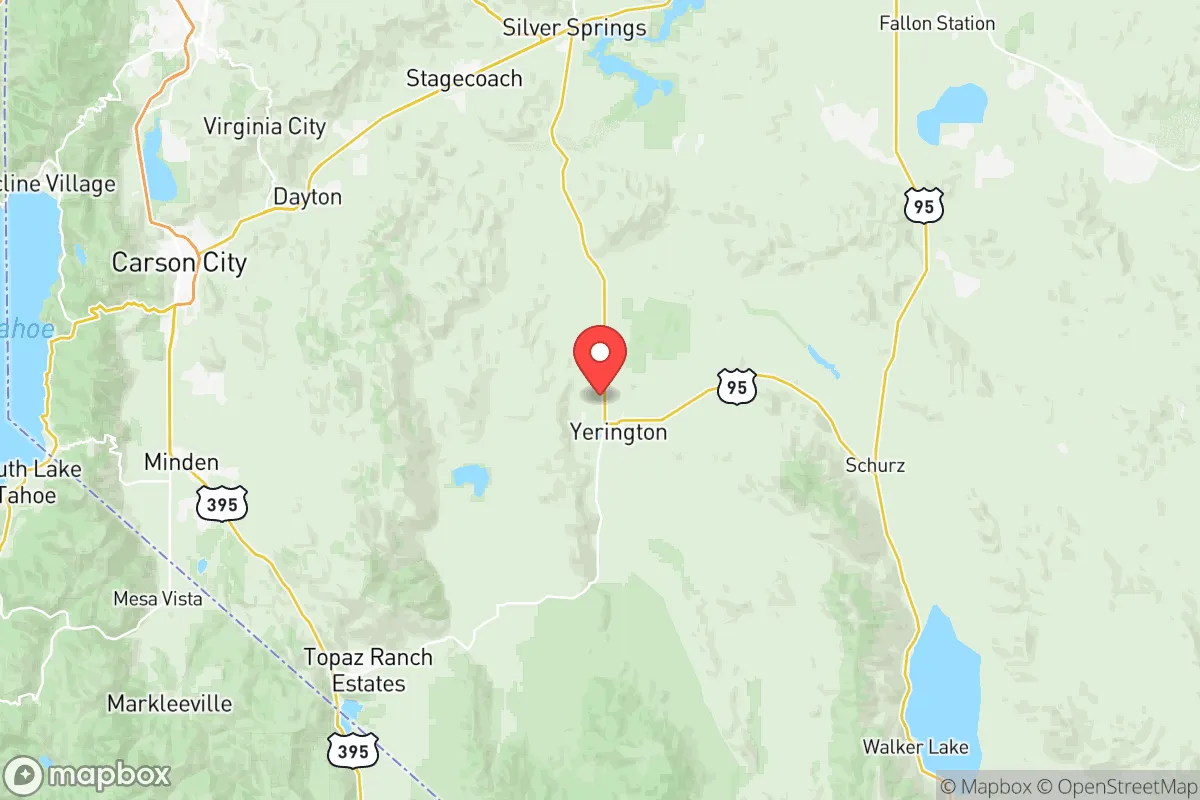
The people of Lyon County, Nevada today number 60,630, forming a predominantly white (71.7%) and Hispanic (18.7%) population that is notably less diverse and less college-educated (17.2%) than the state average. The county’s identity is rooted in its rural, working-class character, with a strong libertarian-conservative streak and a deep connection to mining, agriculture, and the commuter economy serving the Reno-Sparks and Carson City metro areas. Distinctive markers include a low foreign-born share (3.6%), a population concentrated in the western corridor from Silver Springs to Yerington, and a sense of being a quieter, more affordable alternative to the booming urban centers to the north and south.
Settlement & growth (pre-1960)
Long before European contact, the region now known as Lyon County was home to the Northern Paiute and Washoe peoples, who lived in seasonal patterns across the Walker River and Carson River basins. These Native nations relied on hunting, fishing, and gathering piñon nuts, with settlements concentrated near water sources that would later draw Euro-American settlers. The first significant non-Native presence came with the California Gold Rush of 1849, when emigrants passed through the area along the Carson River Route, but permanent settlement did not begin until the discovery of silver in the Comstock Lode at Virginia City in 1859.
Lyon County was formally created in 1861, and its early population was overwhelmingly composed of white American and European miners, merchants, and farmers drawn by the Comstock boom. The county’s first major settlement, Dayton, emerged as a milling and supply center for the mines, while Yerington was founded in the 1870s as a railroad town serving the booming copper mines of the Mason Valley. The population during this period was almost entirely native-born white or of Northern European stock—English, Irish, German, and Cornish miners—with a small number of Chinese laborers who worked on the railroads and in mining camps. By the 1880s, the Chinese population in Lyon County had grown to several hundred, concentrated in Dayton and Yerington, but anti-Chinese sentiment and exclusion laws drove most out by the early 1900s.
The early 20th century brought a second wave of growth tied to agriculture and the expansion of the Walker River Irrigation District. Smith Valley and Mason Valley became centers of alfalfa, cattle, and dairy farming, attracting homesteaders from the Midwest and Great Plains. The Dust Bowl of the 1930s pushed a modest number of displaced farmers from Oklahoma and Texas into the area, though Lyon County’s population remained small—under 5,000 until the 1950s. The construction of U.S. Highway 95 and the completion of the Lahontan Dam in 1915 spurred further agricultural development, but the county’s isolation and arid climate limited large-scale in-migration. By 1960, the population had reached just 6,143, with the majority living in Yerington, Dayton, and the rural farming communities of Silver Springs and Fernley.
Modern era (post-1965)
The 1965 Hart-Cellar Act, which ended national-origin quotas, had a minimal direct effect on Lyon County’s demographics due to its remote location and limited economic opportunities. Unlike urban Nevada, the county did not see significant new immigrant waves from Asia or Latin America during the 1970s and 1980s. Instead, the major demographic shift came from domestic migration: the rise of the Reno-Sparks metropolitan area and the expansion of the Tahoe-Reno Industrial Center began pulling new residents into western Lyon County. Fernley, in particular, transformed from a small farming town into a commuter suburb, with its population surging from 1,600 in 1990 to over 19,000 by 2020. This growth was driven by affordable housing, proximity to Interstate 80, and the expansion of logistics and warehouse jobs in nearby Sparks and Storey County.
The Hispanic population grew steadily but gradually, rising from roughly 5% in 1990 to 18.7% by 2024. This growth came primarily from Mexican-American families moving from California and from within Nevada, drawn by agricultural work in the Mason and Smith Valleys and by construction and service jobs in the growing suburbs. Yerington and Dayton saw the largest Hispanic concentrations, with many families settling in established neighborhoods and working in farming, landscaping, and hospitality. The East/Southeast Asian population (1.3%) and Black population (1.0%) remain very small, with no distinct ethnic enclaves forming; most Asian and Black residents are scattered across Fernley and Silver Springs, often employed in professional or technical roles tied to the industrial corridor.
The post-2000 period also saw an influx of retirees and second-home buyers from California, drawn by lower taxes and a slower pace of life. This wave concentrated in Dayton and the rural subdivisions around Silver Springs, where new housing developments catered to those seeking a rural lifestyle within commuting distance of Carson City. The county’s college-educated share remains low at 17.2%, reflecting the predominance of blue-collar and service-sector employment, though the Fernley area has seen a modest uptick in remote workers and professionals priced out of Reno.
The future
Lyon County’s population is projected to continue growing, driven by spillover from the Reno-Sparks metro and the ongoing development of the Tahoe-Reno Industrial Center, which is expected to add thousands of warehouse and logistics jobs in the next decade. The Hispanic share is likely to rise gradually, potentially reaching 25-30% by 2040, as younger families move in and birth rates remain higher than the white population. However, the county is not expected to see significant growth in Asian, Black, or Indian subcontinent populations, as the area lacks the professional job base and cultural infrastructure that attract these groups to larger cities.
The cultural identity of Lyon County is likely to remain predominantly white and conservative, with the Hispanic population assimilating into the broader working-class culture rather than forming distinct enclaves. The influx of California transplants may introduce some political tension, but the county’s strong libertarian streak—embodied in its support for gun rights, low taxes, and limited government—appears durable. The biggest demographic challenge will be housing affordability: as Fernley and Dayton become more popular with commuters, home prices are rising, potentially pricing out the very working-class families that have long defined the county.
For someone moving in now, Lyon County offers a stable, low-diversity, family-oriented environment with a strong sense of local identity and a practical, no-frills lifestyle. The population is becoming slightly more diverse and more suburban, but the core character—rural, conservative, and rooted in mining and agriculture—remains intact. The county is not homogenizing into a generic suburb; rather, it is absorbing new residents into its existing cultural framework, making it a predictable choice for those seeking an affordable, safe, and traditional community in western Nevada.

* Values derived from national, state, county, city and local statistics and may differ in a specific area. Last updated: 2026-05-12T09:23:36.000Z
Narrative content on this page is AI-generated and may contain mistakes. Verify any details that matter before acting on them.
ReloMaps may earn a commission from affiliate links at no extra cost to you.

