Photo: Wikipedia
Demographics of Peralta, NM
Affluence Level in Peralta, NM
A middle-class area roughly in line with national averages across income, home values, education, and employment.
People of Peralta, NM
The people of Peralta, New Mexico, today number 3,385, forming a community that is nearly evenly split between Hispanic (46.6%) and non-Hispanic White (43.2%) residents. This small Valencia County town, located just south of Los Lunas along the Rio Grande, has a distinctly working-class character with a low foreign-born population of 2.7% and a college attainment rate of 24.8%. The population is overwhelmingly native-born, and the town’s identity is rooted in its deep Hispano heritage and a more recent wave of Anglo families seeking affordable rural living within commuting distance of Albuquerque.
How the city was settled and grew
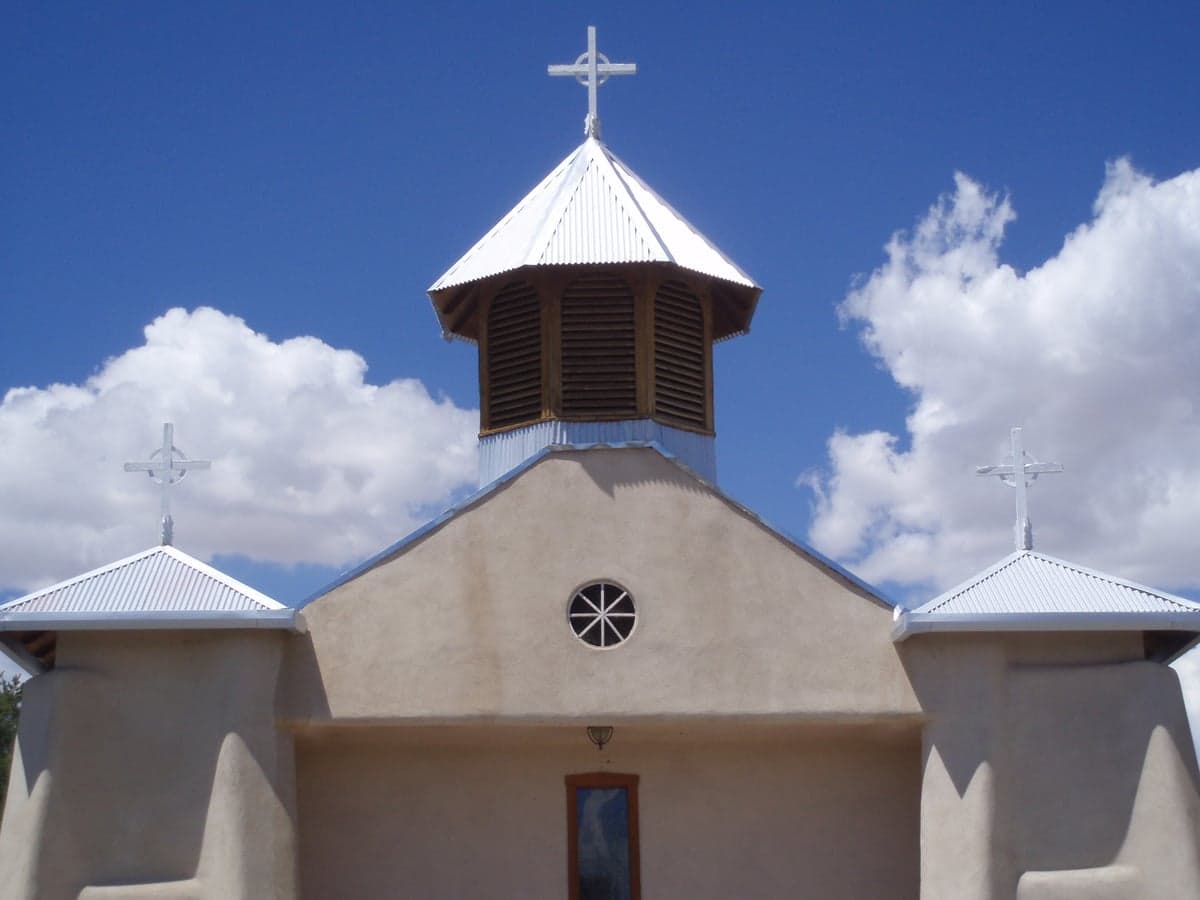
Peralta’s human history begins not with a city charter but with Spanish land grants in the 1700s. The area was part of the Belen Land Grant, awarded to Spanish settlers who established farming and ranching communities along the Rio Grande. These early settlers were Hispanos—descendants of Spanish colonists and mestizos—who built the first acequias (irrigation ditches) and laid out small homesteads. The historic core of what is now Peralta developed around the Peralta Plaza neighborhood, where the original adobe homes and the San Clemente Church (established in the 1800s) still anchor the community. For over a century, the population remained almost entirely Hispano, tied to subsistence agriculture and sheep grazing. The arrival of the railroad in the late 1800s through nearby Belen brought modest growth but did not fundamentally alter the ethnic composition; Peralta remained a Hispano farming village through the 1940s.
Modern era (post-1965)
The post-1965 period brought two major shifts. First, the Immigration and Nationality Act of 1965 had little direct effect on Peralta’s foreign-born population—which remains very low at 2.7%—but the broader suburbanization of the Albuquerque metro area began to reshape the town. Starting in the 1970s and accelerating through the 1990s, Anglo families moved into Peralta, drawn by cheaper land and larger lots compared to Albuquerque’s West Side. These newcomers settled primarily in newer subdivisions like Rio Grande Estates and Sunset Hills, which feature modern tract homes on half-acre lots. Meanwhile, the historic Hispano population remained concentrated in the Peralta Plaza and Old Town Peralta neighborhoods, where multigenerational families still live in homes passed down through generations. The 2000s saw a small influx of East/Southeast Asian residents (now 0.9% of the population), mostly professionals working at Kirtland Air Force Base or Sandia National Laboratories, who settled in the newer Meadowbrook subdivision. The Black population remains at 0.0%, and there is no measurable Indian subcontinent or Arab community. The result is a town that is tribalizing into distinct enclaves: the old Hispano core around the plaza, and the newer Anglo subdivisions to the east and south.
The future
Peralta’s demographic future points toward gradual homogenization rather than diversification. The foreign-born share is negligible and unlikely to rise significantly, as the town lacks the rental housing stock and job base that attract immigrant populations. The Hispanic share (46.6%) is stable, sustained by natural increase among established Hispano families, while the White share (43.2%) is likely to grow modestly as more Albuquerque-area families seek affordable acreage. The small East/Southeast Asian community (0.9%) is plateauing, as most are tied to specific professional roles at the labs and base. The key trend is suburban infill: new developments like Peralta Trails and Valle del Sol are attracting young Anglo families with children, pushing the town’s character toward a commuter suburb. Over the next 10–20 years, expect the population to grow to roughly 4,000–4,500, with the Anglo share inching up to near parity with the Hispanic share. The town will not become a melting pot; instead, it will remain a dual-heritage community where the Hispano old guard and Anglo newcomers coexist in separate neighborhoods but share a common identity as a quiet, low-tax alternative to Albuquerque.
For someone moving in now, Peralta offers a stable, predominantly native-born community where the cultural divide is not between immigrants and natives but between two long-established American groups: Hispanos with centuries of roots and Anglos seeking space and affordability. The town is becoming more suburban and more Anglo, but it retains a strong Hispano character in its historic core. New residents should expect a quiet, family-oriented environment with low crime and good schools in Los Lunas, but little ethnic diversity beyond the Hispanic-Anglo binary.

* Values derived from national, state, county, city and local statistics and may differ in a specific area. Last updated: 2026-05-01T04:03:06.000Z
Narrative content on this page is AI-generated and may contain mistakes. Verify any details that matter before acting on them.
ReloMaps may earn a commission from affiliate links at no extra cost to you.

