Photo: Wikipedia
Personal Sovereignty in Weirton, WV
Strong independent fundamentals that actively favor personal liberty and low regulation.
What does Personal Sovereignty tell us?
Personal Sovereignty measures your capacity for self-reliance and independence with minimal government friction. Higher scores mean fewer barriers between you and the way you want to live... but it assumes you have the space you need and good neighbors.
What does this tell us?
Personal Sovereignty measures your capacity for self-reliance and independence with minimal government friction. Higher scores mean fewer barriers between you and the way you want to live... but it assumes you have the space you need and good neighbors.
State Policy
Energy independence: Net exporter (200% of energy produced in-state)
Personal Liberty
Homesteading

Personal Liberty Analysis
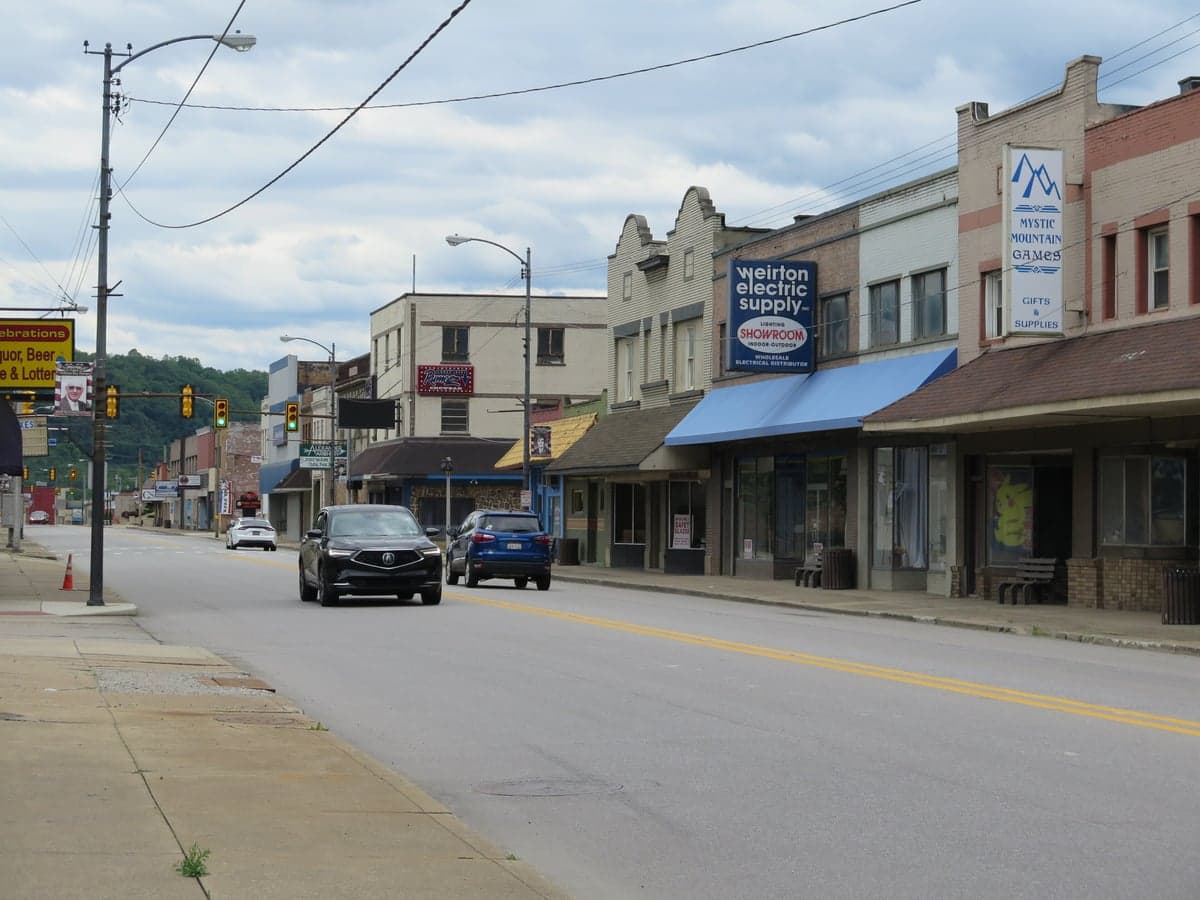
Weirton, West Virginia, offers one of the strongest personal sovereignty environments in the upper Ohio Valley, largely because it sits in a state that has actively pushed back against federal overreach and maintains a culture of self-reliance. For the survivalist or prepper, this means fewer legal barriers to living life on your own terms—whether that involves securing your property, making medical decisions for your family, or building a resilient homestead. While no location is a fortress against federal encroachment, Weirton’s position in West Virginia provides a legal and cultural buffer that many other regions simply lack.
Tax burden and regulatory posture for independent living
West Virginia’s tax structure is a net positive for anyone seeking to minimize government extraction from their income and property. The state has a flat personal income tax rate of 3.99% as of 2025, down from higher progressive rates in prior years, and there are ongoing legislative efforts to reduce it further. Property taxes in Hancock County, where Weirton sits, are among the lowest in the nation—typically 0.5% to 0.7% of assessed value—meaning a $150,000 home might carry an annual tax bill of only $750 to $1,050. There is no state-level sales tax on groceries or prescription drugs, and the general sales tax is a modest 6%. For the prepper, this low tax burden translates directly into more capital for land, supplies, and infrastructure rather than funding state programs you may not support. On the regulatory side, West Virginia has a reputation for being business-friendly and light on occupational licensing compared to neighboring Pennsylvania and Ohio. Zoning in Weirton itself is relatively permissive for a former steel town, though some residential areas have restrictions on livestock and commercial structures. The broader Hancock County area, especially outside city limits, has minimal zoning, allowing for workshops, storage sheds, and even small-scale agricultural operations without endless permit battles. This regulatory posture means you can spend your time preparing, not pleading with bureaucrats.
Self-defense and gun law specifics in West Virginia
For anyone serious about personal sovereignty, the right to keep and bear arms is non-negotiable, and West Virginia delivers. The state is a constitutional carry jurisdiction—no permit required to carry a concealed firearm for any law-abiding adult 21 or older (18 for open carry). There is no state-level firearm registration, no magazine capacity restrictions, and no "red flag" law that allows confiscation without due process. Weirton’s local law enforcement, the Weirton Police Department, generally respects these rights, and the city has no additional gun ordinances beyond state law. Stand-your-ground laws are in full effect, meaning there is no duty to retreat before using deadly force if you are lawfully present and believe it is necessary to prevent death or great bodily harm. For the prepper, this legal environment means you can maintain a fully stocked armory, train on your own property, and carry daily without fear of technical violations. The only notable restriction is that firearms are prohibited in certain state-owned buildings and schools, but even those areas have carve-outs for locked vehicles. Compared to states like New York or California, where gun ownership is treated as a privilege to be managed, West Virginia treats it as a fundamental right.
Self-reliance and homesteading viability in Weirton
Weirton’s geography and land-use patterns make it a viable location for a self-reliant lifestyle, though it is not wide-open frontier. The city itself is built on a hilly terrain with a mix of older residential lots and some undeveloped parcels. Within city limits, typical lot sizes range from 0.1 to 0.5 acres, which is enough for a substantial garden, a small chicken coop, and rainwater collection, but not for larger livestock or extensive off-grid solar arrays. The real opportunity lies just outside town in Hancock County and neighboring Brooke County, where undeveloped land sells for $3,000 to $8,000 per acre—a fraction of the cost in suburban Pittsburgh or Washington, D.C. Zoning in these rural areas is minimal; you can build a pole barn, install a septic system, and set up solar panels with few hurdles. Off-grid living is legally feasible, though you will need to comply with state health department regulations for well water and septic. There is no state ban on rainwater harvesting, and West Virginia’s net metering policy allows you to sell excess solar power back to the grid. For the prepper focused on food security, the growing season runs from April to October, and the soil in the Ohio River valley is fertile enough for corn, beans, squash, and root vegetables. Deer hunting is excellent in the surrounding national forest and state game lands, with a robust population that helps keep the freezer full. The main limitation is the industrial legacy—some vacant lots in Weirton have soil contamination from decades of steel production, so test any land you plan to garden. Overall, the area offers a realistic path to significant self-reliance without requiring a massive land purchase.
Personal liberties: parental rights, medical autonomy, and property
West Virginia has taken a strong stance on several fronts that matter to those concerned about government overreach. Parental rights are explicitly protected under state law, with a 2023 bill (HB 2007) affirming that parents have the fundamental right to direct the upbringing, education, and healthcare of their children. This means no school district can hide medical or mental health information from parents, and there is no state mandate for controversial curriculum content. Medical autonomy is also robust: West Virginia has no vaccine mandate for adults, and while school vaccine requirements exist, medical and religious exemptions are available. The state passed a law in 2024 prohibiting the enforcement of federal public health orders that would restrict individual movement or commerce without explicit legislative approval—a direct response to COVID-era lockdowns. Property rights are similarly strong, with no state-level forced annexation of land for private development, and a relatively straightforward process for challenging eminent domain. Free speech is protected under the state constitution, and there are no hate speech laws that criminalize political or religious expression. For the prepper, this legal environment means you can homeschool your children without excessive oversight, refuse medical treatments you disagree with, and speak your mind on local governance without fear of reprisal. The only area where West Virginia lags is in privacy protections for digital data—there is no comprehensive state privacy law, so your online activities are subject to federal surveillance. But for physical, tangible sovereignty, the state is a clear win.
In the broader landscape of American personal sovereignty, Weirton and West Virginia rank among the top tier for those seeking to minimize government interference in daily life. The combination of constitutional carry, low taxes, permissive zoning, parental rights protections, and a culture of self-reliance creates an environment where a prepper or survivalist can operate with few legal constraints. Compared to the Pacific Northwest or New England, where regulatory burdens and cultural hostility to firearms are common, Weirton offers a refuge. Compared to the Deep South, it offers lower humidity and better access to freshwater. The trade-off is a limited local economy and aging infrastructure, but for someone whose priority is personal freedom and the ability to prepare for uncertain times, Weirton is a solid strategic choice. It is not a libertarian utopia—federal law still applies, and local politics can be parochial—but it is a place where you can live largely as you see fit, without the state constantly looking over your shoulder.

* Values derived from national, state, county, city and local statistics and may differ in a specific area. Last updated: 2026-05-02T02:24:03.000Z
Narrative content on this page is AI-generated and may contain mistakes. Verify any details that matter before acting on them.
ReloMaps may earn a commission from affiliate links at no extra cost to you.

