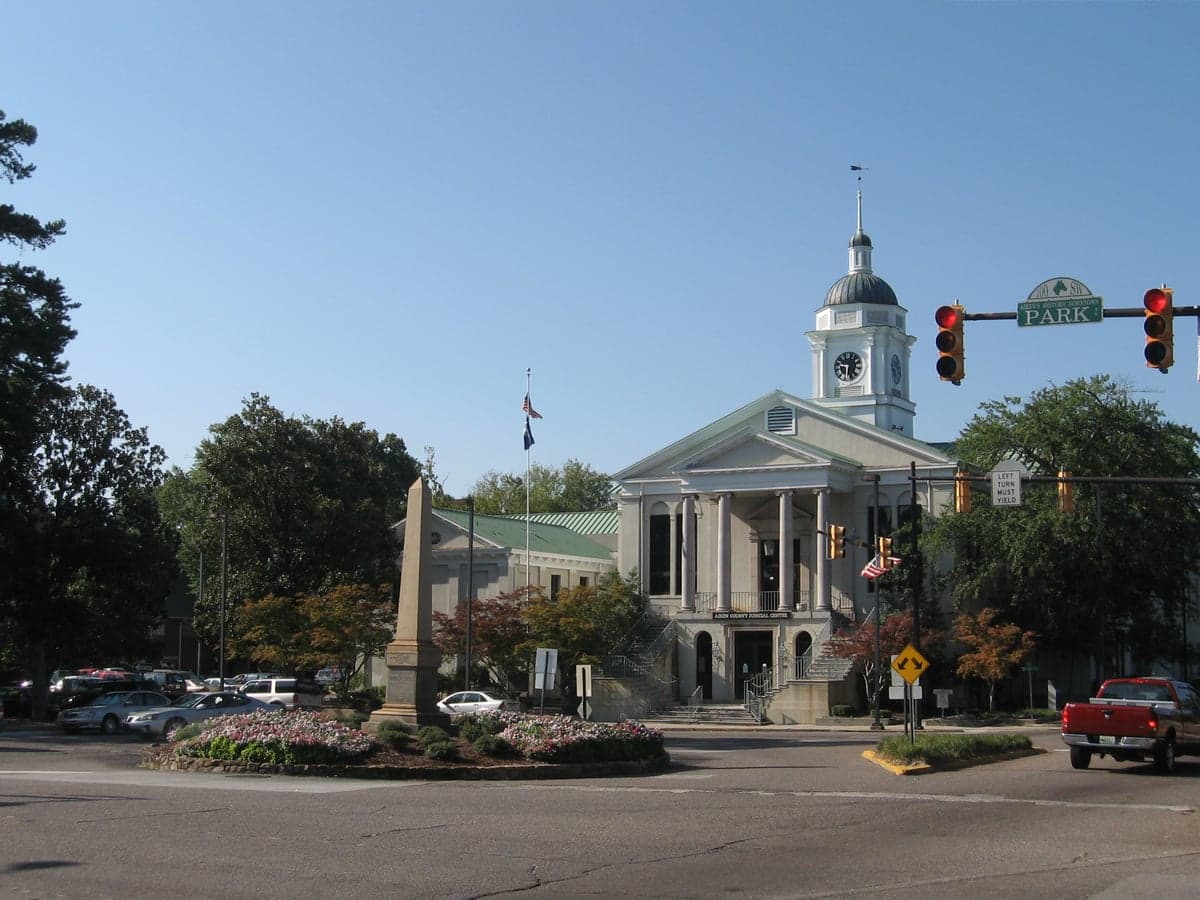
Photo: Wikipedia
Personal Sovereignty in Aiken, SC
Viable for self-reliance. Generally workable, though some barriers may limit total independence.
What does Personal Sovereignty tell us?
Personal Sovereignty measures your capacity for self-reliance and independence with minimal government friction. Higher scores mean fewer barriers between you and the way you want to live... but it assumes you have the space you need and good neighbors.
What does this tell us?
Personal Sovereignty measures your capacity for self-reliance and independence with minimal government friction. Higher scores mean fewer barriers between you and the way you want to live... but it assumes you have the space you need and good neighbors.
State Policy
Energy independence: Importer (25% of energy produced in-state)
Personal Liberty
Homesteading

Personal Liberty Analysis
Aiken, South Carolina, offers a notably high degree of personal sovereignty compared to many other regions in the Southeast, particularly for those who prioritize minimal government interference in daily life. The city and surrounding Aiken County operate within a state framework that consistently ranks among the most free in the nation for property rights, self-defense, and tax burden. For a single individual or family approaching relocation with a survivalist or prepper mindset, the key question is not whether Aiken is free—it is—but whether its specific blend of local ordinances and state-level protections aligns with your particular autonomy priorities.
Tax burden and regulatory posture: How South Carolina’s fiscal climate supports self-reliance
South Carolina’s tax structure is a strong net positive for personal sovereignty. There is no state tax on Social Security benefits, and the state income tax is a flat 6.2% (as of 2026), with a standard deduction that shields a significant portion of earned income. For a single individual earning $60,000 annually, the effective state income tax rate is roughly 4.5% after deductions. Property taxes in Aiken County are among the lowest in the state, with an average effective rate of 0.52% of assessed home value—roughly half the national average. A $300,000 home would carry an annual tax bill of about $1,560. There is no state-level property tax on vehicles, and the annual vehicle property tax in Aiken County is typically under $200 for a standard sedan. The regulatory environment is equally favorable: South Carolina is a right-to-work state, there is no state-level occupational licensing for many trades that require it elsewhere, and Aiken County has no countywide zoning in unincorporated areas—meaning you can build a workshop, store supplies, or keep livestock on your property without seeking a variance, provided you meet basic setback and septic requirements. This combination of low taxes and light regulation directly supports the financial and logistical foundations of a self-reliant lifestyle.
Self-defense and gun law specifics: Stand your ground, permitless carry, and castle doctrine
South Carolina is one of the strongest states in the nation for self-defense rights, and Aiken residents benefit fully from these protections. The state has a permitless (constitutional) carry law that took full effect in 2024, allowing any law-abiding adult 18 or older to carry a concealed firearm without a permit. For those who still want a permit for reciprocity with other states, the process is straightforward: a background check and a short training course, with no fingerprinting requirement. The state’s Stand Your Ground statute (S.C. Code § 16-11-440) removes any duty to retreat before using deadly force if you are lawfully present and reasonably believe force is necessary to prevent death, great bodily harm, or a violent felony. The Castle Doctrine applies to your home, vehicle, and place of business. There is no state-level magazine capacity restriction, no assault weapon ban, and no red flag law. Aiken County’s sheriff’s office is known for a pro-Second Amendment stance, and the local gun culture is robust, with multiple indoor and outdoor ranges within a 30-minute drive. For a prepper, this means you can legally maintain a substantial armory and train with it without bureaucratic hurdles.
Self-reliance and homesteading viability: Lot sizes, zoning, and off-grid feasibility
Aiken’s real estate market offers genuine opportunities for self-reliant living, especially outside the city limits. In unincorporated Aiken County, minimum lot sizes for single-family homes are typically 1 acre in rural areas, though many parcels available for purchase are 5, 10, or even 20 acres. There is no countywide zoning ordinance, so you can keep chickens, goats, or even a few head of cattle without a special permit. Beekeeping is unrestricted. For off-grid living, the picture is mixed but workable: South Carolina has no state law requiring a grid connection, but Aiken County does enforce the International Residential Code for new construction, which includes requirements for septic systems (perk test needed) and well water (permit required). Solar panels are allowed, but net metering policies are less generous than in some states—you cannot sell excess power back at retail rates, only at the avoided-cost rate (roughly 3-4 cents per kWh). Rainwater collection is legal and encouraged for non-potable uses. The climate—220+ growing days per year—makes year-round gardening viable, and the local soil is sandy loam that drains well. For a prepper, the biggest constraint is water: Aiken County averages 48 inches of rain annually, but droughts occur, so a well with a hand pump backup is a prudent investment.
Personal liberties: Parental rights, medical autonomy, speech, and property
South Carolina has a strong track record on several fronts of personal liberty. Parental rights are explicitly protected under state law (S.C. Code § 63-5-340), which affirms that parents have the fundamental right to direct the upbringing, education, and healthcare of their children. The state does not require parental consent for a minor’s COVID-19 vaccine (though it is recommended), but it does require parental consent for most other medical procedures. Medical autonomy for adults is generally respected: there is no state-level vaccine mandate for employment, and the state legislature has passed laws prohibiting discrimination against unvaccinated individuals in public accommodations. Free speech is protected under the First Amendment, and Aiken has no local ordinances restricting political signage or public assembly beyond standard time-place-manner rules. Property rights are robust: there is no state-level inheritance tax, and South Carolina’s homestead exemption protects up to $60,000 of your home’s value from creditors. The state also has a strong eminent domain law that requires a public purpose and just compensation, with no recent controversies over private property seizures for economic development. For a prepper, this means you can store supplies, build structures, and live according to your values without fear of local government overreach—provided you stay within the basic building and health codes.
In the broader context of the Southeast, Aiken represents a solid middle ground between the near-total autonomy of rural Georgia or Alabama and the more restrictive environments of coastal South Carolina or North Carolina. The city itself is small enough (roughly 30,000 residents) that local government remains accessible, but large enough to have a hospital, hardware stores, and a feed-and-seed supply. The biggest sovereignty trade-off is the lack of a state-level income tax exemption for military retirement (though military pensions are partially deductible), and the fact that South Carolina’s sales tax on groceries (6% state plus local) is a regressive burden. For a single individual or family who values the ability to keep and bear arms without permits, to build and live on land with minimal red tape, and to raise children with parental authority intact, Aiken offers a compelling package—one that is likely to remain stable even as other states tighten restrictions.

* Values derived from national, state, county, city and local statistics and may differ in a specific area. Last updated: 2026-04-29T19:51:31.000Z
Narrative content on this page is AI-generated and may contain mistakes. Verify any details that matter before acting on them.
ReloMaps may earn a commission from affiliate links at no extra cost to you.

