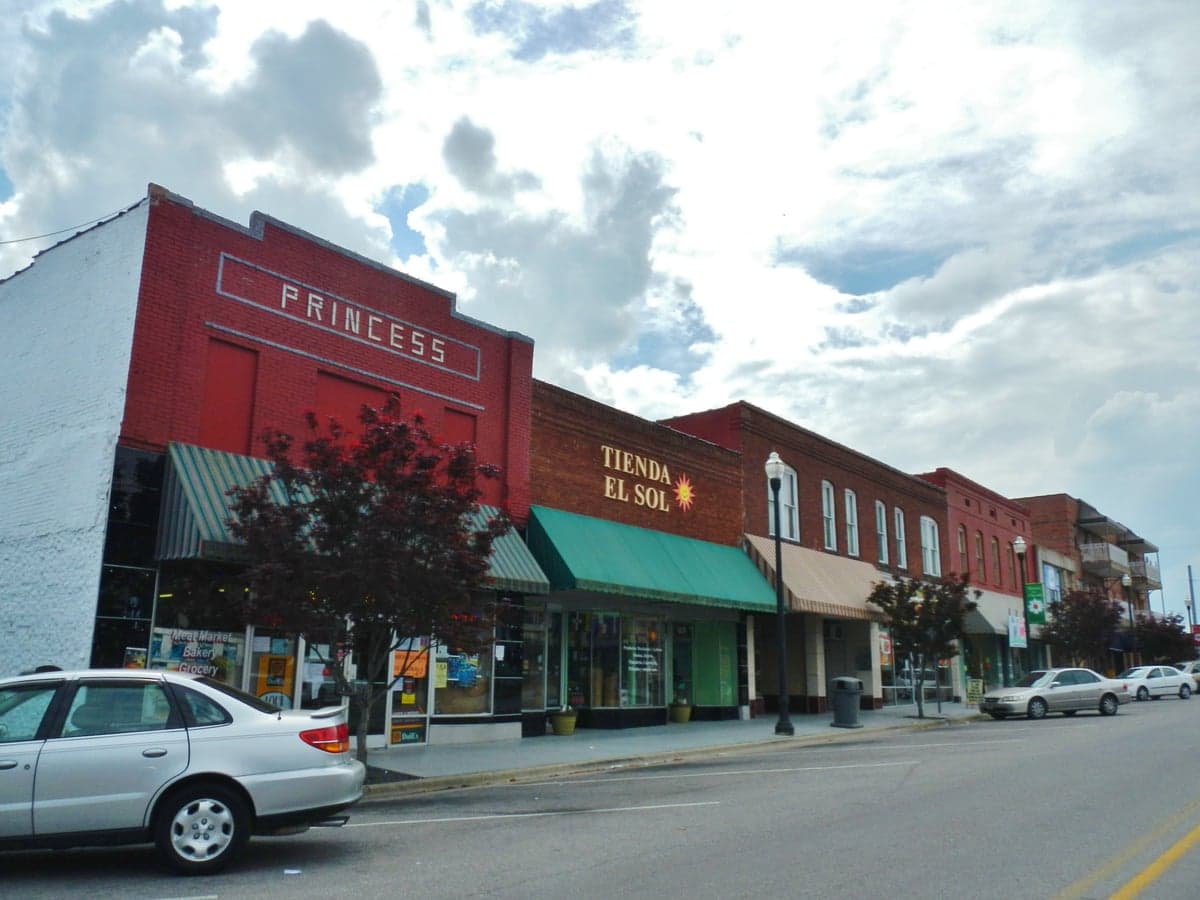
Photo: Wikipedia
Demographics of Albertville, AL
Affluence Level in Albertville, AL
A below-average socioeconomic profile. Incomes, home values, and educational attainment trail the U.S., with higher poverty and unemployment.
People of Albertville, AL
Albertville, Alabama, is a city of 22,584 residents where a white majority (63.9%) coexists with a substantial Hispanic population (30.2%), creating a demographic profile distinct from much of rural North Alabama. The city’s identity is shaped by its roots as a railroad and agricultural hub, now layered with a growing immigrant workforce and a small Black community (3.5%). With a foreign-born share of 10.3%—nearly triple the state average—Albertville is one of the more ethnically diverse small cities in the region, though its college-educated rate (20.9%) trails the national average. This is a working-class town where poultry processing and manufacturing anchor the economy, and where the population is becoming more Hispanic with each passing decade.
How the city was settled and grew
Albertville was founded in the 1880s as a railroad stop on the Memphis and Charleston line, drawing its first settlers from surrounding farm communities and the Tennessee Valley. The original white population—mostly of Scots-Irish and English descent—arrived as subsistence farmers and small merchants, building the first homes in what is now Downtown Albertville along Main Street and the adjacent East Albertville neighborhood. The city incorporated in 1891 and grew slowly through the early 1900s, with the poultry industry emerging after World War II as the primary economic draw. By the 1950s, the construction of processing plants by companies like Wayne Farms and Tyson Foods attracted a wave of white rural migrants from nearby Sand Mountain and DeKalb County, who settled in North Albertville and the Lakeview area near the city’s northern edge. No significant Black settlement occurred during this period; the Black population remained below 2% through the 1960s, as Jim Crow-era patterns kept most African Americans in the county’s older agricultural communities like Boaz and Guntersville.
Modern era (post-1965)
The post-1965 immigration reforms, combined with the poultry industry’s labor demands, triggered Albertville’s most significant demographic shift. Starting in the 1980s, Mexican and Central American workers—initially from Guanajuato and Zacatecas—began arriving to fill jobs in poultry processing plants that white workers were leaving for higher-paying factory work. This wave concentrated in South Albertville, particularly along Gunter Avenue and the streets off Highway 431, where older single-family homes and rental duplexes became the city’s first Hispanic enclave. By 2000, the Hispanic share had reached 15%, and it climbed to 30.2% by the 2020 Census. The West Albertville neighborhood, near the industrial park, absorbed a second wave of immigrants in the 2000s, including a small number of East/Southeast Asian families (0.6% today), mostly Vietnamese and Filipino workers recruited by a local automotive parts supplier. The Black population (3.5%) remains small and is concentrated in a few blocks near the Albertville Housing Authority complex off Horton Road, a legacy of public housing policies rather than historic settlement. The white population, while still the majority, has aged and declined in absolute numbers since 2010, as younger white families have moved to newer subdivisions in nearby Guntersville or to rural Marshall County.
The future
Albertville’s population is trending toward a Hispanic majority within the next 20 years, driven by higher birth rates among immigrant families and continued white out-migration to surrounding unincorporated areas. The Hispanic community is not tribalizing into a permanent enclave; second-generation residents are increasingly bilingual and moving into white-collar jobs, though the city’s low college attainment rate (20.9%) suggests upward mobility remains limited. The East/Southeast Asian population (0.6%) is stable but not growing, as the automotive supplier that drew them has not expanded. The Black population is likely to remain small, as no new economic anchors are attracting African American in-migration. The white population will continue to shrink as older residents age in place and younger families leave for larger lots and lower taxes in rural Marshall County. The city is becoming more homogenized in terms of class—working-class across all groups—but more diverse in ethnicity, with South Albertville and West Albertville solidifying as Hispanic-majority neighborhoods while North Albertville and Lakeview remain predominantly white.
For someone moving in now, Albertville offers a stable, affordable small-city environment where the poultry industry provides reliable employment but where educational and professional opportunities are limited. The demographic trajectory is clear: the city will become majority Hispanic within a generation, with a white minority that is older and more suburban in orientation. New residents should expect a community where Spanish is increasingly common in public life, where the public schools are majority-minority, and where the cultural divide is more about language and generation than about race in the traditional Black-white sense. This is not a city in decline, but it is a city in transition—one where the working-class character remains constant even as the faces change.

* Values derived from national, state, county, city and local statistics and may differ in a specific area. Last updated: 2026-04-19T18:41:35.000Z
Narrative content on this page is AI-generated and may contain mistakes. Verify any details that matter before acting on them.
ReloMaps may earn a commission from affiliate links at no extra cost to you.

