
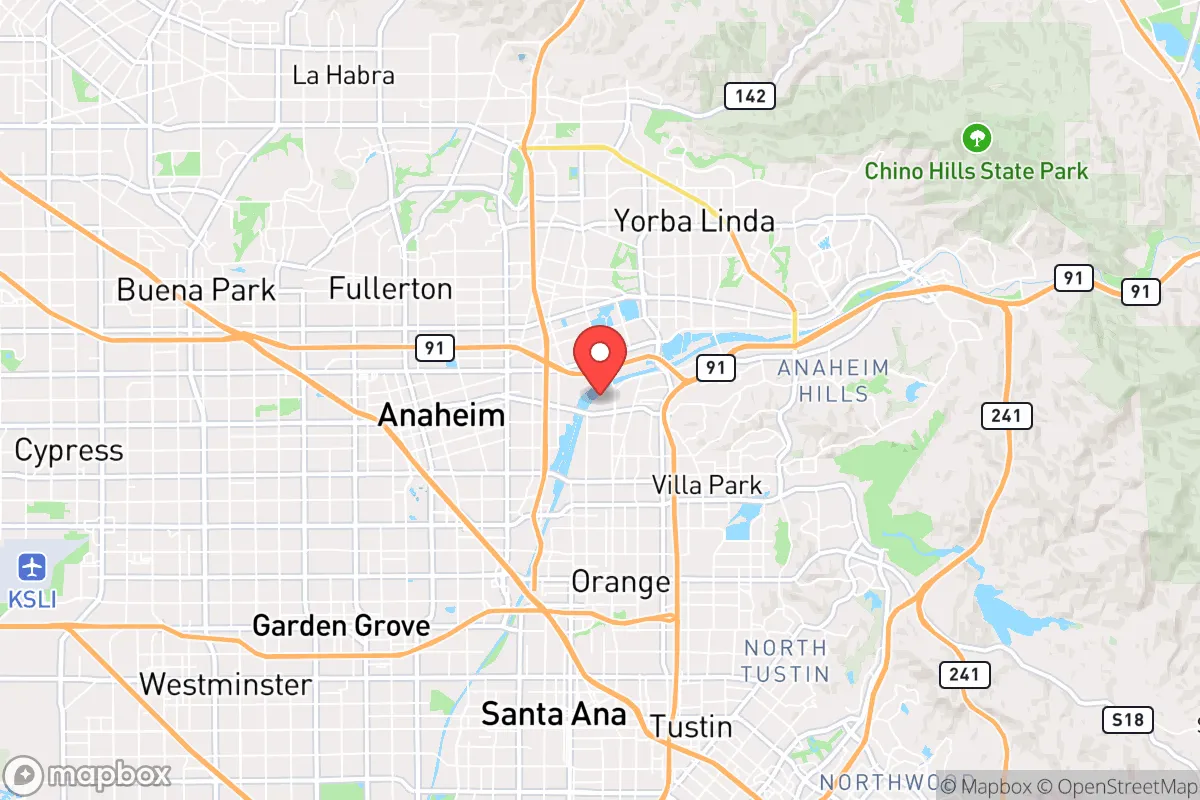
Photo: Wikipedia
Personal Sovereignty in Anaheim, CA
Moderate friction. Expect trade-offs in some aspect of personal liberty and independence.
What does Personal Sovereignty tell us?
Personal Sovereignty measures your capacity for self-reliance and independence with minimal government friction. Higher scores mean fewer barriers between you and the way you want to live... but it assumes you have the space you need and good neighbors.
What does this tell us?
Personal Sovereignty measures your capacity for self-reliance and independence with minimal government friction. Higher scores mean fewer barriers between you and the way you want to live... but it assumes you have the space you need and good neighbors.
State Policy
Energy independence: Importer (33% of energy produced in-state)
Personal Liberty
Homesteading

Personal Liberty Analysis
For the liberty-minded individual or family evaluating Anaheim, California, the personal sovereignty environment is best described as constrained by state-level mandates that preempt local autonomy. While Anaheim itself has a city council that has occasionally pushed back against Sacramento’s overreach, the reality is that California’s regulatory apparatus — from tax policy to health mandates — creates a high-compliance, low-autonomy baseline. A survivalist or prepper assessing this area must weigh the benefits of Southern California’s economic opportunities and climate against a legal framework that systematically reduces individual decision-making power. The net effect is that personal sovereignty in Anaheim is significantly weaker than in states like Texas, Arizona, or Nevada, but pockets of resistance and practical workarounds do exist for those willing to navigate the system.
Tax burden and regulatory posture in Anaheim: what it means for your autonomy
California’s tax structure is a primary drag on personal sovereignty. The state’s top marginal income tax rate of 13.3% — the highest in the nation — applies to income over $1 million, but even middle-income earners in Anaheim face a combined state and local tax burden that ranks among the steepest in the country. Sales tax in Anaheim is 7.75%, and property taxes, while capped by Proposition 13 at roughly 1% of assessed value, can still be substantial given Orange County’s high real estate prices. For a prepper, this means a larger portion of income is diverted to government before you can allocate it to supplies, land, or self-reliance projects. Regulatory posture is equally restrictive: California’s California Environmental Quality Act (CEQA) can be weaponized to delay or block any construction, including off-grid improvements or even simple fencing. Business licenses, contractor requirements, and permitting for rainwater catchment or solar panels are all subject to state-level bureaucracy that erodes the ability to act independently on your own property. Anaheim’s city government is generally more business-friendly than Los Angeles, but it operates within a state framework that prioritizes collective compliance over individual liberty.
Self-defense and gun law specifics in Anaheim: what you can and cannot do
California’s gun laws are among the most restrictive in the nation, and Anaheim residents must comply fully. The state requires a 10-day waiting period and a Firearm Safety Certificate for all purchases, and it bans so-called “assault weapons” by feature — including common rifles like the AR-15. Magazine capacity is capped at 10 rounds. Concealed carry permits (CCWs) are issued by the Orange County Sheriff, and since the Supreme Court’s Bruen decision in 2022, the county has moved to a “shall-issue” standard, but the process still requires a multi-hour training course, live-fire qualification, and a background check that can take months. For a prepper, this means your defensive options are limited: no suppressors, no short-barreled rifles without a federal tax stamp (which California also restricts), and no open carry of handguns. Self-defense in the home is legally protected under the “castle doctrine,” but California does not have a “stand your ground” law — you have a duty to retreat in public if safely possible. This legal environment forces a defensive posture that relies more on situational awareness and less on firepower. For those willing to relocate, neighboring states like Arizona or Nevada offer far greater latitude in both ownership and carry.
Self-reliance and homesteading viability: lot sizes, zoning, and off-grid feasibility
Anaheim is a dense, suburban city with an average lot size of roughly 6,000 to 7,000 square feet in its residential neighborhoods. Zoning is strictly enforced by the city’s planning department, and most single-family lots are subject to HOA or city covenants that restrict livestock, large gardens, and external structures. Raising chickens is permitted in some areas but limited to a small number of hens (no roosters), and larger animals like goats or pigs are generally prohibited. Off-grid living is effectively impossible: the city requires connection to municipal water and sewer, and solar panels must be grid-tied under California’s net metering rules. Rainwater collection is legal but limited to two 50-gallon barrels per household without a permit, and any larger system requires a professional installation and city approval. For a prepper seeking true self-reliance, Anaheim’s suburban density and regulatory oversight make it a poor fit. The more viable option is to look at unincorporated areas of Orange County or neighboring Riverside County, where lot sizes can exceed an acre and zoning is more permissive. Within Anaheim itself, the best you can do is a small vegetable garden, a modest solar setup, and a deep pantry — but you will remain dependent on municipal infrastructure.
Personal liberties in Anaheim: parental rights, medical autonomy, speech, and property
Parental rights in California have been a flashpoint. The state’s AB 1955 (2024) prohibits school districts from requiring parental notification when a child changes gender identity or pronouns, effectively overriding local school board decisions. Anaheim’s school districts — Anaheim Union High School District and Anaheim Elementary School District — have largely complied with state mandates, meaning parents who want full transparency must actively opt out or homeschool. Medical autonomy is similarly constrained: California mandates COVID-19 and other vaccines for school attendance, and the state’s public health orders can override local decisions during emergencies. Free speech is protected under the First Amendment, but California’s “hate speech” laws and workplace harassment statutes create a chilling effect for certain political or religious expressions. Property rights are the most compromised: California’s rent control laws (AB 1482) cap annual rent increases at 5% plus inflation, and Anaheim has its own rent stabilization for mobile home parks. For a prepper, this means your property is subject to state-level use restrictions, and you cannot easily evict tenants or modify your land without layers of approval. The cumulative effect is a legal environment that prioritizes state authority over individual and family decision-making.
Overall, personal sovereignty in Anaheim is a mixed bag that leans negative for the liberty-minded individual. The city offers economic opportunity and a mild climate, but the state-level tax burden, gun restrictions, zoning constraints, and erosion of parental rights create a high-cost, low-autonomy environment. Compared to areas like rural Texas, Idaho, or Montana, Anaheim requires constant navigation of regulatory hurdles that drain time and resources. For a prepper or survivalist, the best strategy is to treat Anaheim as a base for income generation while maintaining a secondary property in a more liberty-friendly jurisdiction. If you must live here, focus on legal compliance, build community networks, and invest in portable assets — because the state’s trajectory suggests further consolidation of power, not devolution to the individual.

* Values derived from national, state, county, city and local statistics and may differ in a specific area. Last updated: 2026-04-24T03:37:24.000Z
Narrative content on this page is AI-generated and may contain mistakes. Verify any details that matter before acting on them.
ReloMaps may earn a commission from affiliate links at no extra cost to you.

