
Photo: Wikipedia
Political ClimatePolitical Climate in Anaheim, CA
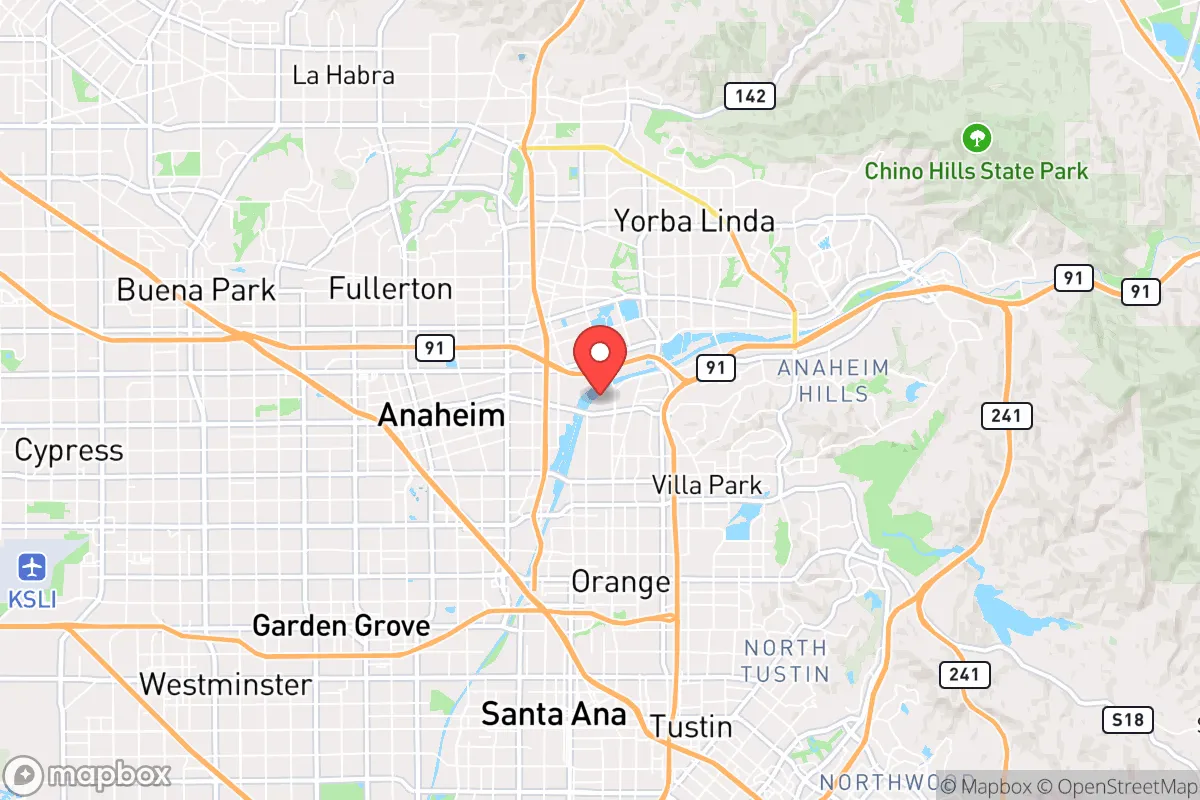
District shown is the primary district for this city’s centroid. Cities may span multiple districts.
Local Political AnalysisPolitical Analysis of Anaheim, CA
Anaheim’s political climate has shifted noticeably over the past decade, and if you’ve lived here as long as I have, you can feel it. The city sits in California’s 45th Congressional District, which carries a Cook PVI of D+11, meaning it leans about 11 points more Democratic than the national average. That’s a far cry from the Anaheim I remember in the 1990s and early 2000s, when the city was a reliable conservative stronghold in Orange County, often voting red in local and national races. Today, the trajectory is unmistakably progressive, driven by demographic changes and an influx of younger, more left-leaning voters. While the city still has a strong conservative base—especially in older neighborhoods and among long-time residents—the overall trend is toward a more liberal, government-heavy approach that raises real concerns about personal freedoms and local control.
How it compares
To understand Anaheim’s shift, you have to look at the surrounding towns. Just a few miles north, Fullerton and Buena Park have also moved left, but not as dramatically—Fullerton’s PVI is D+5, Buena Park’s D+8. Head south to Santa Ana, and you’re in a D+20 district, a deep-blue stronghold where progressive policies on housing, policing, and taxes are the norm. On the flip side, drive east to Yorba Linda or Brea, and you’ll find communities that still vote reliably Republican, with PVIs around R+10 or R+12. Anaheim sits right in the middle of this political patchwork, but its D+11 rating puts it closer to Santa Ana than to Yorba Linda. That’s a big change from 20 years ago, when Anaheim was the conservative anchor of north Orange County. The contrast is stark: in Yorba Linda, you’ll hear talk of limited government and property rights; in Anaheim, the city council has increasingly embraced rent control, higher business taxes, and expanded public spending—moves that feel like government overreach to many of us who remember when the city prided itself on being business-friendly.
What this means for residents
For the average Anaheim resident, this political shift has real, day-to-day consequences. The most immediate is rising housing costs driven by restrictive zoning and rent control policies that make it harder for families to buy homes or for small landlords to stay afloat. Property taxes, while capped by Prop 13, are being supplemented by new local bonds and parcel taxes that voters keep approving—often by slim margins. Then there’s the issue of public safety: the city council has debated defunding the police and redirecting funds to social programs, a move that many long-time residents see as a direct threat to personal safety and property rights. School board elections have become battlegrounds over curriculum transparency and parental rights, with progressive candidates pushing for policies that limit what parents can know about their kids’ education. If you value the freedom to run a small business, choose your own healthcare, or send your kids to school without ideological indoctrination, these trends are concerning. The city’s growing reliance on state and federal grants also means less local control—decisions that used to be made by Anaheim’s own officials are increasingly dictated by Sacramento.
Culturally, Anaheim still has its conservative pockets—especially in the Anaheim Hills and around the resort district—but the overall vibe has shifted. The annual Fourth of July parade, once a patriotic staple, now includes more political activism from progressive groups. The city’s large immigrant population, particularly from Mexico and Central America, has traditionally been more socially conservative, but younger generations are voting increasingly Democratic. The Disneyland Resort, which employs tens of thousands, has become a political force, pushing for higher minimum wages and union-friendly policies that ripple through the local economy. For those of us who remember when Anaheim was a place where you could raise a family without worrying about government overreach, the future looks uncertain. The long-term trend suggests more regulation, higher taxes, and less personal freedom—unless the conservative base can rally and reverse course. For now, it’s a city in transition, and not necessarily in a direction that respects the rights and choices of its residents.

State Political ClimatePolitical Climate in California
State Political AnalysisPolitical Environment in the State
California is a deep blue state where Democrats hold a supermajority in both legislative chambers and control every statewide office, but the political landscape is far more fractured than the statewide numbers suggest. The state’s overall partisan lean has shifted from a purple swing state in the 1990s to a solidly Democratic stronghold over the last 20 years, driven largely by massive population growth in coastal metros and a steady exodus of conservative-leaning residents to states like Texas and Idaho. For a conservative considering relocation, the reality is that California’s political trajectory has been defined by a one-party rule that increasingly prioritizes progressive policy experiments over individual freedoms, with the rural interior and Central Valley providing the only real electoral resistance.
Urban vs. rural divide
The political map of California is a tale of two completely different states. The coastal urban corridor—from San Francisco and Los Angeles down to San Diego—generates the vast majority of Democratic votes, with these metros routinely delivering 70-80% of their ballots to Democratic candidates. In contrast, the interior and northern regions are deeply conservative. Bakersfield in Kern County is a Republican stronghold, consistently voting +20 points or more for GOP candidates, while Redding in Shasta County has become a hub for conservative activism and even flirted with secessionist rhetoric. The Central Valley counties like Fresno and Tulare are more competitive but lean Republican in most statewide races, though they’ve been trending slightly left as Latino voters shift toward Democrats. The real story is the suburban counties that used to be swing areas—like Orange County, which flipped from red to blue in 2018 and hasn’t looked back, and San Diego County, which is now reliably Democratic. The rural-urban divide is so stark that if you removed the coastal metros, California would be a red state by a comfortable margin.
Policy environment
California’s policy environment is a textbook case of progressive governance with little restraint. The state has the highest personal income tax rate in the nation at 13.3% for top earners, a state sales tax that can exceed 10% in some cities, and some of the highest gas taxes in the country—currently over 60 cents per gallon. Property taxes are capped by Proposition 13, but that’s being chipped away by local ballot measures and reassessments. On regulation, California’s environmental laws (CEQA) are used by activists to block housing, energy, and infrastructure projects for years. Education policy is dominated by the teachers’ unions, with school choice virtually nonexistent—no voucher programs and very limited charter school expansion. Healthcare is heavily regulated, with the state moving toward a single-payer system through incremental mandates. Election laws are among the most permissive in the country: universal mail-in voting, same-day registration, and no voter ID requirement, which has fueled ongoing concerns about election integrity among conservatives. The state also has some of the strictest gun control laws in the nation, including an assault weapons ban, magazine capacity limits, and a “may issue” concealed carry system that was recently tightened further.
Trajectory & freedom
California is becoming less free by almost any measure, and the pace has accelerated since 2020. On gun rights, the state passed SB 2 in 2023, which effectively eliminated most public carry by restricting concealed carry permits to “sensitive places” so broadly defined that they cover nearly all public spaces. On parental rights, AB 1955 (2024) prohibits school districts from requiring parental notification when a child changes their gender identity, overriding local school board policies. On medical autonomy, the state has mandated COVID-19 vaccines for schoolchildren and healthcare workers, and it’s considering forced treatment for mental illness under CARE Court. Property rights have been eroded by rent control expansion (AB 1482) and a 2024 ballot measure that allows local governments to impose rent caps on single-family homes. The state’s tax burden continues to rise, with a new wealth tax proposal (Assembly Bill 259) that would tax unrealized capital gains—a direct attack on personal property rights. On free speech, California has passed laws targeting “hate speech” online and requires social media platforms to publish content moderation policies, which critics argue chills conservative speech. The trajectory is clearly toward more government control over personal decisions, from what you can own to what your children learn in school.
Civil unrest & political movements
California has been a flashpoint for political unrest over the last decade. The 2020 George Floyd protests in Los Angeles and Oakland saw widespread property destruction and looting, with some estimates putting damage at over $1 billion. The state’s sanctuary laws (SB 54) have made it a focal point in the immigration debate, with local officials in San Francisco and Los Angeles refusing to cooperate with federal immigration enforcement, even for violent criminals. On the right, the “State of Jefferson” movement in the far northern counties continues to push for secession from California, citing the state’s progressive policies as incompatible with rural values. Election integrity has been a major issue, with the 2020 and 2022 cycles seeing widespread concerns about mail-in ballot harvesting and signature verification, leading to Republican-led audits in counties like Shasta and Orange. The homelessness crisis in cities like San Francisco and Los Angeles has spawned activist groups on both sides—some pushing for more services and decriminalization, others demanding enforcement of camping bans and mental health holds. The recall of Governor Gavin Newsom in 2021 failed, but it showed that a significant portion of the electorate is deeply unhappy with the state’s direction.
Projection
Over the next 5-10 years, California is likely to become even more progressive as the demographic trends continue. The state’s population has been declining since 2020, with net out-migration of over 700,000 people, and those leaving are disproportionately conservative and middle-class. The people moving in—mostly from abroad and other blue states—tend to be younger, more diverse, and more aligned with Democratic policies. The state’s electoral map will continue to shrink Republican representation, with the GOP likely losing its remaining congressional seats in Orange County and the Central Valley. Policy-wise, expect a wealth tax, a single-payer healthcare system, and further restrictions on gun rights and parental authority. The housing crisis will likely force some deregulation, but it will be limited and slow. For a conservative moving in now, the realistic expectation is that you’ll be living under one-party rule with little political influence, and the state will continue to experiment with policies that prioritize collective outcomes over individual liberty.
For a conservative considering California, the bottom line is that you’re moving into a state where your political voice will be marginalized, your tax burden will be among the highest in the nation, and your personal freedoms—from gun ownership to school choice to medical decisions—will be increasingly restricted. The trade-off is access to the state’s natural beauty, economic opportunities in tech and entertainment, and a climate that’s hard to beat. But if political alignment and personal liberty are your priorities, you’ll find more freedom in states like Texas, Florida, or Tennessee. California is a beautiful place to visit, but for a conservative, it’s a tough place to call home.
* Values derived from national, state, county, city and local statistics and may differ in a specific area. Last updated: 2026-04-24T03:37:24.000Z
Narrative content on this page is AI-generated and may contain mistakes. Verify any details that matter before acting on them.
ReloMaps may earn a commission from affiliate links at no extra cost to you.

