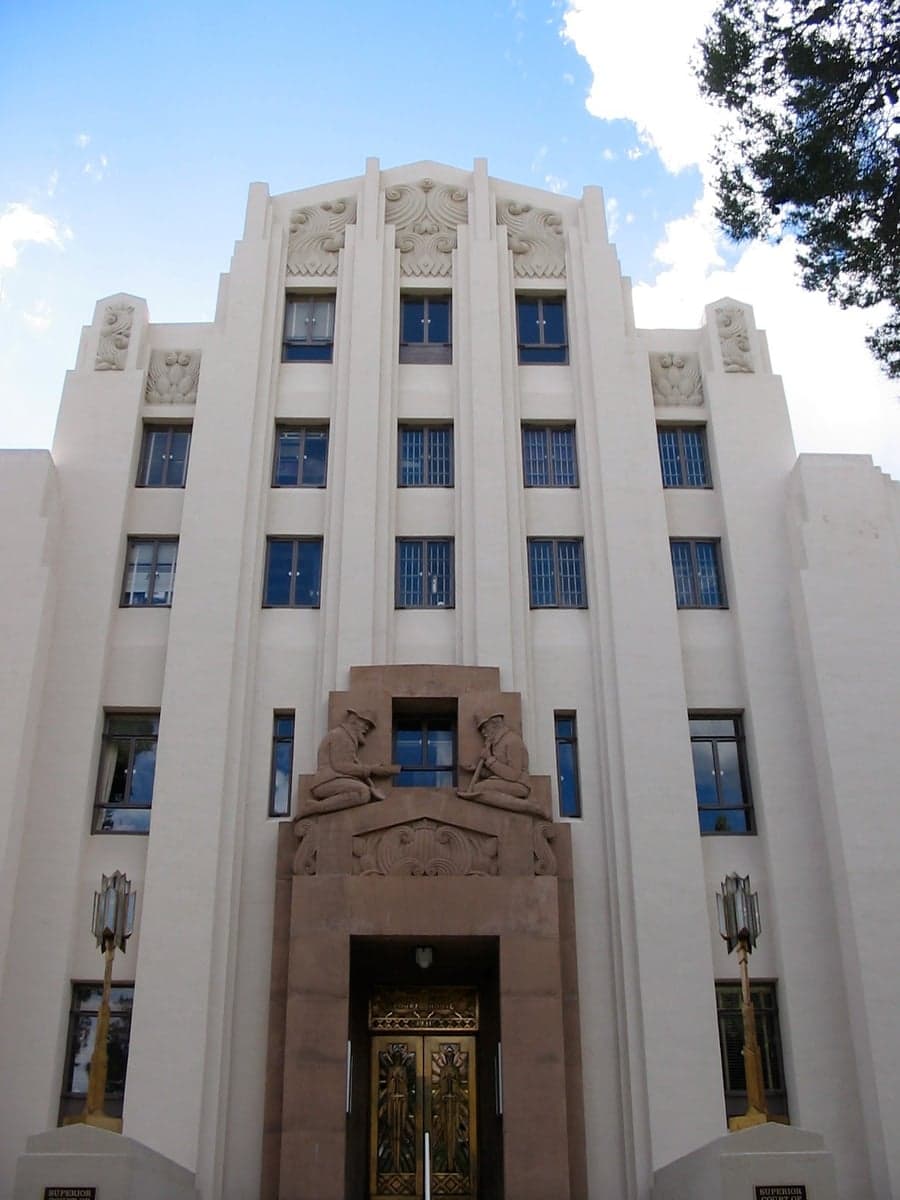
Photo: Wikipedia
Demographics of Cochise County
Affluence Level in Cochise County
A below-average socioeconomic profile. Incomes, home values, and educational attainment trail the U.S., with higher poverty and unemployment.
People of Cochise County
The people of Cochise County, Arizona, today number 125,458, forming a population that is predominantly White (54.6%) and Hispanic (34.3%), with a small but notable Black community (3.2%) and East/Southeast Asian presence (1.7%). The county’s character is defined by its borderland location, a strong military and ranching heritage, and a relatively low foreign-born share of just 4.2%. Distinctive identity markers include a deep-rooted cowboy culture centered in towns like Tombstone and Willcox, a significant retired and veteran population drawn to Sierra Vista near Fort Huachuca, and a growing but still modest college-educated cohort at 27.7%.
Settlement & growth (pre-1960)
Long before European contact, the region that is now Cochise County was home to the Chiricahua Apache, whose bands—including the Chokonen and Nednhi—controlled the mountain ranges and valleys. The Spanish arrived in the 16th century, but permanent colonization was sparse; the area remained a remote frontier of New Spain. After the Mexican-American War (1846–1848) and the Gadsden Purchase (1854), the U.S. took formal control, and the first major American wave arrived in the 1870s and 1880s, drawn by the discovery of silver and copper. The boomtown of Tombstone exploded after 1877, attracting a mix of Anglo-American miners, merchants, and speculators, along with Mexican laborers who had long worked the region’s mines and ranches. The 1880s also saw the establishment of Bisbee as a copper mining powerhouse, pulling in Cornish miners, Irish immigrants, and Mexican workers, creating a multi-ethnic but heavily Anglo-dominated workforce.
The Apache Wars ended with the surrender of Geronimo in 1886, opening the land for more intensive settlement. Ranching became the backbone of the economy in towns like Willcox and Douglas, with Anglo cattlemen and Mexican vaqueros shaping the region’s cowboy identity. The railroad arrived in the 1880s, linking the county to national markets and bringing a second wave of European immigrants—Germans, Italians, and Slavs—who worked in the mines and on the railroads. By 1900, the population was roughly 60% Anglo-American, 30% Mexican-American, and 10% other European, with a tiny Black population mostly employed as servants or railroad workers.
The 1910s and 1920s saw the peak of copper production in Bisbee, which became the largest city in the county. The Bisbee Deportation of 1917, when company-backed vigilantes forcibly expelled 1,200 striking miners (mostly Mexican and European immigrants) to New Mexico, underscored the ethnic tensions of the era. The Great Depression and the decline of copper prices in the 1930s led to out-migration, but World War II revived the mines and brought a new wave of domestic migrants, including Dust Bowl refugees from Oklahoma and Texas. Fort Huachuca, established in 1877 as a frontier post, expanded massively during the war, drawing Black soldiers of the 92nd and 93rd Infantry Divisions and creating a small but lasting Black community in Sierra Vista. By 1960, the county’s population stood at about 55,000, with a demographic profile that was roughly 65% White, 30% Hispanic, and 3% Black, concentrated in Bisbee, Douglas, and Sierra Vista.
Modern era (post-1965)
The 1965 Hart-Cellar Act fundamentally reshaped U.S. immigration, but Cochise County’s location on the Mexican border meant its Hispanic population had always been a mix of long-established families and newer arrivals. Post-1965, the county saw a steady increase in Mexican immigration, both legal and undocumented, driven by agricultural labor in the Sulphur Springs Valley and service jobs in Sierra Vista and Douglas. The Hispanic share rose from about 30% in 1970 to 34.3% today, a slower growth rate than in many other Arizona border counties, reflecting the county’s relatively modest economic draw. The East/Southeast Asian population (1.7%) is a post-1965 phenomenon, largely composed of Filipino and Vietnamese families who settled near Fort Huachuca, often as military spouses or civilian contractors. The Indian subcontinent population (0.2%) is tiny and concentrated in Sierra Vista, mostly in professional roles tied to the military base.
Domestic migration has been the bigger story. The 1970s and 1980s saw a wave of retirees and veterans moving to Sierra Vista, drawn by the mild climate, low cost of living, and proximity to Fort Huachuca’s medical and recreational facilities. This influx was overwhelmingly White and middle-class, shifting the county’s center of gravity from the historic mining towns of Bisbee and Tombstone to the newer, more suburban Sierra Vista. The 1990s and 2000s brought a second wave of domestic migrants: Californians and other Sun Belt seekers fleeing high housing costs, settling in master-planned subdivisions around Sierra Vista and, to a lesser extent, in Benson and St. David. This group is more politically diverse but still leans conservative, reinforcing the county’s Republican character. The Black population (3.2%) remains concentrated in Sierra Vista, tied to the military base, with a smaller presence in Douglas and Bisbee.
Suburbanization has been uneven. Sierra Vista has grown from a small town of 10,000 in 1970 to about 45,000 today, absorbing most of the county’s new housing and retail development. Bisbee, by contrast, has become a haven for artists and retirees, with a more liberal tilt and a stable population. Douglas and Naco remain heavily Hispanic and working-class, with strong cross-border ties to Agua Prieta, Sonora. Tombstone has become a tourist town, its population barely growing but its identity as a living history museum intact. The county’s overall density remains low—about 12 people per square mile—with vast stretches of ranchland and desert between settlements.
The future
The population of Cochise County is projected to grow slowly, reaching roughly 140,000 by 2040, driven primarily by domestic in-migration of retirees and remote workers rather than by immigrant arrivals. The Hispanic share is likely to plateau or rise modestly, as Mexican immigration has slowed and younger Hispanic residents are assimilating into the broader culture, with English fluency and intermarriage rates high. The East/Southeast Asian and Indian subcontinent populations will remain small, tied to Fort Huachuca’s continued role as a military intelligence hub. The county is not tribalizing into distinct ethnic enclaves; instead, it is slowly homogenizing around a conservative, English-dominant, suburban lifestyle centered on Sierra Vista, while Bisbee retains a small liberal counterculture and Douglas remains a bilingual border town.
In-migration from California and other high-cost states is likely to continue, bringing more White retirees and some younger families, but at a pace that will not dramatically alter the county’s cultural identity. The biggest demographic wildcard is Fort Huachuca: any major base realignment could trigger out-migration of the military-affiliated population (about 15% of the county), which would disproportionately affect the Black and Asian communities. Absent that, the county will become slightly older, slightly more White, and slightly more suburban, with the Hispanic population integrating into the mainstream rather than forming a separate enclave. For a conservative-leaning mover, Cochise County offers a stable, low-density environment where the population is largely native-born, English-speaking, and culturally traditional, with the border providing a tangible sense of place rather than a source of demographic upheaval.
This is a place where the past—Apache wars, mining booms, cowboy ranching—is still visible in the landscape and the people, but the future is quietly suburban. The population is not fragmenting into ethnic clusters; it is slowly converging on a shared, conservative, military-adjacent identity. For someone moving in now, the bottom line is that Cochise County offers a predictable, slow-growing community where the demographic trends are gradual and the cultural character is resilient, anchored by the twin pillars of Fort Huachuca and the ranching heritage that still defines towns like Willcox and Tombstone.

* Values derived from national, state, county, city and local statistics and may differ in a specific area. Last updated: 2026-05-14T12:26:00.000Z
Narrative content on this page is AI-generated and may contain mistakes. Verify any details that matter before acting on them.
ReloMaps may earn a commission from affiliate links at no extra cost to you.

