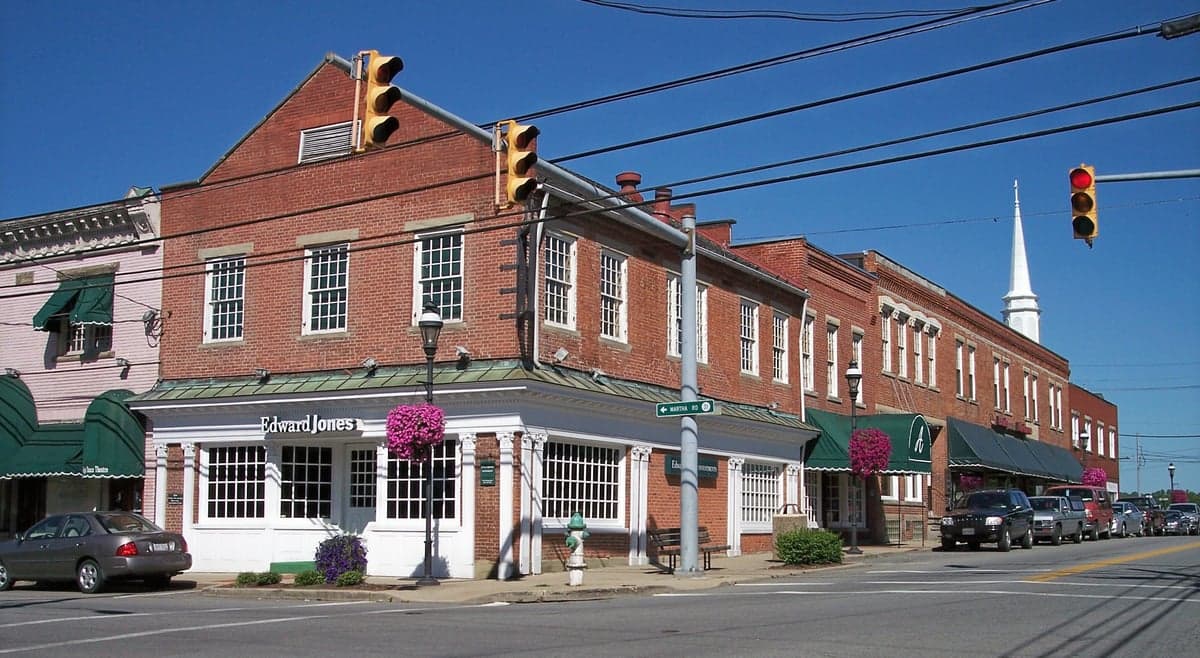
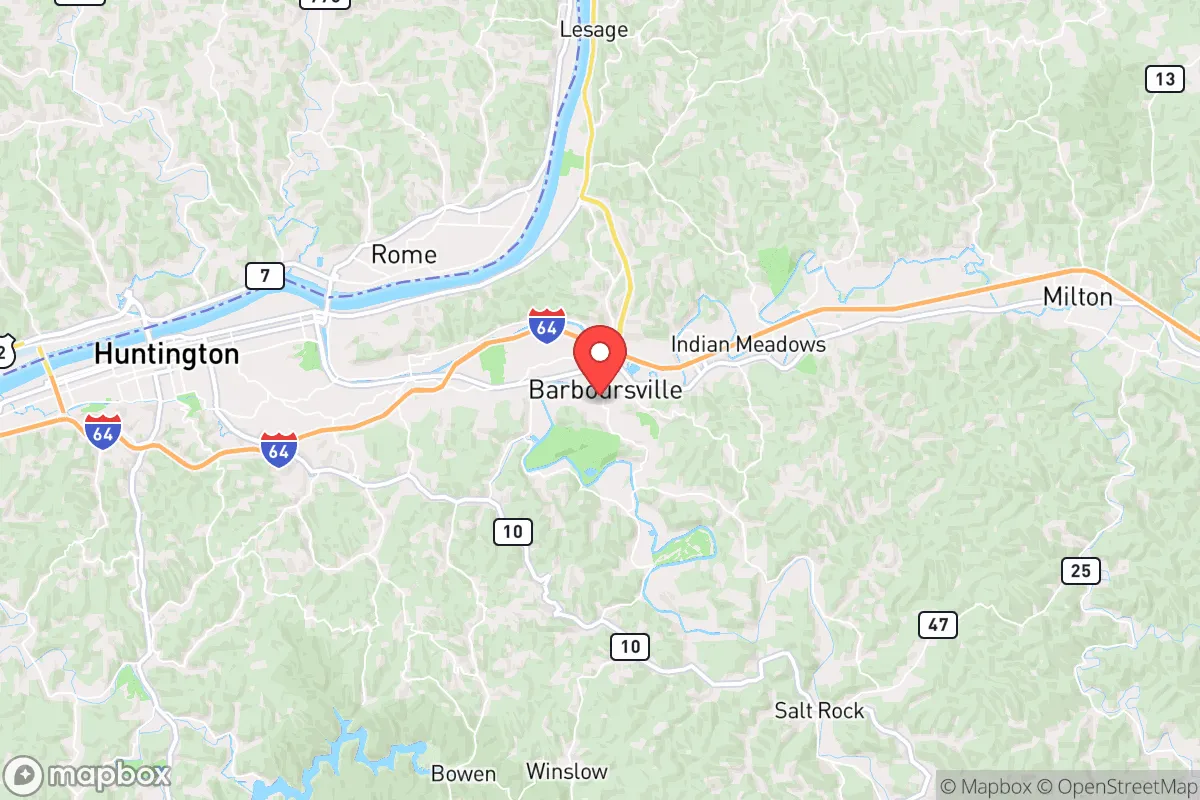
Photo: Wikipedia
Demographics of Barboursville, WV
Affluence Level in Barboursville, WV
A middle-class area roughly in line with national averages across income, home values, education, and employment.
People of Barboursville, WV
The people of Barboursville, West Virginia today number 4,394, forming a predominantly white (87.4%) community with a notable and growing Indian-subcontinent population (2.8%) that is the largest non-white group in the village. The population is relatively well-educated, with 36.7% holding a college degree, and the foreign-born share stands at 4.0%. This is a small, tight-knit village that blends Appalachian roots with a modest but distinct international presence, concentrated in specific neighborhoods that reflect the community’s layered settlement history.
How the city was settled and grew
Barboursville was founded in 1813 on land granted to early settlers along the Guyandotte River, with the original population drawn by fertile bottomlands and the promise of river trade. The village was named for Philip Barbour, a U.S. Supreme Court justice, and grew slowly as a farming and milling center through the 19th century. The arrival of the Chesapeake and Ohio Railway in the 1870s spurred a modest boom, bringing Irish and German laborers who built homes in what is now the Old Town Historic District, centered around Main Street and the village square. These immigrant workers, along with native-born Appalachian farmers, formed the core of Barboursville’s population through the early 1900s. A second wave came during the 1930s and 1940s, when the nearby Huntington shipyards and chemical plants (notably the Allied Chemical plant in South Point, Ohio) drew workers from rural West Virginia and Kentucky. These families settled in the Farm District area along Route 60, building modest single-family homes on larger lots. By 1950, Barboursville was a nearly all-white community of roughly 2,500, with a small number of Black families living in the Green Valley area near the river, a neighborhood that had been home to African American families since the late 1800s.
Modern era (post-1965)
The post-1965 period brought significant demographic change, driven by two forces: suburbanization from Huntington and the arrival of professional immigrants. The completion of Interstate 64 in the 1970s made Barboursville a commuter suburb for Huntington, attracting middle-class white families to new subdivisions like Foxfire Estates and Woodland Hills, both built on former farmland east of the village core. These neighborhoods remain predominantly white and home to many of the village’s college-educated professionals. The most striking modern shift has been the growth of the Indian-subcontinent population, which now stands at 2.8% (roughly 123 people). This community began arriving in the 1990s and 2000s, drawn by professional opportunities at Marshall University in nearby Huntington and at the St. Mary’s Medical Center and Cabell Huntington Hospital. Indian families have concentrated in the Huntington Road Corridor (Route 60 east), where newer apartment complexes and townhomes offer affordable entry points, and in the Merritt Creek area, a subdivision of larger homes built in the 2000s. The East/Southeast Asian population (1.6%) is smaller and more dispersed, with families often living in the same Huntington Road corridor. The Black population (4.0%) remains concentrated in the historic Green Valley neighborhood and in scattered rental properties near the village center. The Hispanic population (3.5%) is the most geographically diffuse, with families living in both the Farm District and in newer apartments along Route 60.
The future
Barboursville’s population is likely to continue its slow growth, driven by suburban infill and the expansion of the Indian-subcontinent community, which is the fastest-growing non-white group. The village is not homogenizing into a single demographic bloc; instead, it is tribalizing into distinct enclaves. The white population, while still the overwhelming majority, is aging, with many younger adults moving to larger cities for work. The Indian community is younger and more family-oriented, and its growth is likely to continue as professionals are recruited to the region’s healthcare and education sectors. The East/Southeast Asian and Hispanic populations are plateauing, with little new immigration to the area. The Black population is stable but aging, with younger Black families often moving to Huntington or Columbus. Over the next 10-20 years, Barboursville will likely become slightly more diverse, with the Indian share potentially reaching 4-5%, but the village will remain a predominantly white, conservative-leaning community. The key demographic story is the emergence of a small but visible Indian professional class, which is reshaping the village’s identity from a purely Appalachian suburb to a more cosmopolitan, if still small, place.
For someone moving in now, Barboursville offers a stable, low-crime environment with good schools and a strong sense of community, but with a growing diversity that is most visible in the professional class. The village is becoming a place where old Appalachian traditions coexist with new immigrant families, particularly in the Huntington Road corridor and Merritt Creek area. It is not a melting pot, but a collection of distinct neighborhoods that reflect the layered history of who came, when, and why.

* Values derived from national, state, county, city and local statistics and may differ in a specific area. Last updated: 2026-04-23T05:46:36.000Z
Narrative content on this page is AI-generated and may contain mistakes. Verify any details that matter before acting on them.
ReloMaps may earn a commission from affiliate links at no extra cost to you.

