Photo: Wikipedia
Demographics of Basin, WY
Affluence Level in Basin, WY
A middle-class area roughly in line with national averages across income, home values, education, and employment.
People of Basin, WY
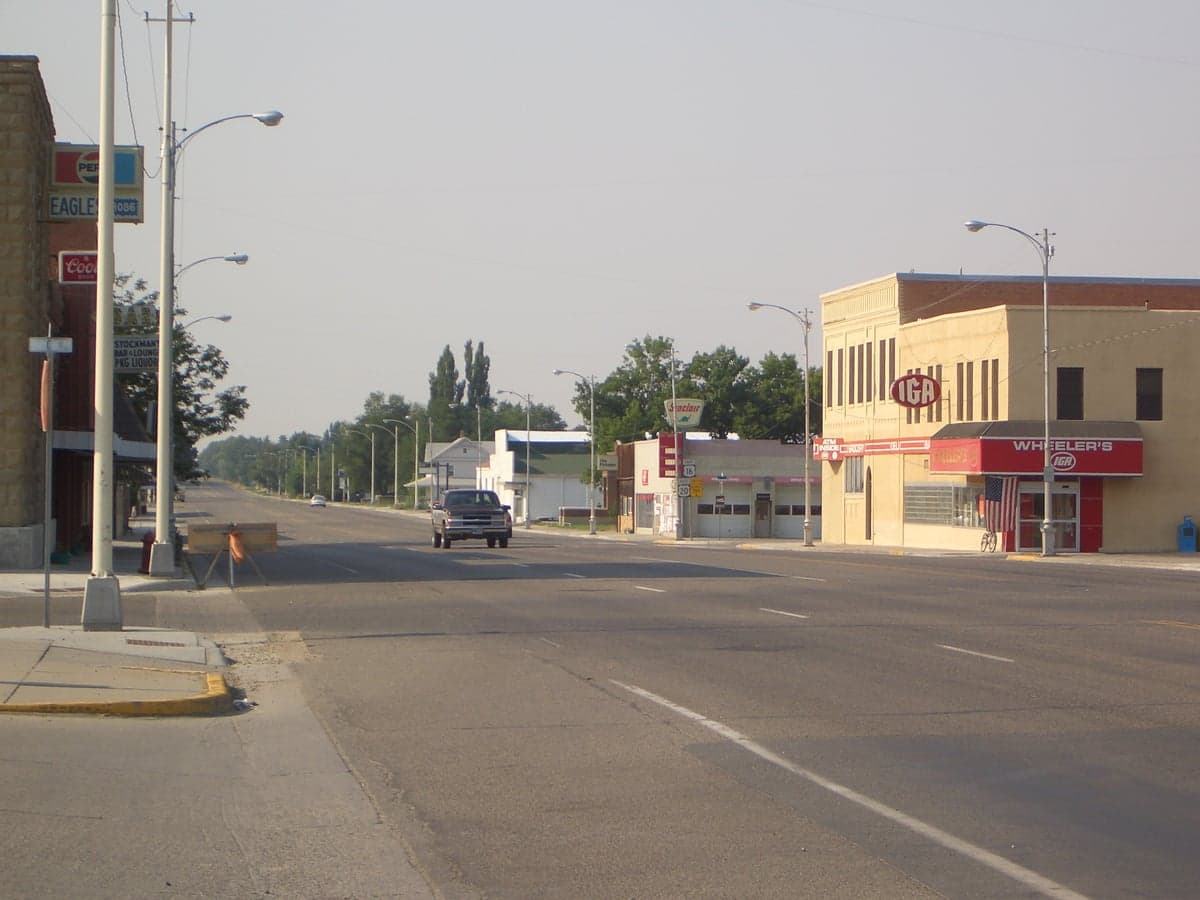
Basin, Wyoming, is a small, tight-knit community of 1,304 residents where 91.5% of the population identifies as White, and the foreign-born share is just 1.3%. The city’s character is defined by its deep agricultural roots and a quiet, self-reliant lifestyle, with a median age that skews older than the national average. Distinctive identity markers include a strong sense of local history tied to the Big Horn Basin’s irrigation projects and a population density of roughly 1,100 people per square mile, giving it a rural but not isolated feel. For those moving in, Basin offers a stable, culturally homogeneous environment where family ties and community events like the annual Basin Days remain central to daily life.
How the city was settled and grew
Basin’s human history begins with the Crow and Shoshone tribes, who used the Big Horn Basin as seasonal hunting grounds before European-American settlement. The city was formally founded in 1896 as a railroad town on the Chicago, Burlington and Quincy line, which opened the region to homesteaders. The original wave of settlers were predominantly Anglo-American farmers and ranchers drawn by the federal Carey Act of 1894, which funded irrigation canals—most notably the Hanover Canal—that transformed arid land into productive fields. These early residents built the South Side Historic District, a neighborhood of modest frame houses and brick storefronts along C Street, where many descendants of the original homesteaders still live today. By 1910, the population had reached 600, with a second wave of German and Scandinavian immigrants arriving to work the sugar beet fields and the newly opened oil fields near the Greybull River. These families settled in the North Basin Addition, an area of small cottages and truck gardens that remains a working-class enclave. The city’s growth plateaued after World War II, as the agricultural economy mechanized and younger generations began moving to larger towns like Cody or Billings for employment.
Modern era (post-1965)
After the 1965 Immigration and Nationality Act, Basin saw virtually no demographic change—the foreign-born population remains at 1.3%, and the Hispanic share is only 3.6%, with no Black, East/Southeast Asian, or Indian-subcontinent residents recorded in the most recent data. Domestic in-migration has been limited to retirees and a small number of remote workers seeking low property taxes and a slower pace, with most newcomers settling in the West Basin Ranchettes, a newer subdivision of acreage lots west of the town core. The city’s college-educated share is 21.3%, below the national average, reflecting a workforce concentrated in agriculture, oil-field services, and local government. The East Basin Industrial Corridor along Highway 20, home to a few light manufacturing and trucking firms, has absorbed some younger families, but the overall population has declined slightly from 1,350 in 2000 to 1,304 today. There are no distinct ethnic enclaves; the city remains overwhelmingly White and native-born, with assimilation not a factor given the lack of immigrant communities.
The future
Basin’s population is likely to continue a slow decline or stagnation over the next 10–20 years, as the aging demographic—many residents are over 55—and limited job growth discourage in-migration. The city is not homogenizing further because it is already highly homogeneous; it is instead tribalizing along economic lines, with the South Side Historic District retaining older, established families and the West Basin Ranchettes attracting newer, slightly more affluent arrivals. The Hispanic share, currently 3.6%, may grow modestly as agricultural labor needs persist, but the foreign-born rate is unlikely to rise significantly given the lack of industry or housing stock to attract immigrants. The Downtown Core around C Street, with its vacant storefronts and aging infrastructure, faces the risk of further depopulation unless local efforts to attract small businesses or telecommuters succeed. No major subdivisions or annexations are planned, and the city’s school district has seen enrollment drop by 15% since 2010.
For someone moving in now, Basin is becoming a quieter, older version of itself—a place where stability and predictability are the main draws, but where economic and demographic dynamism are absent. The city offers a low-cost, low-crime lifestyle for those who value space and tradition over diversity or career opportunity, but newcomers should expect a community that is slowly shrinking and unlikely to change its character in the coming decades.

* Values derived from national, state, county, city and local statistics and may differ in a specific area. Last updated: 2026-04-21T11:27:52.000Z
Narrative content on this page is AI-generated and may contain mistakes. Verify any details that matter before acting on them.
ReloMaps may earn a commission from affiliate links at no extra cost to you.

