Photo: Wikipedia
Demographics of Beckley, WV
Affluence Level in Beckley, WV
A low-income area with significant economic hardship. Household wealth and educational attainment are well below national averages.
People of Beckley, WV
The people of Beckley, West Virginia, today number roughly 16,977, forming a community that is predominantly white (71.4%) with a significant Black minority (15.0%) and small but growing East/Southeast Asian (2.1%) and Hispanic (2.8%) populations. The city’s character remains rooted in its Appalachian coal-mining heritage, with a lower-than-national college attainment rate (25.9%) and a very small foreign-born share (0.9%). Beckley is a place where old family ties run deep, yet the population is slowly diversifying through niche immigration and domestic in-migration, creating a quiet tension between tradition and change.
How the city was settled and grew
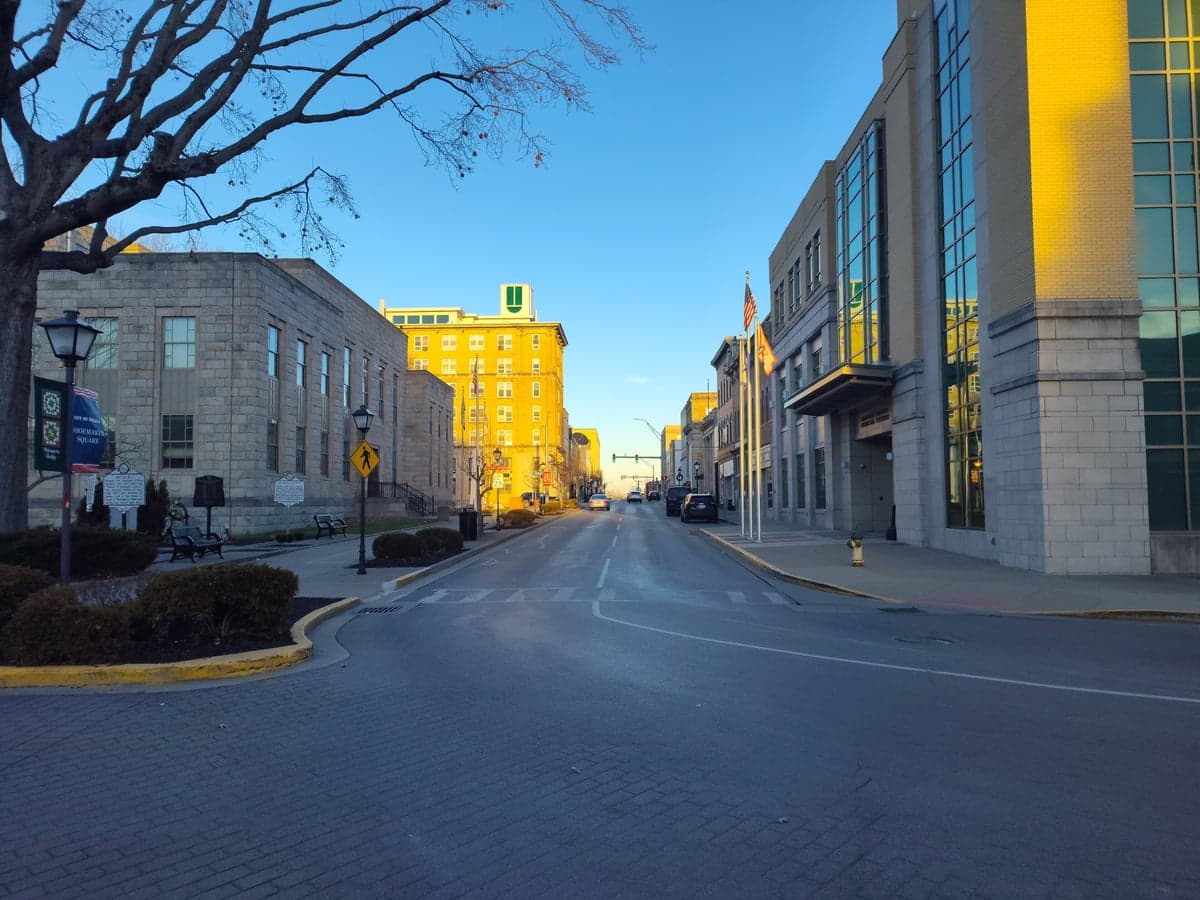
Beckley’s human history begins not with colonial settlement but with the post-Civil War coal boom. Founded in 1838 as a county seat, the city remained a tiny hamlet until the Chesapeake & Ohio Railway arrived in the 1870s, unlocking the region’s vast bituminous coal seams. The first major wave of settlers were white Appalachian farmers and laborers from surrounding counties, who built the original core around Uptown Beckley (the historic commercial district along Neville Street). By the 1890s, coal companies recruited Black miners from Virginia and the Deep South to work the mines, and these families settled in what became South Beckley and the Piney View area, establishing the city’s enduring Black community. A smaller wave of European immigrants—mostly Italian and Polish miners—arrived in the early 1900s, clustering in East Beckley near the rail yards. The population peaked around 19,000 in the 1950s, driven by wartime coal demand and the expansion of the Raleigh County seat’s administrative and retail roles.
Modern era (post-1965)
After the 1965 Hart-Cellar Act, Beckley saw minimal new immigration—the foreign-born share remains under 1%—but domestic shifts reshaped the city. The mechanization of coal mining in the 1970s and 1980s triggered a steady out-migration of younger white families to larger metros, a trend that continues today. Meanwhile, the Black population, which had been concentrated in South Beckley and Piney View, began a slow suburban spread into Harper Heights and Stanaford as housing discrimination eased. The most notable modern change is the arrival of small East/Southeast Asian and Indian-subcontinent communities, drawn by jobs at the Beckley VA Medical Center and West Virginia University’s satellite campus. These groups are tiny (2.1% East/Southeast Asian, 0.8% Indian) but visible in Uptown Beckley’s new ethnic restaurants and near the university. The Hispanic population (2.8%) grew modestly after 2000, largely through domestic migration from other U.S. states rather than direct immigration, and is dispersed across the city without a distinct enclave.
The future
Beckley’s population is slowly homogenizing in terms of race—the white share has held steady near 71% since 2010—but tribalizing by age and income. Younger, college-educated residents (25.9% of adults) are concentrating in Uptown Beckley’s revitalized lofts and near the university, while older, less-mobile populations remain in South Beckley and Piney View. The immigrant communities are plateauing: the East/Southeast Asian and Indian groups are small and stable, with little new inflow, and the Hispanic share is growing only incrementally. The biggest demographic trend is overall decline—the city lost about 5% of its population between 2010 and 2020—driven by out-migration of young adults and low birth rates. Over the next 10–20 years, Beckley will likely become older, slightly more Hispanic, and more bifurcated between a small, educated core in Uptown and a larger, older, less-mobile population in the historic neighborhoods.
For someone moving in now, Beckley offers a stable, low-cost community with deep Appalachian roots and a modest but real diversity in its Black and Asian populations. The city is not becoming a melting pot—it’s too small and too remote for that—but it is slowly shifting from a coal-dependent past to a more mixed economy anchored by healthcare and education. The neighborhoods that once defined ethnic enclaves are now more integrated, though economic divides persist. A newcomer will find a place where change comes slowly, but where the people are welcoming to those who respect the local way of life.

* Values derived from national, state, county, city and local statistics and may differ in a specific area. Last updated: 2026-05-02T06:25:53.000Z
Narrative content on this page is AI-generated and may contain mistakes. Verify any details that matter before acting on them.
ReloMaps may earn a commission from affiliate links at no extra cost to you.

