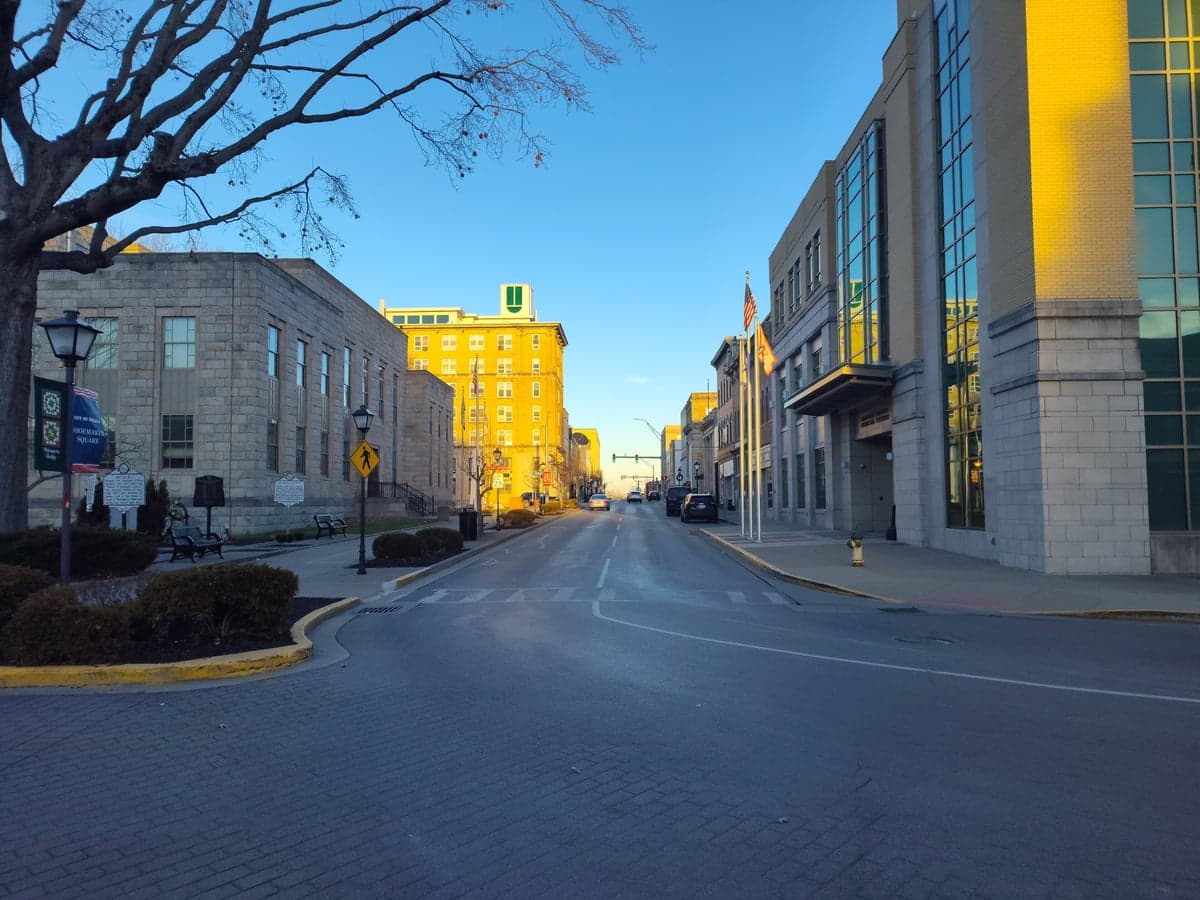
Photo: Wikipedia
Political ClimatePolitical Climate in Beckley, WV
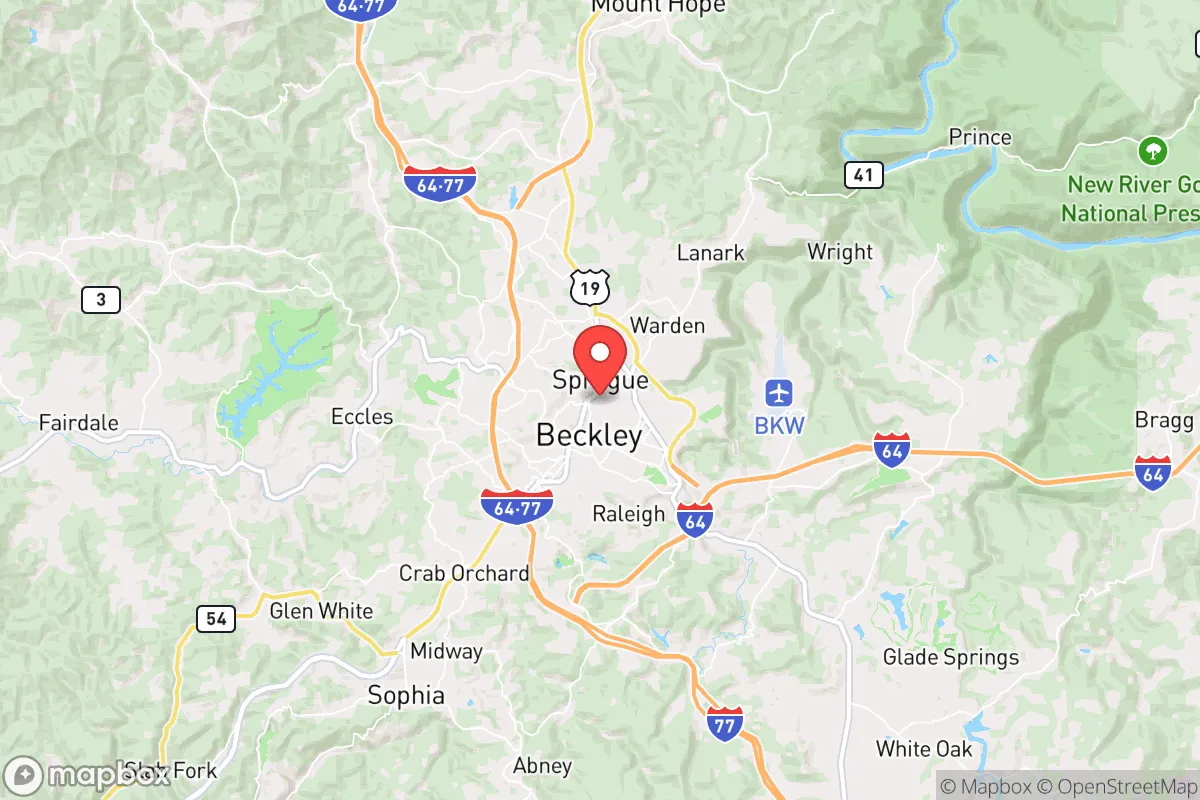
District shown is the primary district for this city’s centroid. Cities may span multiple districts.
Local Political AnalysisPolitical Analysis of Beckley, WV
Beckley leans heavily conservative, with a Cook PVI of R+22 that puts it among the most reliably Republican areas in West Virginia. That's not just a number on a map—it reflects a deep-rooted cultural and political identity that has held steady for decades, even as the rest of the country has seesawed. You won't find much appetite here for progressive experiments or top-down mandates from Charleston or Washington. The local trajectory is toward doubling down on that conservative foundation, especially as younger families move in from bluer states looking for lower taxes and fewer regulations.
How it compares
Drive thirty minutes north to Fayetteville, and you'll feel a subtle shift—more transplants, more outdoor-recreation money, and a slightly more purple vibe, especially around the New River Gorge. Head east toward Lewisburg, and you're in a similar conservative pocket, though with a stronger libertarian streak and a bigger retiree population. The real contrast is with Morgantown, three hours north, where the university pulls the politics leftward. Beckley stays closer to the coal-country heartland: think Princeton, Bluefield, and Oak Hill. Those towns share Beckley's skepticism of government overreach, whether it's gun control, energy regulations, or COVID-era business closures. The surrounding Raleigh County voted over 70% for Trump in 2020, and local elections rarely see competitive Democratic candidates.
What this means for residents
For someone living here, the political climate means a government that mostly stays out of your way. Property taxes are low, zoning is minimal, and you can run a small business or own a firearm without jumping through hoops. The downside is that public services—roads, broadband, healthcare access—can feel underfunded, because the local philosophy is "we'd rather keep our money than send it to a bureaucracy." That trade-off sits fine with most folks I know. What gets people riled up is when outside groups try to push progressive policies into local schools or county commissions. There's a strong sense that Beckley should solve its own problems, not import solutions from Portland or New York. The long-term concern is that as the coal economy shrinks, outside money and newcomers could dilute that independence. But so far, the political culture has proven stubbornly resistant to change.
One cultural distinction worth noting: Beckley has a strong Second Amendment culture that goes beyond just hunting. Open carry is common, and the local sheriff's office is openly pro-gun. There's also a palpable distrust of federal land management—the nearby New River Gorge National Park designation in 2020 was met with mixed feelings, with many worried about federal overreach into private property rights. On social issues, the area is traditional: church attendance is high, and LGBTQ+ rights debates are largely settled in favor of religious liberty. If you're looking for a place where the government respects your personal freedoms and doesn't treat every local issue as a chance to experiment with progressive ideology, Beckley fits the bill. It's not perfect, but it's honest, and that counts for a lot around here.

State Political ClimatePolitical Climate in West Virginia
State Political AnalysisPolitical Environment in the State
West Virginia is one of the most reliably Republican states in the nation, with a partisan lean of roughly +39 points for the GOP in the 2024 presidential election, making it the reddest state in the country by that measure. The dominant coalition is a mix of rural, working-class voters who have shifted sharply away from the Democratic Party over the past two decades, driven by cultural and economic grievances. Over the last 10-20 years, the state has undergone a complete political realignment: in 2000, it was a swing state that voted for George W. Bush, but by 2016 it had become a Trump stronghold, with every county flipping red by 2020. This trajectory reflects a deep distrust of national Democratic policies on energy, gun rights, and social issues, and the state’s politics now feel like a fortress of conservative values in a rapidly changing country.
Urban vs. rural divide
The political map of West Virginia is starkly divided between a few small urban centers and the vast, deeply red rural countryside. The only significant blue-leaning area is Morgantown, home to West Virginia University, where Monongalia County voted for Joe Biden in 2020 by a narrow margin, driven by the academic and younger population. Charleston, the state capital, is a purple-ish island in Kanawha County, which has trended red but still shows some Democratic resistance due to union ties and state government employees. Huntington in Cabell County is reliably red now, reflecting the broader Appalachian shift. The real story is in the rural counties: places like Mingo, Logan, and McDowell in the southern coalfields vote Republican by margins of 70-80%, a dramatic flip from their union-Democrat past. The Eastern Panhandle counties like Berkeley and Jefferson are more competitive due to commuters from the D.C. area, but they still lean red overall. For a conservative moving in, the rural areas feel like a safe haven, while Morgantown is the only place where you’ll encounter visible progressive activism.
Policy environment
West Virginia’s policy environment is aggressively conservative, with a focus on low taxes, deregulation, and cultural traditionalism. The state has no personal income tax on Social Security benefits and has been phasing down its personal income tax rate—currently at 3.99% for most brackets, with a goal of elimination by 2026 under Governor Jim Justice’s tax reform plan. Property taxes are among the lowest in the nation, capped by the state constitution at 1.5% of assessed value for residential property. Regulatory posture is business-friendly, especially for energy extraction, with the state actively courting natural gas and coal industries. Education policy includes a robust school choice program: the Hope Scholarship, enacted in 2021, provides state funding for private school tuition or homeschooling expenses, a major win for parental rights. Healthcare is a mixed bag—the state expanded Medicaid under the Affordable Care Act in 2014, but there’s no state-level push for further government control. Election laws are solid: voter ID is required, early voting is available, and there’s no widespread mail-in ballot expansion, which keeps election integrity concerns low. For a conservative, this is a state that respects local control and limits government overreach in daily life.
Trajectory & freedom
West Virginia is becoming more free in many respects, especially on gun rights and parental autonomy. In 2023, the state passed constitutional carry, allowing permitless concealed carry for adults 21 and over, a clear expansion of Second Amendment rights. The same year, the legislature passed the Parental Bill of Rights, which requires schools to notify parents about curriculum changes and medical services, and bans instruction on gender identity and sexual orientation in elementary grades—a direct response to progressive overreach in other states. On medical autonomy, the state has a strong religious exemption for vaccine mandates and banned COVID-19 vaccine passports in 2021. Property rights are well-protected, with no state-level rent control and limited eminent domain abuse. However, there are concerns: the state’s heavy reliance on federal funding (over 40% of its budget) creates a dependency that could limit future freedom if Washington tightens strings. Also, the state’s opioid crisis has led to some government intervention in healthcare that feels paternalistic. Overall, the trajectory is toward more personal liberty, especially for families and gun owners, but the economic freedom is constrained by federal ties.
Civil unrest & political movements
Civil unrest in West Virginia is minimal compared to larger states, but there are notable flashpoints. The 2018 teachers’ strike was a major event, shutting down schools across the state for nine days over pay and benefits—this was a rare moment of cross-party labor activism, but it didn’t translate into lasting progressive power. More recently, the state has seen organized conservative movements, particularly around election integrity and parental rights. In 2020, there were protests in Charleston against COVID-19 lockdowns, with groups like “Reopen WV” drawing thousands. Immigration politics are largely absent, as the state has a tiny foreign-born population (about 1.5%), so there’s no sanctuary city debate. There’s been some secessionist rhetoric in the Eastern Panhandle, where residents have floated the idea of joining Virginia due to cultural differences with the rest of the state, but it’s fringe. The most visible political movement is the Moms for Liberty chapter in Berkeley County, which has been active in school board meetings over curriculum transparency. For a new resident, you’ll see more pro-Trump flags than protest signs, and the political climate feels stable, not volatile.
Projection
Over the next 5-10 years, West Virginia will likely become even more conservative, driven by demographic trends and in-migration patterns. The state is losing population overall (down about 3% since 2020), but the people leaving are often younger and more liberal, while those moving in—especially retirees and remote workers from the D.C. area—tend to be conservative or libertarian. The Eastern Panhandle will see the most growth, potentially shifting its politics slightly toward the center as more ex-urban professionals arrive, but the rural core will remain deeply red. The state’s tax reforms will likely continue, with the income tax fully phased out by 2028, making it even more attractive for conservatives fleeing high-tax states like New York and California. However, the opioid crisis and economic stagnation in the southern coalfields will keep poverty high, which could fuel populist anger against both parties. Expect more legislation on school choice, gun rights, and parental control, but also potential friction with federal mandates on environmental regulations for coal and gas. For someone moving in now, expect a state that feels like a conservative stronghold for at least another decade, with no real risk of flipping blue.
For a conservative individual or family, West Virginia offers a rare combination of low taxes, strong gun rights, parental control in education, and a cultural environment that respects traditional values. The political climate is stable and aligned with your priorities, with the only caution being the state’s economic dependence on federal money and the lingering effects of the opioid crisis. If you’re looking for a place where government stays out of your life and your kids’ education, this is one of the best bets in the country. Just be prepared for a slower pace and a population that’s aging, but the freedom you gain is worth the trade-off.
* Values derived from national, state, county, city and local statistics and may differ in a specific area. Last updated: 2026-05-02T06:25:53.000Z
Narrative content on this page is AI-generated and may contain mistakes. Verify any details that matter before acting on them.
ReloMaps may earn a commission from affiliate links at no extra cost to you.

