Photo: Wikipedia
Demographics of Belfast, ME
Affluence Level in Belfast, ME
A middle-class area roughly in line with national averages across income, home values, education, and employment.
People of Belfast, ME
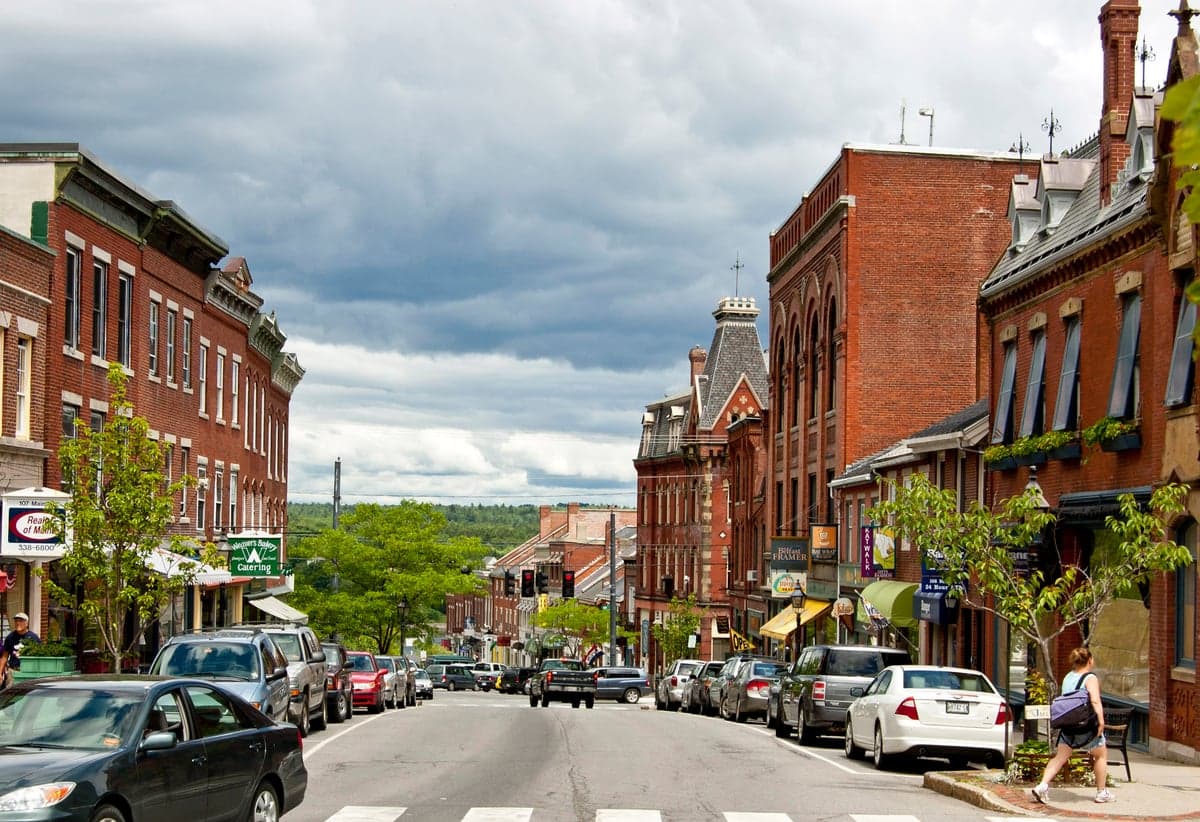
The people of Belfast, Maine today number roughly 6,985, forming a predominantly white (87.5%) and highly educated (48.2% college-educated) community that blends historic Yankee stock with a notable influx of out-of-state retirees and remote workers. The city is denser than much of Waldo County, with a walkable downtown core and a distinctive character shaped by its working waterfront, arts scene, and a growing population of conservative-leaning families seeking a quieter, safer lifestyle. Foreign-born residents make up just 2.8% of the population, and the city remains one of the least ethnically diverse in coastal Maine, with small Hispanic (1.4%), Black (1.2%), East/Southeast Asian (0.3%), and Indian-subcontinent (0.1%) communities.
How the city was settled and grew
Belfast was settled in 1770 by European colonists, primarily of English and Scots-Irish descent, who were drawn by land grants from the Plymouth Company and the promise of a deep-water harbor on Penobscot Bay. The original settlement clustered around the waterfront in what is now the Historic District, where shipbuilding and maritime trade drove early growth. By the mid-19th century, Belfast became a major shipbuilding center, attracting skilled craftsmen and laborers from coastal New England and the Maritime provinces of Canada. The High Street corridor and Church Street neighborhoods were built by these shipwrights and merchant families, with many of their Greek Revival and Federal-style homes still standing. A smaller wave of Irish immigrants arrived during the 1840s famine, settling in the Front Street area near the waterfront, where they worked as dockhands and mill laborers. The city’s population peaked around 5,200 in 1900, then declined as shipbuilding gave way to poultry processing and light manufacturing through the mid-20th century.
Modern era (post-1965)
After the 1965 Hart-Cellar Act, Belfast saw negligible immigration from abroad, consistent with its current 2.8% foreign-born share. Instead, the city’s modern demographic story is one of domestic in-migration. Beginning in the 1970s, a wave of back-to-the-land homesteaders and artists from urban centers like Boston and New York settled in the East Belfast and Belfast Heights neighborhoods, drawn by cheap property and a rural coastal lifestyle. This influx accelerated after 2000, as remote work and retirement migration brought more affluent, often conservative-leaning families from southern New England and the Mid-Atlantic. The Northport Avenue corridor and Coastal Ridge subdivisions have absorbed much of this growth, with new single-family homes and townhouses catering to families seeking lower taxes and better schools than in southern Maine. The city’s racial composition has remained overwhelmingly white, with the small Hispanic and Black populations concentrated in the downtown rental stock near Main Street, while East/Southeast Asian and Indian-subcontinent residents are scattered across the city, often in professional roles tied to the nearby University of Maine or regional hospitals.
The future
Belfast’s population is projected to grow modestly, driven by continued domestic in-migration of retirees and remote workers rather than international immigration. The city is likely to remain overwhelmingly white and highly educated, with the foreign-born share staying below 5% for the foreseeable future. The small Hispanic and Black communities may grow slowly through natural increase and limited service-sector migration, but they are not expected to form distinct ethnic enclaves. Instead, the city is homogenizing around a demographic profile of older, affluent, and politically moderate-to-conservative residents, with younger families priced out of the historic downtown and settling in the Belfast Heights and Coastal Ridge subdivisions. The next 10-20 years will likely see Belfast become more economically stratified—wealthy newcomers in the hills and waterfront, and a smaller, older working-class population in the downtown rental stock—but not more racially diverse.
For someone moving in now, Belfast is becoming a stable, predominantly white, and increasingly affluent coastal town where conservative values and a high quality of life attract families and retirees from away. The city offers a safe, walkable downtown and strong schools, but newcomers should expect limited racial diversity and a population that skews older and wealthier than the national average.

* Values derived from national, state, county, city and local statistics and may differ in a specific area. Last updated: 2026-04-22T22:11:04.000Z
Narrative content on this page is AI-generated and may contain mistakes. Verify any details that matter before acting on them.
ReloMaps may earn a commission from affiliate links at no extra cost to you.

