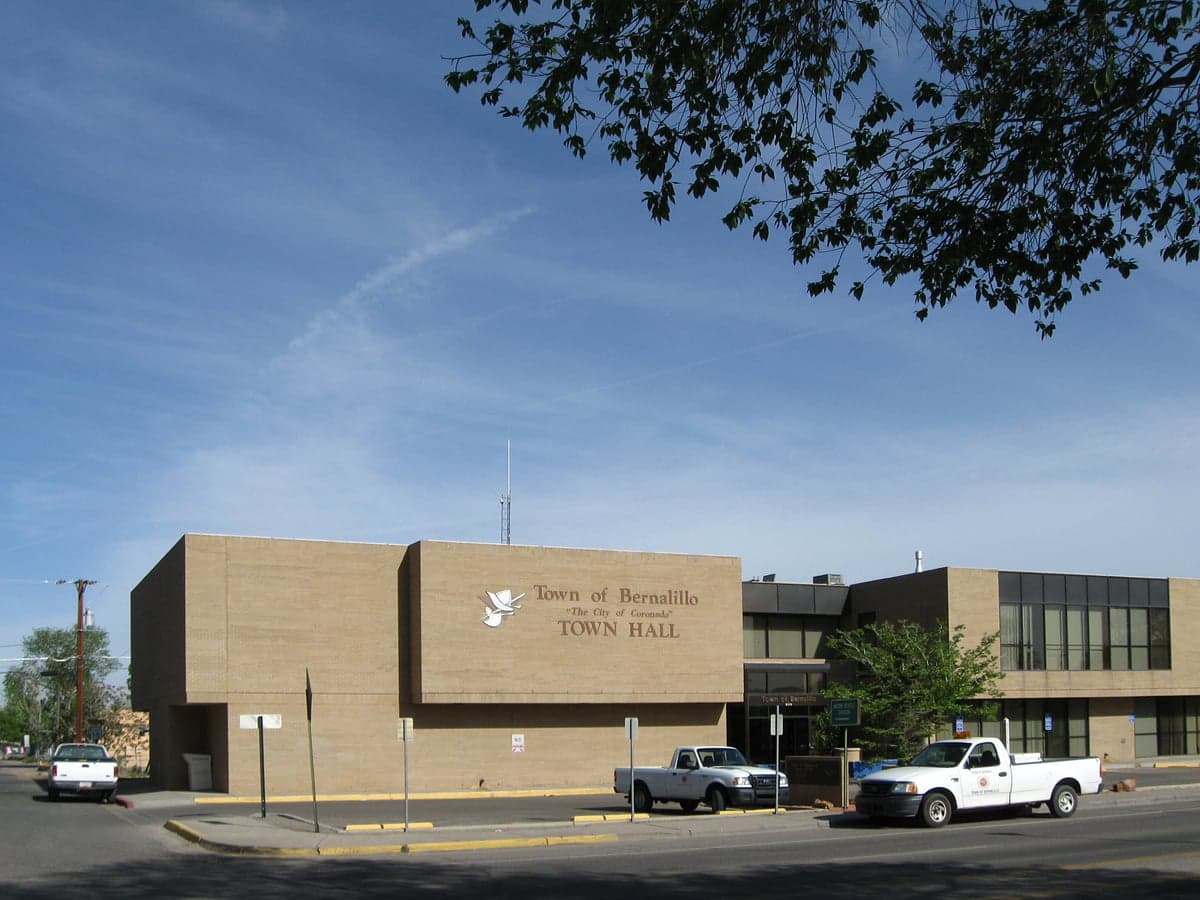
Photo: Wikipedia
Demographics of Bernalillo, NM
Affluence Level in Bernalillo, NM
A middle-class area roughly in line with national averages across income, home values, education, and employment.
People of Bernalillo, NM
The people of Bernalillo, New Mexico, today number 9,068, forming a community that is overwhelmingly Hispanic (66.2%) with a significant White minority (27.8%). The city is characterized by its deep-rooted Hispano heritage, a legacy of Spanish and Mexican land grants, and a small but notable foreign-born population of 7.9%. With a college attainment rate of 24.0%, Bernalillo is a working-class town with a distinct cultural identity, where the old and new Southwest meet along the Rio Grande.
How the city was settled and grew
Bernalillo’s population history begins not with Anglo settlers but with Spanish colonists and their descendants. The area was part of the original 1692 Spanish land grant system, with the town itself founded around 1695. The original settlers were Spanish soldiers and their families, who established a farming and ranching community along the Rio Grande. The historic Old Town Bernalillo district, centered around the San Felipe de Neri Church (though the current church is in Old Town, the original settlement was nearby), was the core of this early Hispano settlement. These families, known as Hispanos, held large land grants and formed the backbone of the population for over two centuries. The arrival of the railroad in the 1880s brought a small wave of Anglo merchants and railroad workers, who settled in the Railroad District near the depot, but the Hispano population remained dominant. The mid-20th century saw a modest influx of Anglo families drawn by government jobs in nearby Albuquerque and the Sandia National Laboratories, settling in newer subdivisions like Sandia Vista.
Modern era (post-1965)
After the 1965 Immigration and Nationality Act, Bernalillo did not experience the large-scale immigration from Asia or Latin America seen in many other U.S. cities. The foreign-born population today is only 7.9%, and the city's demographic story is primarily one of domestic migration and natural increase. The Hispanic population, already the majority, has remained stable or grown slightly through higher birth rates and continued in-migration from other parts of New Mexico. The White population, which includes both long-time Anglo families and newer retirees, has seen a relative decline as a share of the total. The Placitas area, a census-designated place just north of Bernalillo, has attracted a more affluent, often White, population seeking scenic views and larger lots, but this is outside the city limits. Within Bernalillo, the Sun Ranch subdivision, developed in the 2000s, has drawn a mix of Hispanic and White families, while the Historic District remains predominantly Hispano. The East/Southeast Asian population is negligible at 0.1%, and the Indian subcontinent population is 0.0%, reflecting no significant immigration from those regions. The Black population is also minimal at 0.4%.
The future
Bernalillo’s population is likely to remain predominantly Hispanic, with a gradual increase in the White share as Albuquerque’s suburban sprawl pushes northward. The city is not homogenizing into a single cultural bloc; rather, it is seeing a subtle tribalization along geographic and economic lines. The Historic District and older neighborhoods near the river will likely retain their strong Hispano character, while newer subdivisions like Sun Ranch and Sandia Vista will become more mixed, attracting both Hispanic families moving up the economic ladder and White families seeking more affordable housing than Albuquerque offers. The foreign-born population is expected to remain small, as Bernalillo lacks the industrial or agricultural jobs that draw large immigrant communities. The college attainment rate, currently below the national average, may rise slowly as more residents commute to professional jobs in Albuquerque, but the city will likely remain a working-class bedroom community. The next 10-20 years will see steady, modest growth, with the population becoming slightly more diverse in terms of income and background, but the core Hispano identity will persist.
For someone moving in now, Bernalillo offers a community where deep historical roots are still visible in the population’s composition and daily life. It is a place where the Hispano culture is not a minority experience but the mainstream, and where newcomers, whether from elsewhere in New Mexico or from out of state, will find a town that is both traditional and slowly modernizing. The demographic trajectory points toward a stable, family-oriented community with a strong sense of place, rather than a rapidly changing or diversifying one.

* Values derived from national, state, county, city and local statistics and may differ in a specific area. Last updated: 2026-05-01T09:11:52.000Z
Narrative content on this page is AI-generated and may contain mistakes. Verify any details that matter before acting on them.
ReloMaps may earn a commission from affiliate links at no extra cost to you.

