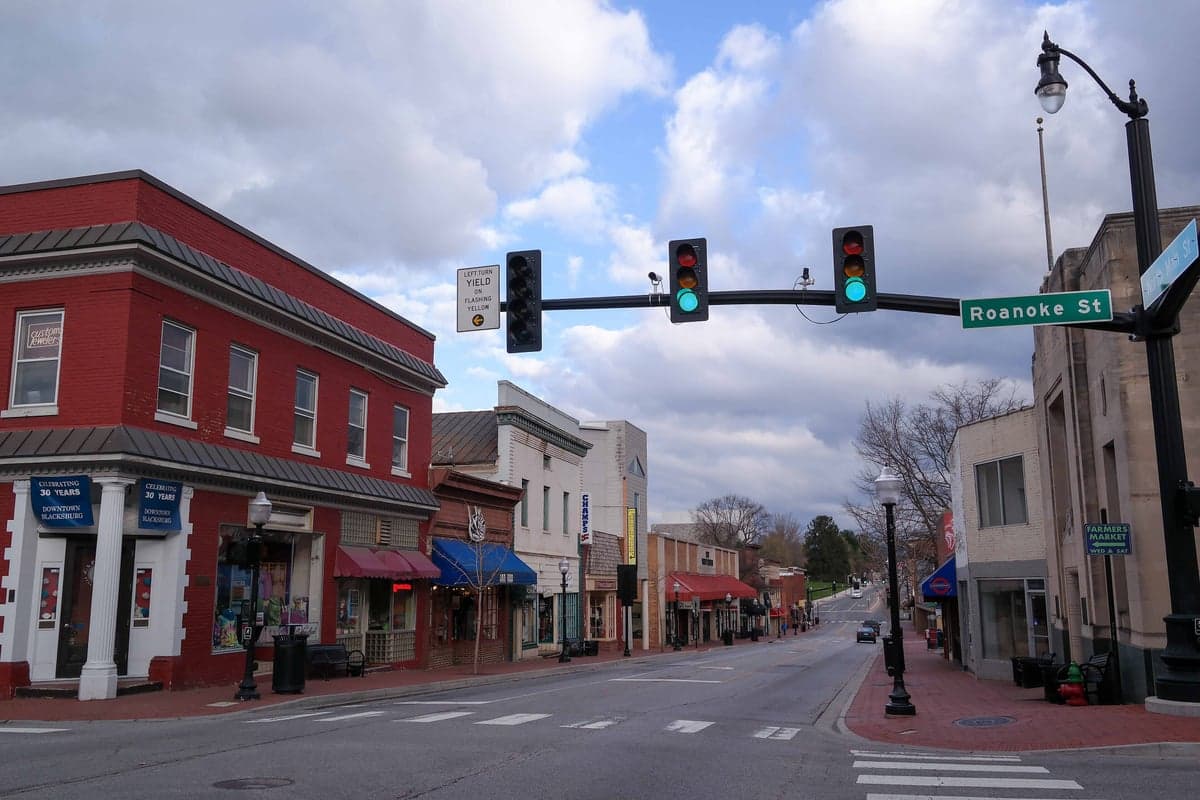
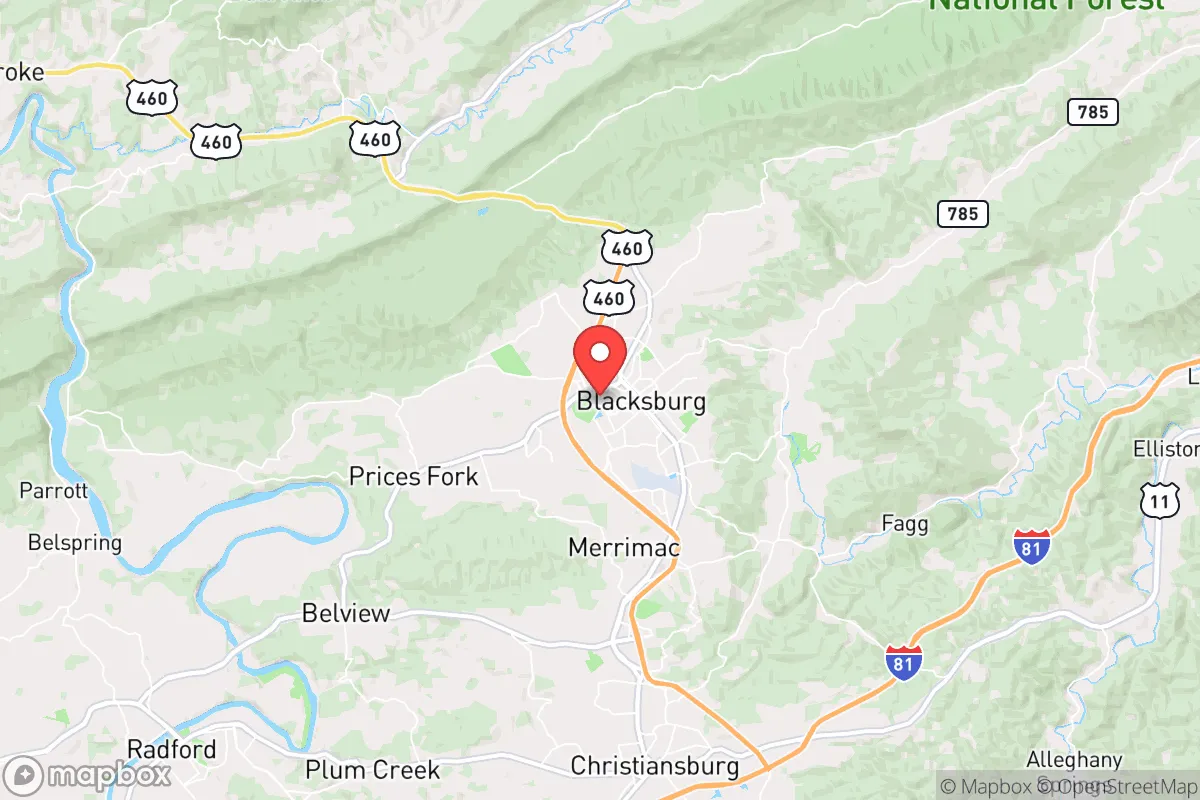
Photo: Wikipedia
Demographics of Blacksburg, VA
Affluence Level in Blacksburg, VA
A middle-class area roughly in line with national averages across income, home values, education, and employment.
People of Blacksburg, VA
Blacksburg, Virginia, is a college town of 45,288 residents defined by its high educational attainment—69.7% hold a bachelor’s degree or higher—and a population that is predominantly white (75.6%) but with notable Asian and Indian professional enclaves tied to Virginia Tech. The city’s character is shaped by a transient student body and a stable core of university faculty, researchers, and tech-sector workers, giving it a dense, educated, and politically moderate-to-liberal atmosphere that contrasts with the surrounding rural counties. Distinctive identity markers include a strong outdoor recreation culture, a downtown centered on College Avenue, and a housing market heavily influenced by the academic calendar.
How the city was settled and grew
Blacksburg was founded in 1798 on land granted to William Black, a Scots-Irish settler, and remained a small agricultural hamlet through the 19th century. The arrival of the Virginia Agricultural and Mechanical College (now Virginia Tech) in 1872 transformed the town’s population, drawing faculty and students from across the Appalachian region and the broader South. The original settlers were predominantly of English, Scots-Irish, and German descent, and their descendants concentrated in the Old Town neighborhood, where 19th-century farmhouses and early 20th-century bungalows still line the streets. A second wave of growth came with the post-World War II GI Bill, which swelled Virginia Tech’s enrollment and brought a new cohort of middle-class students and faculty to neighborhoods like University Terrace and Hethwood, built in the 1950s and 1960s to accommodate the boom. These areas remain stable, family-oriented enclaves with a mix of long-term residents and university-affiliated renters.
Modern era (post-1965)
The 1965 Immigration and Nationality Act opened the door for a significant influx of international students and professionals, reshaping Blacksburg’s demographic profile. Virginia Tech’s engineering and computer science programs attracted a wave of East/Southeast Asian students and faculty—primarily from China, South Korea, and Taiwan—who settled in the Foxridge apartment complex and the Chasewood Downs area, both of which became hubs for Asian graduate students and their families. By 2024, East/Southeast Asians made up 7.7% of the city’s population, with many graduates staying on as tech workers at the university or at nearby firms like Moog and Torc Robotics. A separate Indian-subcontinent community (3.1% of the population) grew rapidly after 2000, driven by Virginia Tech’s strong computer science and business programs; these families concentrated in newer subdivisions like Smiths Landing and Tom’s Creek Village, where single-family homes and townhouses cater to dual-income professional households. The Hispanic population (4.5%) and Black population (4.3%) are smaller but have grown steadily since the 1990s, with Hispanic residents often working in construction, hospitality, and landscaping, and Black residents concentrated in the North Main Street corridor and near the university’s administrative offices. The foreign-born share now stands at 9.4%, nearly double the 2000 level, reflecting Blacksburg’s role as a regional magnet for skilled immigrants.
The future
Blacksburg’s population is trending toward greater ethnic diversity, but the growth is uneven and largely driven by university recruitment. The East/Southeast Asian and Indian communities are expected to continue expanding as Virginia Tech invests in STEM fields and international partnerships, with new arrivals likely to settle in the Prices Fork Road corridor, where apartment complexes and townhome developments are being built to meet demand. The white population, while still the majority, is aging and slowly declining in share as younger, more diverse cohorts replace retirees. The city is not tribalizing into hostile enclaves—neighborhoods like Foxridge and Smiths Landing are integrated by income and education level—but distinct cultural clusters persist around specific apartment complexes and subdivisions. The Hispanic and Black populations are growing more slowly, constrained by housing costs and limited economic mobility outside the university orbit. Over the next 10–20 years, Blacksburg will likely become more Asian and Indian, more transient, and more expensive, with the university’s gravitational pull continuing to define who moves in and who leaves.
For a conservative-leaning individual or family considering a move, Blacksburg is a place where high educational attainment and a university-driven economy create a stable, safe environment, but where the cultural and political tenor is distinctly academic and left-leaning. The population is becoming more diverse and more professional, with strong Asian and Indian communities anchored by the university, while the surrounding rural areas remain overwhelmingly white and conservative. The city offers excellent schools, low crime, and a tight-knit feel, but newcomers should expect a community that values education, environmentalism, and progressive politics—a trade-off that suits those who prioritize intellectual and economic opportunity over cultural homogeneity.

* Values derived from national, state, county, city and local statistics and may differ in a specific area. Last updated: 2026-05-01T04:05:30.000Z
Narrative content on this page is AI-generated and may contain mistakes. Verify any details that matter before acting on them.
ReloMaps may earn a commission from affiliate links at no extra cost to you.

