
Photo: Wikipedia
Political ClimatePolitical Climate in Blacksburg, VA
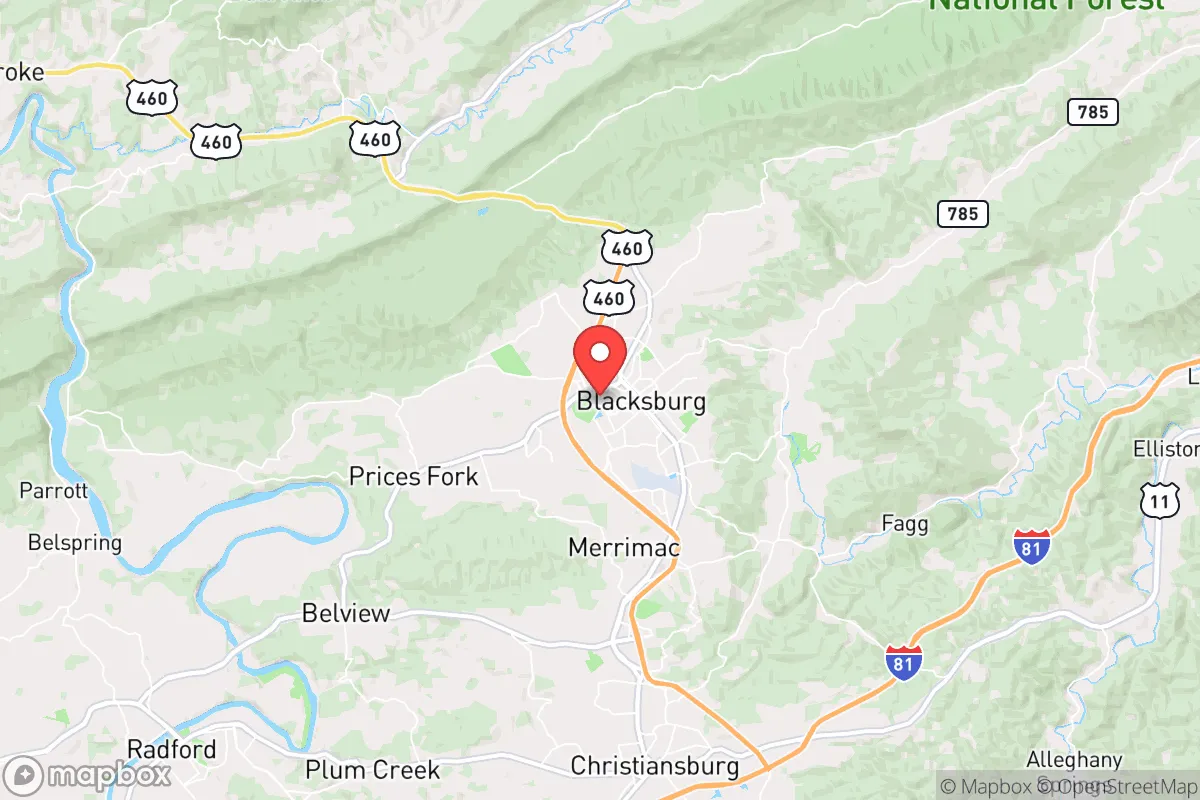
District shown is the primary district for this city’s centroid. Cities may span multiple districts.
Local Political AnalysisPolitical Analysis of Blacksburg, VA
Blacksburg, Virginia, sits in a county with a Cook PVI of R+22, meaning the area leans heavily Republican in federal elections, but don’t let that number fool you into thinking the town itself is a conservative stronghold. The reality on the ground is more complicated, shaped by the massive presence of Virginia Tech, which pulls the local culture and voting patterns noticeably leftward. Over the last decade, I’ve watched the town shift from a place where folks mostly kept their politics to themselves to one where progressive activism is increasingly visible in local government and campus life. If you’re looking at the broader Montgomery County numbers, they’ve stayed red, but the town of Blacksburg itself has been trending blue, and that trend is accelerating.
How it compares
To understand Blacksburg’s political climate, you have to look at the surrounding areas. Drive 15 minutes south to Christiansburg, and you’ll find a more traditional, conservative-leaning community where the R+22 rating actually feels accurate—churches are full, gun rights are respected, and local officials are wary of government overreach. Head east to Radford, and you get a similar story, though with a smaller university influence. The real contrast is with places like Roanoke, about 40 minutes north, which has a more mixed political scene, or Charlottesville, which is a full-on progressive bubble. In Blacksburg, the tension is between the long-time residents—farmers, retirees, small business owners who value personal freedom and limited government—and the influx of faculty, students, and tech workers who bring a more interventionist mindset. That divide shows up in everything from zoning debates to school board meetings, where you’ll hear arguments about individual property rights versus collective planning goals.
What this means for residents
For someone who values personal freedoms and wants to keep government out of their daily life, Blacksburg requires a bit of navigation. The town council has shown a willingness to push policies that feel like overreach—think mask mandates that lingered longer than neighboring counties, or discussions about restricting short-term rentals that would tell you what you can do with your own home. The school system, while solid academically, has seen curriculum debates that lean progressive, with more emphasis on social-emotional learning and diversity initiatives than on core academics. On the plus side, the R+22 countywide vote means that state-level representation remains solidly conservative, so you’re not completely boxed in. Property taxes are reasonable compared to Northern Virginia, and the gun culture here is still strong—you’ll see plenty of “Come and Take It” stickers on trucks in the Kroger parking lot. But if you’re the type who gets uneasy when the town starts talking about “equity” initiatives or “sustainability” mandates, you’ll want to keep an eye on local elections and get involved in civic groups that push back.
Culturally, Blacksburg still holds onto some of its Appalachian roots—there’s a respect for self-reliance and a wariness of outsiders telling locals how to live. The Virginia Tech influence is a double-edged sword: it brings economic stability and a vibrant community, but it also imports a lot of out-of-state attitudes that don’t always mesh with Virginia values. You’ll find a handful of churches that preach traditional values, and the local Republican committee is active, though often outspent by university-affiliated PACs. Looking ahead, I’d expect the progressive drift to continue as the university expands and more remote workers move in from blue states. The key for conservatives here is to stay engaged, because if you let the town council and school board slide too far left, you’ll wake up to policies that chip away at your freedoms one ordinance at a time.

State Political ClimatePolitical Climate in Virginia
State Political AnalysisPolitical Environment in the State
Virginia has long been a political bellwether, but over the past two decades it has shifted from a reliably purple state to a solidly blue one at the statewide level. The Democratic coalition is now dominant in presidential and Senate races, powered by the explosive growth of Northern Virginia’s tech corridor and the increasingly progressive Richmond metro. However, the state’s political soul remains deeply divided: the rural south and southwest, along with the Shenandoah Valley and parts of central Virginia, vote overwhelmingly Republican, creating a stark urban-rural chasm that defines every election cycle. For a conservative considering relocation, Virginia offers a mixed bag—low taxes and strong gun rights in many counties, but a state government that has aggressively pushed progressive policies on education, energy, and social issues since Democrats took full control in 2019.
Urban vs. rural divide
The political map of Virginia is essentially two states. The blue stronghold is the crescent from Northern Virginia through Richmond to Hampton Roads. Fairfax County alone casts more votes than many entire states, and its suburban voters—influenced by federal employment, tech jobs, and high education levels—have driven the statewide Democratic trend since 2008. Loudoun County, once a conservative bastion, flipped decisively blue in the 2010s and now sends Democrats to the General Assembly. Richmond city is deep blue, while its surrounding counties like Chesterfield and Hanover are trending purple but still lean Republican. Virginia Beach remains a swing area, but the military and defense contractor presence keeps it more conservative than the rest of Hampton Roads. In contrast, the rural Southside—counties like Pittsylvania, Halifax, and Mecklenburg—vote Republican by 60-70% margins. Roanoke and Lynchburg are conservative islands in the Blue Ridge, with Lynchburg home to Liberty University and a strong evangelical base. The Shenandoah Valley counties (Rockingham, Augusta, Shenandoah) are reliably red, driven by agriculture and a strong gun culture. The divide is so sharp that Virginia’s 5th Congressional District, which stretches from Charlottesville’s liberal precincts to the deeply red Southside, is one of the most gerrymandered and competitive seats in the nation.
Policy environment
Virginia’s tax burden is moderate compared to the Northeast, but it’s no low-tax paradise. The state income tax is a flat 5.75%, and property taxes are set locally—averaging around 0.8-1.0% of assessed value, which is reasonable. However, Northern Virginia’s high property values mean tax bills can be crushing, with a $600,000 home in Fairfax costing $6,000+ annually. Sales tax is 5.3% statewide, but localities can add up to 1% more. On regulation, Virginia is a mixed bag: it’s a right-to-work state, which keeps unions weak, but the Democratic-controlled General Assembly has passed a slew of business mandates, including a $12 minimum wage (rising to $15 by 2026) and mandatory paid sick leave for many workers. Education policy has become a flashpoint. Governor Glenn Youngkin’s 2022 executive orders on parental rights—allowing parents to opt out of mask mandates and review instructional materials—were a major win for conservatives, but the Democratic legislature blocked his efforts to expand school choice and ban critical race theory in classrooms. The state’s public schools are highly rated in wealthy suburbs but struggling in rural areas. Election laws are relatively secure: Virginia requires photo ID to vote, has no-excuse absentee voting, and offers same-day registration. However, the 2020 election saw massive mail-in ballot expansion, which many conservatives view as a vulnerability. The state also has a Democratic trifecta in the legislature as of 2024, meaning Youngkin’s veto pen is the only check on progressive legislation.
Trajectory & freedom
Virginia’s trajectory over the past five years has been concerning for conservatives. The 2020 General Assembly, under Democratic control, passed a sweeping gun control package: universal background checks, a red flag law, a one-handgun-per-month limit, and a ban on assault weapons (though the latter was later struck down by a court). Gun rights advocates have seen Virginia go from a “shall-issue” to a “may-issue” state in practice, with some localities imposing their own restrictions. On medical freedom, the state imposed strict COVID-19 mandates on state employees and schools, though Youngkin ended the school mask mandate on his first day in office. Parental rights have been a battleground: Youngkin’s executive orders were popular, but the legislature has resisted codifying them into law. On energy, Virginia passed the Virginia Clean Economy Act in 2020, mandating a 100% carbon-free grid by 2050, which has driven up electricity rates and forced the closure of coal plants. Property rights are generally strong, but localities have used zoning to block new housing, particularly in Northern Virginia. The state’s tax burden has crept upward, with the gas tax indexed to inflation and a new 1% regional tax in Northern Virginia for transit. The overall trend is toward more government control, not less, and conservatives are fighting a rear-guard action to preserve Second Amendment rights, school choice, and low taxes.
Civil unrest & political movements
Virginia has been a national flashpoint for political violence and activism. The 2017 Unite the Right rally in Charlottesville, which turned deadly, left a lasting stain and led to the removal of Confederate statues statewide. That event galvanized both the progressive left and the alt-right, and the city remains a tense symbol of racial and political division. In 2020, Richmond saw massive Black Lives Matter protests, including the toppling of a statue of Jefferson Davis on Monument Avenue. The city’s progressive city council has since removed all Confederate monuments, a move that outraged conservatives. On the right, the Virginia Citizens Defense League (VCDL) has organized massive gun rights rallies at the state capitol, including the 2020 rally that drew 22,000 people and prompted then-Governor Ralph Northam to declare a state of emergency. Immigration politics are relatively quiet compared to border states, but Fairfax County and Richmond have declared themselves “sanctuary cities”, refusing to cooperate with ICE detainers—a major concern for conservatives. Election integrity remains a hot-button issue: the 2020 election saw no major fraud, but the 2021 gubernatorial race (won by Youngkin) was marred by a last-minute ballot-counting controversy in Fairfax County that fueled distrust. The state also has a history of secessionist rhetoric, with some rural counties exploring “secession” to join West Virginia, though nothing has materialized.
Projection
Over the next 5-10 years, Virginia will likely continue its slow drift leftward, driven by demographic trends. Northern Virginia’s population is growing rapidly, fueled by tech and federal jobs, and these new residents are overwhelmingly Democratic. The rural areas are losing population, meaning their electoral weight is shrinking. By 2030, the state could be as blue as New Jersey or Maryland, with Republicans only competitive in the governor’s mansion (thanks to off-year elections) and a few swing districts. The state’s tax burden will likely increase as the Clean Economy Act’s costs hit ratepayers and the legislature eyes new revenue for education and transit. Gun rights will continue to erode, with the red flag law likely expanded and the assault weapons ban possibly revived. Parental rights will remain a battleground, but the Democratic legislature will resist codifying them. The biggest wild card is in-migration: if conservatives from blue states continue to move to Virginia’s rural areas and exurbs, they could slow the leftward trend. But the overall trajectory is clear: Virginia is becoming a state where personal freedom is increasingly constrained by government mandates, particularly on guns, energy, and education.
For a conservative moving to Virginia, the bottom line is this: choose your county carefully. If you want low taxes, strong gun rights, and a community that shares your values, look at the Shenandoah Valley, the Southside, or the Lynchburg-Roanoke corridor. Avoid Northern Virginia and Richmond city unless you’re prepared for high costs, progressive policies, and a culture that may feel alien. The state government will continue to push left, but local control still matters—and in many rural counties, you can still live a life free from the worst of it. Just don’t expect the state to have your back if the legislature comes for your rights.
* Values derived from national, state, county, city and local statistics and may differ in a specific area. Last updated: 2026-05-01T04:05:30.000Z
Narrative content on this page is AI-generated and may contain mistakes. Verify any details that matter before acting on them.
ReloMaps may earn a commission from affiliate links at no extra cost to you.

