Photo: Wikipedia
Demographics of Bladensburg, MD
Affluence Level in Bladensburg, MD
A below-average socioeconomic profile. Incomes, home values, and educational attainment trail the U.S., with higher poverty and unemployment.
People of Bladensburg, MD
Today, Bladensburg, Maryland is a densely populated, majority-minority suburb of Washington, D.C., where 57.7% of residents identify as Black or African American and 39.0% as Hispanic or Latino. With a population of 9,552 and a foreign-born share of 25.3%, the city is a classic immigrant gateway and a working-class hub defined by its proximity to the nation's capital. The population is notably young and family-oriented, though only 14.1% of adults hold a college degree, reflecting a community built around service, logistics, and trades rather than white-collar professions.
How the city was settled and grew
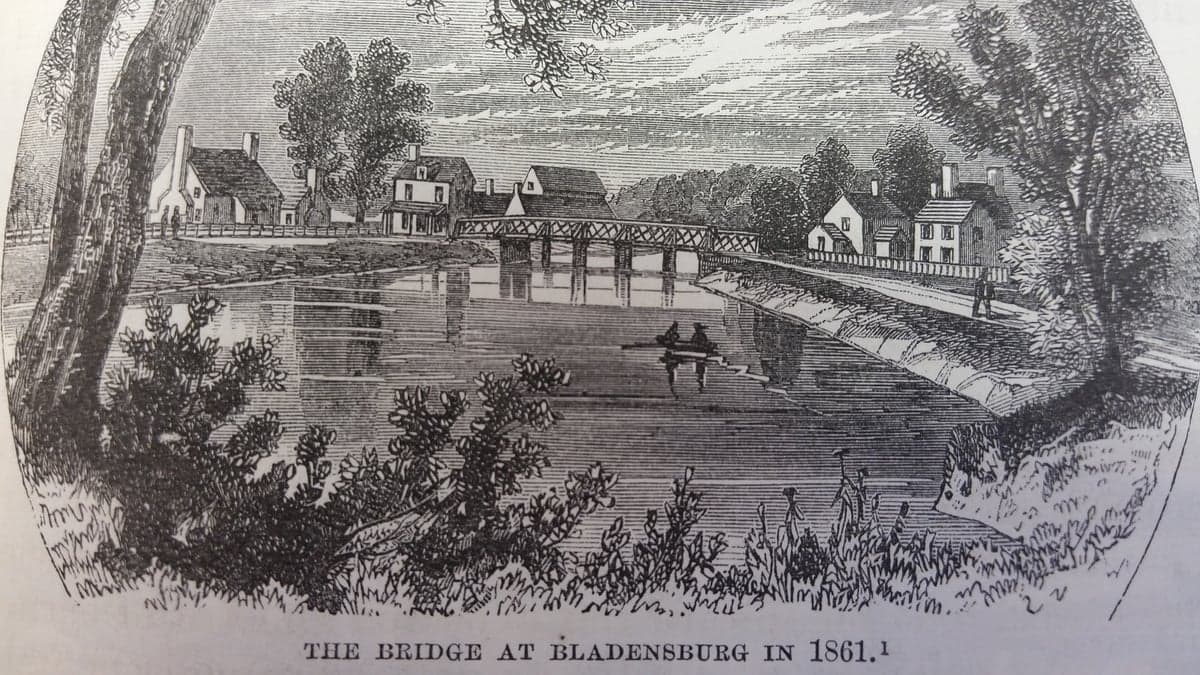
Bladensburg was founded in 1742 as a tobacco port on the Anacostia River, drawing its earliest European settlers—mostly English and Scottish merchants—who built the town around the waterfront and along what is now Annapolis Road. The original plat, laid out by Christopher Lowndes, attracted planters and traders who constructed brick homes and warehouses in the area now known as Old Town Bladensburg, a historic district that still contains 18th-century structures. Through the 19th century, the town stagnated as the port silted in, and its population remained small and overwhelmingly white until the early 1900s. The arrival of the Washington, Baltimore and Annapolis Electric Railway in the early 20th century spurred modest growth, drawing a mix of German and Irish laborers who settled in the Port Towns corridor, a cluster of working-class neighborhoods along the river that included Bladensburg, Colmar Manor, and Cottage City. By 1950, the city had fewer than 3,000 residents, nearly all white, employed in local manufacturing and the nearby Washington Navy Yard.
Modern era (post-1965)
The post-1965 era transformed Bladensburg’s population dramatically. The Hart-Celler Act of 1965 opened immigration from non-European countries, and the city’s affordable housing stock and proximity to D.C. jobs began attracting Black families fleeing segregation and later, Hispanic immigrants. The 1970s and 1980s saw a rapid white exodus, and by 1990, Bladensburg had become a predominantly Black community, with African American families concentrated in the Edmonston Heights and West Bladensburg neighborhoods, areas of modest single-family homes and garden apartments. The Hispanic share grew steadily from the 1990s onward, driven by Central American immigrants—particularly from El Salvador and Guatemala—who settled in the East Bladensburg area near the industrial corridor along Route 450. Today, the city’s foreign-born population of 25.3% is overwhelmingly Hispanic, with smaller numbers of East/Southeast Asian residents (0.6%) and virtually no Indian-subcontinent population (0.0%). The Black population, while still the largest group, has declined slightly from its peak in the 2000s as some families moved to more suburban Prince George’s County neighborhoods like Bowie or Upper Marlboro.
The future
Bladensburg’s population is trending toward a more balanced Black-Hispanic split, with the Hispanic share likely to continue rising as new immigrants arrive and birth rates remain above replacement level. The city is not homogenizing; rather, it is becoming more ethnically segmented, with Black families concentrated in the older, more established West Bladensburg and Edmonston Heights neighborhoods, while Hispanic households cluster in East Bladensburg and the Port Towns area near the Anacostia River. The Asian and Indian populations are negligible and unlikely to grow significantly given the city’s lack of high-skilled job centers or top-tier schools. Gentrification pressure from nearby Washington, D.C., and the redevelopment of the Bladensburg Waterfront park and marina may slowly attract higher-income residents, but the city’s low educational attainment (14.1% college educated) and limited housing stock suggest it will remain a working-class, immigrant-heavy suburb for the next decade. The foreign-born share may plateau as second-generation families assimilate and move outward, but continued immigration from Central America will likely sustain the Hispanic growth trajectory.
For a conservative-leaning individual or family considering a move, Bladensburg offers a dense, affordable, and ethnically vibrant community with strong ties to D.C. employment, but it is not a place of upward mobility or high educational opportunity. The city is becoming a stable, majority-minority enclave where Black and Hispanic families coexist in distinct neighborhoods, and where the next generation will likely face the same challenges of low college attainment and limited professional job access. Those seeking a quiet, suburban, or predominantly English-speaking environment should look elsewhere; those comfortable with a dynamic, working-class, immigrant gateway will find a tight-knit, affordable base near the capital.

* Values derived from national, state, county, city and local statistics and may differ in a specific area. Last updated: 2026-04-22T02:45:51.000Z
Narrative content on this page is AI-generated and may contain mistakes. Verify any details that matter before acting on them.
ReloMaps may earn a commission from affiliate links at no extra cost to you.

