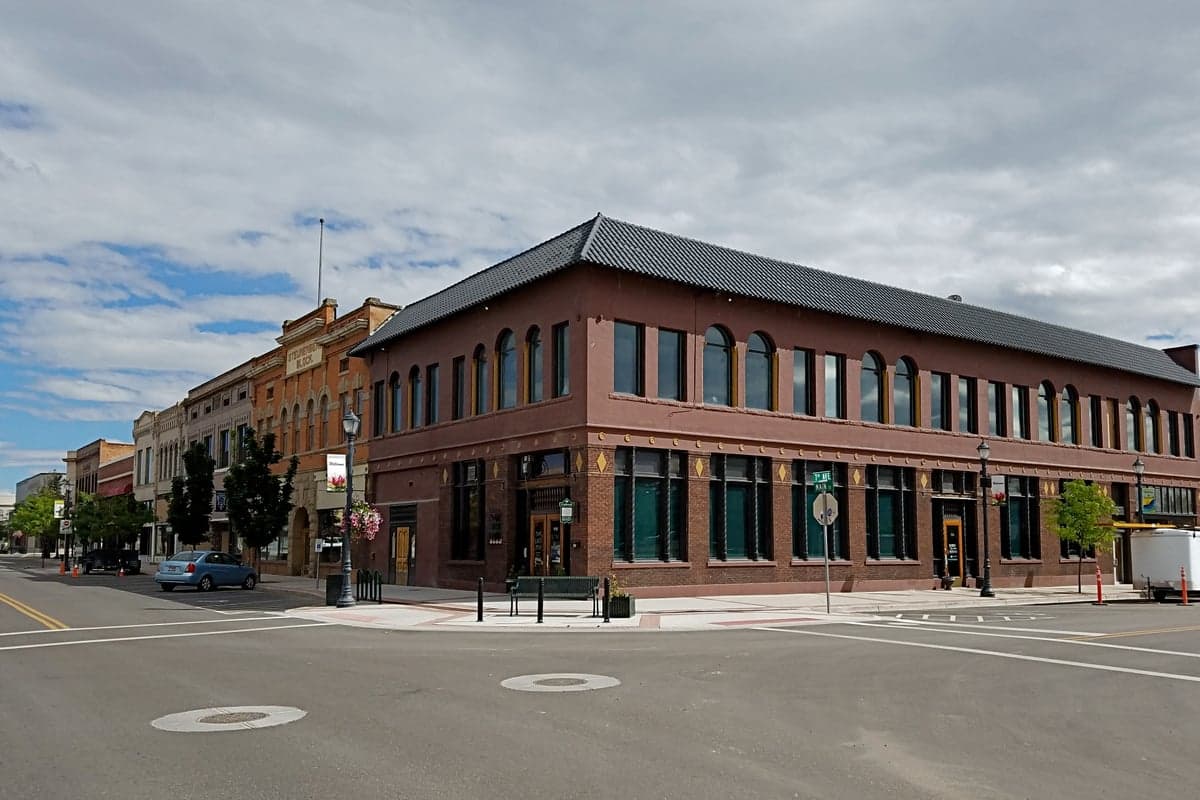
Photo: Wikipedia
Demographics of Caldwell, ID
Affluence Level in Caldwell, ID
A below-average socioeconomic profile. Incomes, home values, and educational attainment trail the U.S., with higher poverty and unemployment.
People of Caldwell, ID
The people of Caldwell, Idaho today form a community of roughly 63,465 residents defined by a stark demographic duality: a white population at 55.2% and a Hispanic population at 38.1%, making it one of Idaho’s most ethnically balanced cities. The city is notably less college-educated than the national average, with only 17.8% holding a bachelor’s degree, and its foreign-born share stands at 7.7%. This is a working-class, family-oriented city where agriculture, food processing, and logistics anchor daily life, and where distinct neighborhoods still echo the settlement patterns of the past century.
How the city was settled and grew
Caldwell was founded in 1883 as a railroad town on the Oregon Short Line, named after U.S. Senator Alexander Caldwell. The original white settlers were predominantly Anglo-American homesteaders drawn by the federal Homestead Act and the promise of irrigated farmland along the Boise River. These early families built the core of what is now the Lincoln District, a historic neighborhood centered on the College of Idaho campus, with Craftsman and Victorian homes that still stand. By the early 1900s, the city’s economy shifted toward sugar beet processing and fruit packing, attracting a first wave of Mexican laborers. These workers settled in what became South Caldwell, a low-lying area near the railroad tracks and the old sugar factory, forming the city’s first Hispanic enclave. A second wave of Anglo farmers arrived during the 1930s Dust Bowl, displaced from the Great Plains, and established themselves in the North Caldwell grid, where larger lots and newer bungalows appeared. Through the mid-20th century, Caldwell remained overwhelmingly white and Protestant, with a small but stable Mexican-American community concentrated in South Caldwell.
Modern era (post-1965)
The 1965 Immigration and Nationality Act opened the door for a much larger wave of Mexican and Central American immigration, which reshaped Caldwell’s population. By the 1980s, the Hispanic share had risen past 15%, driven by year-round jobs at the J.R. Simplot potato plant and the fruit-packing sheds along the Union Pacific line. These newer arrivals expanded beyond South Caldwell into the West Caldwell corridor along Highway 20/26, where modest ranch-style homes and mobile home parks absorbed the growing workforce. The 1990s and 2000s saw a second domestic migration: white retirees and remote workers from California and the Pacific Northwest, drawn by lower housing costs, settled in the newer Sky Ranch subdivision on the city’s eastern edge. This created a visible geographic split—Sky Ranch and North Caldwell remain predominantly white and more affluent, while South Caldwell and West Caldwell are heavily Hispanic and lower-income. The Asian population, at just 1.0%, is small and largely composed of Vietnamese and Filipino families who arrived in the 1990s to work in the food-processing sector; they are scattered across the city with no single ethnic enclave. The Indian-subcontinent population is negligible at 0.1%, and the Black population at 0.3% is similarly tiny. The foreign-born share of 7.7% is overwhelmingly Mexican-born, with a small but growing number of Central American families.
The future
Caldwell’s population is trending toward a continued Hispanic majority, likely crossing the 50% threshold within the next decade. The white population is aging and declining in absolute numbers, while the Hispanic population is younger and has higher birth rates. The city is not tribalizing into hostile enclaves—intermarriage and shared civic life are common—but economic segregation is deepening: newer subdivisions like Ridgecrest on the south side are attracting middle-class Hispanic families, while the poorest residents remain in the older South Caldwell and West Caldwell neighborhoods. The East/Southeast Asian and Indian communities are not growing significantly and are likely to remain below 2% combined. The college-educated share is rising slowly as remote workers and Boise commuters discover Caldwell’s lower home prices, but the city’s industrial base—Simplot, fruit packing, and a new Amazon distribution center—will keep the workforce predominantly blue-collar. The next 10-20 years will likely see Caldwell become a majority-Hispanic, working-class city with a white minority concentrated in the northern and eastern subdivisions, and a small but stable Asian community integrated into the broader population.
For someone moving in now, Caldwell is a city in demographic transition—still affordable and family-oriented, but with a clear economic and ethnic geography. The schools and local government are adapting to a bilingual reality, and the city’s identity is shifting from a white agricultural town to a Hispanic-majority industrial hub. New residents should expect a community where hard work and family are central values, but where the cultural and political landscape is increasingly shaped by its Mexican-American majority.

* Values derived from national, state, county, city and local statistics and may differ in a specific area. Last updated: 2026-04-19T09:41:32.000Z
Narrative content on this page is AI-generated and may contain mistakes. Verify any details that matter before acting on them.
ReloMaps may earn a commission from affiliate links at no extra cost to you.

