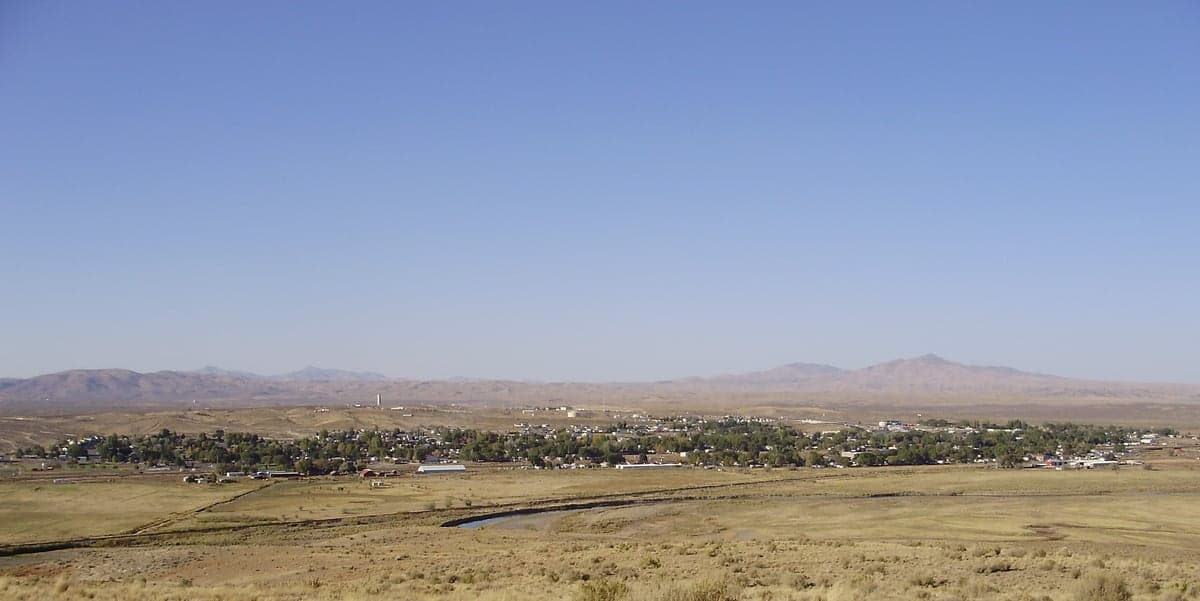
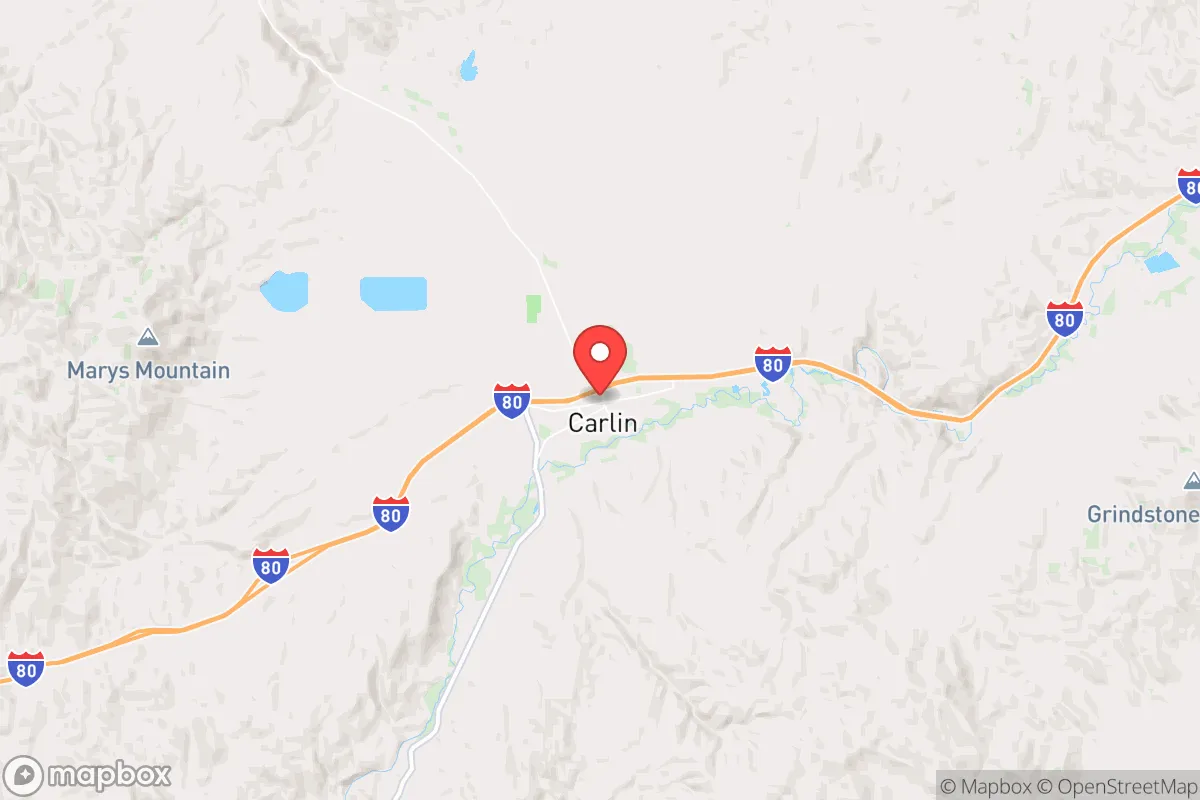
Photo: Wikipedia
Demographics of Carlin, NV
Affluence Level in Carlin, NV
A middle-class area roughly in line with national averages across income, home values, education, and employment.
People of Carlin, NV
The people of Carlin, Nevada, today number 2,164, forming a tight-knit, predominantly working-class community defined by its railroad and mining heritage. The population is notably less diverse than the national average, with a White majority of 62.7% and a significant Hispanic minority of 23.9%, while foreign-born residents are statistically nonexistent at 0.0%. With only 15.1% holding a college degree, Carlin’s identity is rooted in blue-collar labor, family ties, and a strong sense of local independence, making it a distinctively insular and stable place in a state known for rapid change.
How the city was settled and grew
Carlin’s human history begins not with pioneers but with the railroad. Founded in 1868 as a station on the Central Pacific Railroad, the town was initially a camp for Irish and Chinese laborers laying track through the Humboldt River Valley. The original settlement clustered around the rail yards in what is now Old Town Carlin, a historic district along the tracks where the Irish built modest wood-frame homes and the Chinese established a small but vital community, complete with a laundry and boarding houses. By the 1880s, the railroad’s dominance attracted a second wave: Cornish and Italian miners drawn by the discovery of gold and silver in the nearby Tuscarora Mountains. These families settled in the Southside neighborhood, south of the tracks, where they built sturdy brick houses and founded St. Mary’s Catholic Church in 1885. The town’s population peaked at around 1,500 by 1910, then stagnated as mining booms faded, leaving a core of railroad employees and ranchers who defined Carlin’s character through the mid-20th century.
Modern era (post-1965)
The post-1965 era brought little demographic upheaval to Carlin, as the town remained overwhelmingly White and native-born. The 1970s saw a modest influx of families from the Midwest and California, drawn by stable employment at the Southern Pacific Railroad’s Carlin Yard, which expanded as a major freight hub. These newcomers settled in the West End, a postwar subdivision of ranch-style homes built on former ranchland west of the original town. The most significant shift began in the 1990s, when the Newmont Mining Corporation’s Carlin Trend operations—the largest gold-mining district in the United States—drew a wave of Hispanic workers, primarily from rural Mexico and Texas. These families concentrated in the Eastside neighborhood, east of the Humboldt River, where affordable mobile homes and small rental houses created a distinct enclave. By 2020, the Hispanic share of Carlin’s population had risen to 23.9%, while the White share fell to 62.7%. The Black population remains tiny at 1.2%, and East/Southeast Asian communities—descendants of the original Chinese railroad workers, now largely assimilated—make up 3.6%. The Indian-subcontinent population is 0.0%, reflecting Carlin’s lack of professional or tech-sector employment that attracts such groups elsewhere in Nevada.
The future
Carlin’s population is heading toward slow, modest homogenization rather than fragmentation. The Hispanic community, now a quarter of the population, is increasingly second- and third-generation, with younger families moving out of the Eastside into the Mountain View subdivision, a newer development of single-family homes built in the 2010s near the Carlin High School. This geographic dispersal suggests assimilation rather than tribalization, as intermarriage and shared school activities blur ethnic lines. The White population is aging, with many retirees staying in Old Town and the West End, while younger White families are drawn to the Riverbend area, a small cluster of homes along the Humboldt River popular with railroad employees. The foreign-born share will likely remain near zero, as Carlin offers few entry-level service jobs and no immigrant-support networks. The college-educated share may rise slowly as remote work grows, but the town’s isolation and lack of amenities will limit this trend. Over the next 10–20 years, Carlin will likely become slightly more Hispanic, slightly older, and slightly more suburban in character, but its core identity as a railroad-and-mining town will persist.
For someone moving in now, Carlin offers a stable, low-drama community where neighbors know each other and change comes slowly. The population is not diversifying rapidly, nor is it shrinking; it is quietly evolving into a more blended, working-class town with a strong sense of place. If you value predictability, affordable housing, and a life centered on family and outdoor recreation, Carlin is a solid bet. If you seek ethnic diversity, urban amenities, or a fast-growing economy, look elsewhere.

* Values derived from national, state, county, city and local statistics and may differ in a specific area. Last updated: 2026-04-30T00:47:43.000Z
Narrative content on this page is AI-generated and may contain mistakes. Verify any details that matter before acting on them.
ReloMaps may earn a commission from affiliate links at no extra cost to you.

