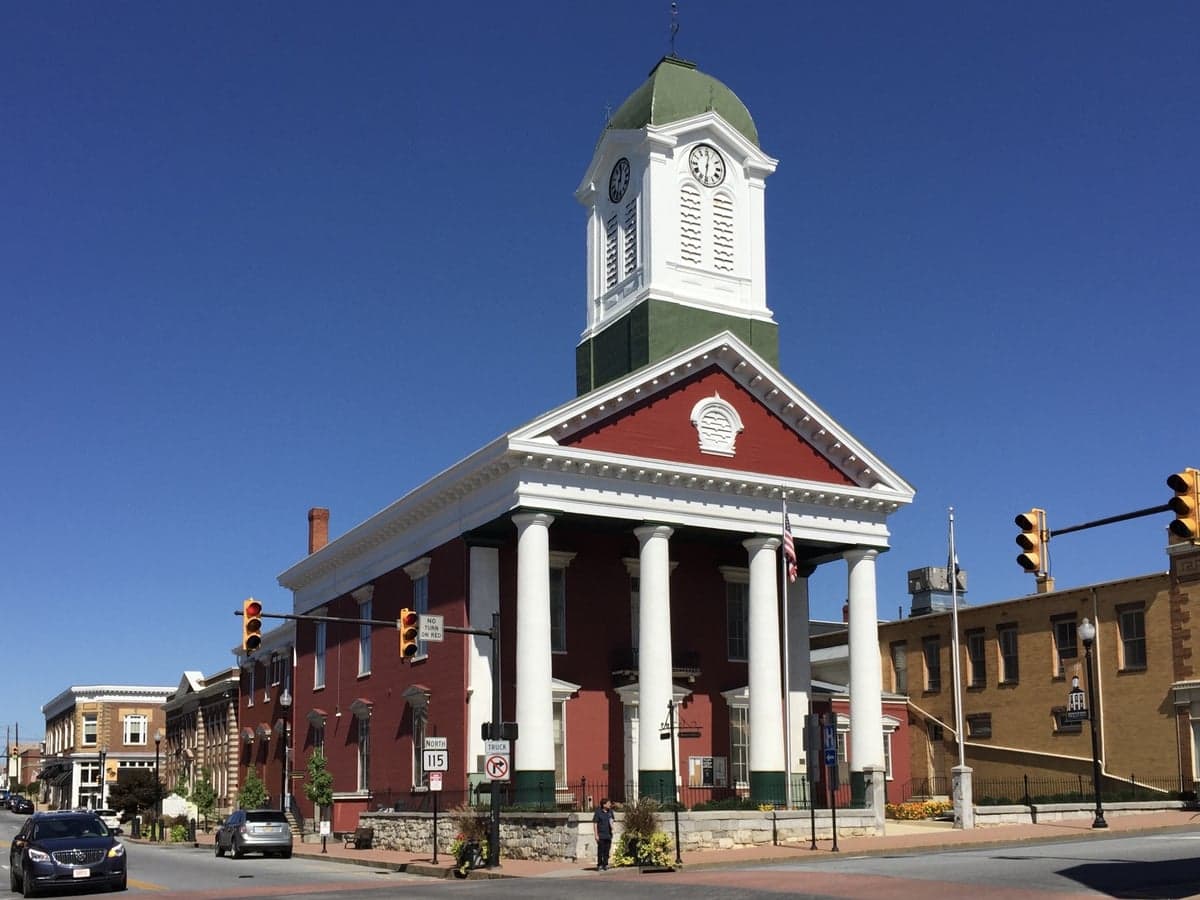
Photo: Wikipedia
Personal Sovereignty in Charles Town, WV
Strong independent fundamentals that actively favor personal liberty and low regulation.
What does Personal Sovereignty tell us?
Personal Sovereignty measures your capacity for self-reliance and independence with minimal government friction. Higher scores mean fewer barriers between you and the way you want to live... but it assumes you have the space you need and good neighbors.
What does this tell us?
Personal Sovereignty measures your capacity for self-reliance and independence with minimal government friction. Higher scores mean fewer barriers between you and the way you want to live... but it assumes you have the space you need and good neighbors.
State Policy
Energy independence: Net exporter (200% of energy produced in-state)
Personal Liberty
Homesteading

Personal Liberty Analysis
Charles Town, West Virginia, offers a notably high degree of personal sovereignty compared to much of the Mid-Atlantic, largely due to the state’s constitutional culture and a legal framework that prioritizes individual liberty over government mandate. For those approaching relocation from a survivalist or prepper mindset, the area presents a strategic balance: proximity to the D.C. metro for economic opportunity, yet a political and regulatory environment that is far less intrusive. The key question is whether this autonomy is durable, and the answer lies in West Virginia’s deeply ingrained resistance to federal overreach and its own state-level protections for gun rights, property use, and medical choice. This analysis examines the specific pillars of that sovereignty—tax burden, self-defense law, homesteading feasibility, and personal liberties—to determine if Charles Town is a genuine refuge or merely a suburban extension of the coastal regulatory state.
Tax burden and regulatory posture: How much the state leaves in your pocket
West Virginia’s tax structure is one of the most favorable in the region for individuals seeking to keep more of their earnings and reduce government entanglement. The state has no personal property tax on vehicles or business inventory, and its income tax is a graduated system with a top marginal rate of 5.12% (as of 2026), which is competitive against neighboring Maryland (5.75% flat) and Virginia (up to 5.75%). More importantly, the state legislature has been actively reducing the income tax burden, with a goal of eventual elimination—a signal that the political climate is aligned with fiscal autonomy. Property taxes in Jefferson County are low, typically around 0.8% to 1.0% of assessed value, and the state does not impose a separate estate or inheritance tax. From a regulatory standpoint, West Virginia is a right-to-work state with minimal business licensing hurdles, and it has no state-level environmental mandates that exceed federal baseline requirements. For a prepper or survivalist, this means fewer layers of bureaucratic permission needed to own land, run a small business, or store resources. The state’s posture is one of “leave us alone,” and Charles Town benefits from being in a county that votes overwhelmingly Republican and consistently opposes new state-level regulations.
Self-defense and gun law specifics: What you can carry and where
West Virginia is a constitutional carry state, meaning no permit is required to carry a concealed firearm for any law-abiding adult 21 or older (18 for open carry). This is a foundational sovereignty right that Charles Town residents exercise without the permission slips required in Maryland or Virginia. The state preempts all local gun ordinances, so Jefferson County cannot impose its own bans on magazine capacity, firearm types, or carry locations beyond state law. Stand-your-ground and castle doctrine laws are fully in effect, with no duty to retreat in any place you are lawfully present. For those concerned about government overreach, West Virginia also passed a Second Amendment Preservation Act, which prohibits state resources from being used to enforce federal gun laws that the state deems unconstitutional—a direct shield against potential federal confiscation efforts. The only notable restriction is that carrying in a church or school requires permission from the governing body, but this is a minor caveat. For a prepper, the legal environment is unambiguous: your right to defend yourself, your family, and your property is not subject to local political whims. Charles Town’s proximity to the restrictive D.C. and Maryland borders makes this contrast even more pronounced—you can legally carry a firearm in West Virginia that would be a felony two miles east.
Self-reliance and homesteading viability: Lot sizes, zoning, and off-grid feasibility
Charles Town itself is a small city with a historic downtown, but the surrounding Jefferson County area offers significant opportunities for self-reliant living. Zoning in unincorporated parts of the county is minimal; there are no county-wide building codes for agricultural structures, and land use is largely governed by right-to-farm laws that protect livestock, gardening, and small-scale farming from nuisance complaints. Lot sizes vary widely, but it is still possible to find parcels of 1 to 5 acres within 15 minutes of downtown for under $15,000 per acre, and larger tracts of 10 to 50 acres are available further out. Off-grid feasibility is high: West Virginia has no state law requiring connection to municipal water or sewer, and private wells and septic systems are standard. Solar panel installation is unrestricted, and net metering is available, though the state’s energy policy is still coal-friendly, meaning no punitive fees for disconnecting from the grid. Rainwater collection is legal and unregulated. The main constraint is that Jefferson County is growing, and some subdivisions near Charles Town have HOA covenants that restrict livestock, external storage, or vehicle parking—so buyers must carefully check deed restrictions. For a prepper seeking to stockpile supplies, raise animals, and generate independent power, the regulatory environment is among the most permissive in the eastern U.S., provided you buy outside of municipal limits.
Personal liberties: Parental rights, medical autonomy, speech, and property
West Virginia has a strong track record on parental rights, with a state law that explicitly affirms parents’ fundamental right to direct the upbringing, education, and healthcare of their children. The state does not have a universal vaccine mandate for school attendance, and parents can opt out of any immunization for medical, religious, or philosophical reasons. Homeschooling is straightforward: parents need only submit a notice of intent and provide a basic instructional plan, with no standardized testing requirements or home visits. Medical autonomy is similarly robust—West Virginia has no state-level vaccine passport system, and the state legislature has repeatedly blocked efforts to mandate COVID-19 or other vaccines for employment or public access. The state also passed a law prohibiting discrimination against unvaccinated individuals in healthcare settings. Free speech is protected by the state constitution, and there are no hate speech laws or social media content mandates that exceed First Amendment protections. Property rights are strong: eminent domain is limited to public use (not economic development), and the state has a right-to-farm law that protects agricultural operations from nuisance lawsuits. For those concerned about government overreach into medical decisions or educational content, Charles Town sits in a county that consistently votes against expanding state power in these areas. The only caveat is that Jefferson County is more politically mixed than the rest of West Virginia due to D.C. commuters, so local school board and county commission races can be competitive—but the state-level legal framework remains firmly liberty-oriented.
Overall, Charles Town offers a level of personal sovereignty that is rare within a two-hour drive of a major metropolitan area. The combination of constitutional carry, low taxes, minimal zoning, strong parental rights, and medical autonomy creates a legal environment where a prepper or survivalist can operate with minimal government friction. The main risk is not state overreach but local growth pressure—as more people flee restrictive states, Jefferson County may see increased zoning debates and school board battles. For now, however, Charles Town remains a strategic outpost where an individual can maintain a self-reliant lifestyle while still accessing the economic benefits of the D.C. region. Compared to areas like Loudoun County, Virginia, or Montgomery County, Maryland, the sovereignty differential is stark: what is a right in West Virginia is often a privilege requiring a permit or a fee across the state line. For those prioritizing autonomy above all else, Charles Town is one of the strongest options in the eastern United States.

* Values derived from national, state, county, city and local statistics and may differ in a specific area. Last updated: 2026-04-23T05:31:28.000Z
Narrative content on this page is AI-generated and may contain mistakes. Verify any details that matter before acting on them.
ReloMaps may earn a commission from affiliate links at no extra cost to you.

