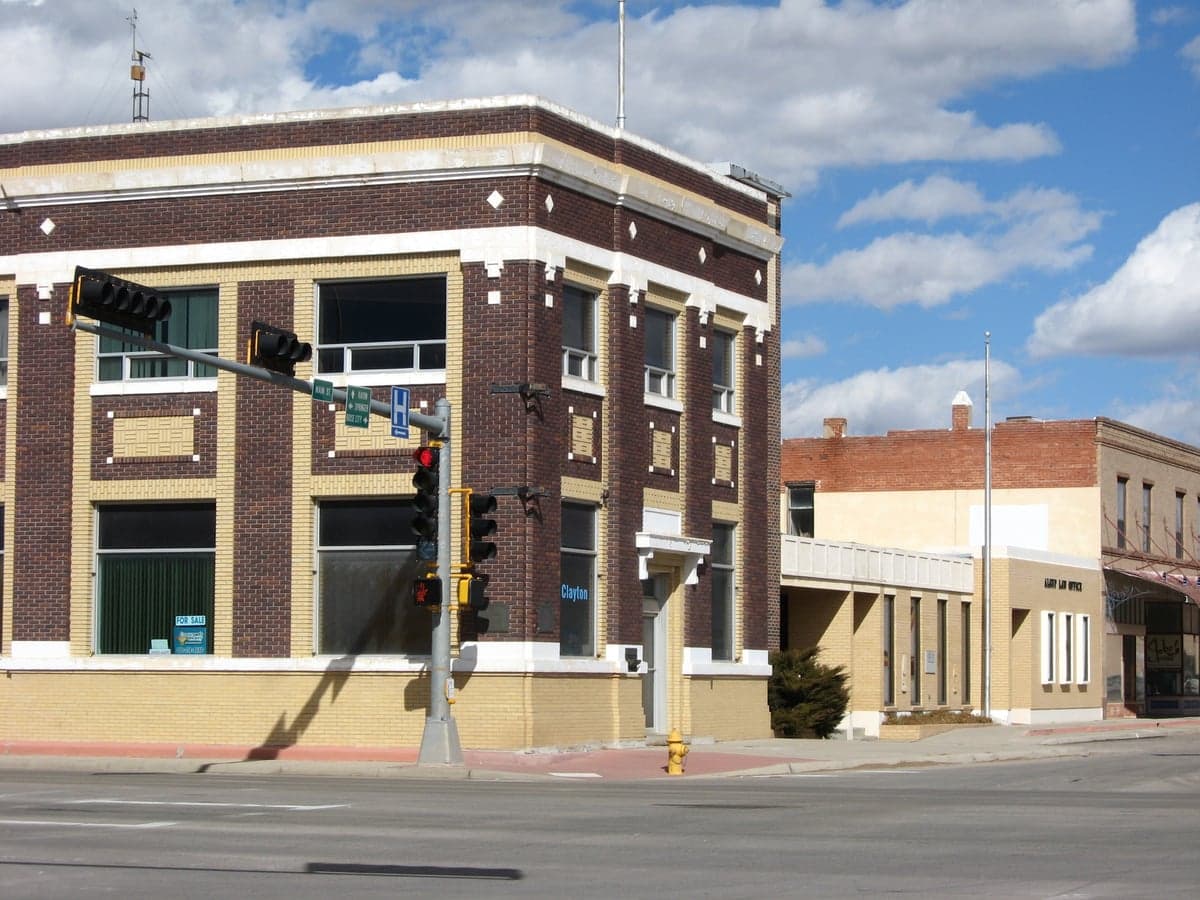
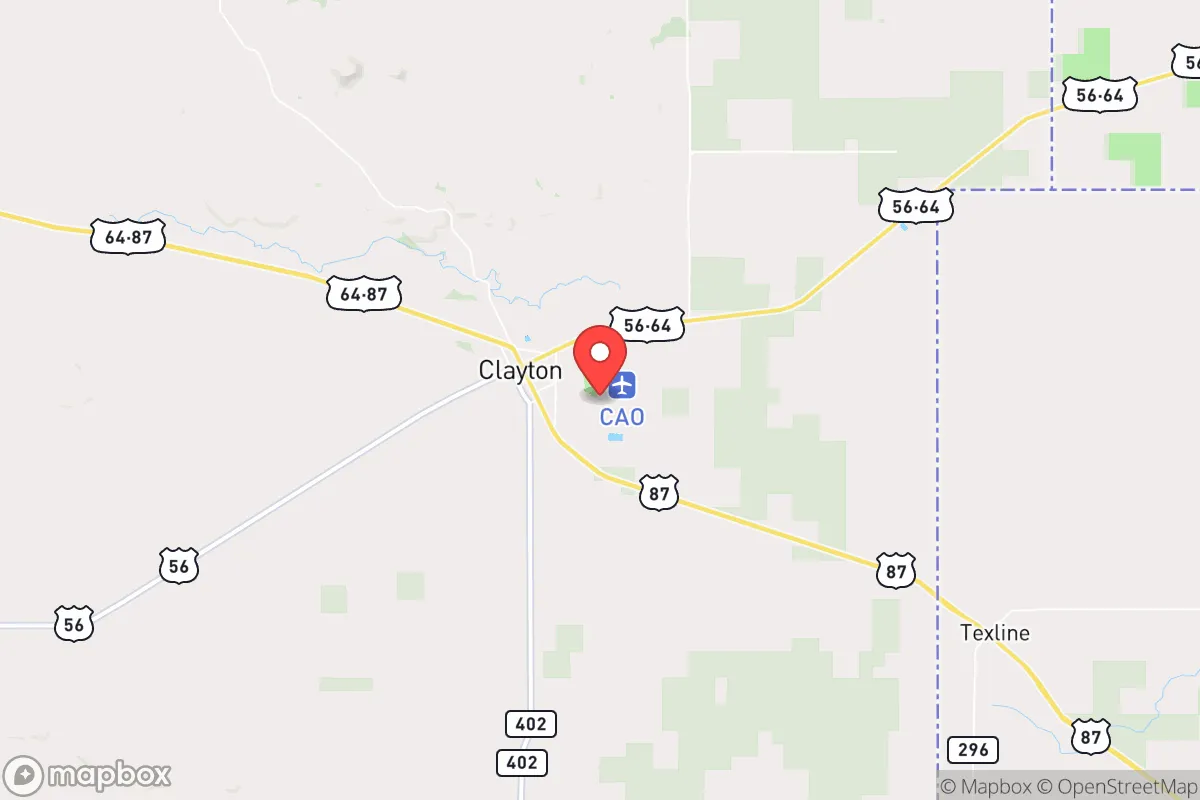
Photo: Wikipedia
Demographics of Clayton, NM
Affluence Level in Clayton, NM
A below-average socioeconomic profile. Incomes, home values, and educational attainment trail the U.S., with higher poverty and unemployment.
People of Clayton, NM
The people of Clayton, New Mexico, today form a small, tight-knit community of roughly 2,680 residents, characterized by a Hispanic-majority population (52.5%) alongside a significant White non-Hispanic minority (39.6%). The town’s identity is rooted in its role as the Union County seat, a ranching and railroad hub where a strong sense of self-reliance and local governance prevails. With a foreign-born population of just 2.9% and a college attainment rate of 13.6%, Clayton remains a predominantly native-born, working-class community where family ties and agricultural traditions run deep.
How the city was settled and grew
Clayton’s human history begins not with Spanish colonization but with the arrival of the railroad in the late 1880s. The town was founded in 1887 as a stop on the Chicago, Rock Island and Pacific Railroad, which opened the high plains of northeastern New Mexico to Anglo-American ranchers and homesteaders. The original settlers were largely White cattlemen and farmers from Texas and the Midwest, drawn by the promise of open range and cheap land under the Homestead Act. They built the Original Townsite around the railroad depot, a grid of streets that still forms the commercial core. A second wave arrived in the early 1900s: Hispanic families from the Rio Grande Valley and southern Colorado, who came to work on the ranches and in the railroad yards. These families settled primarily in what is now known as South Clayton, a neighborhood south of the tracks where adobe and frame houses line unpaved roads. By 1910, Clayton’s population had reached about 1,500, with the two groups living in largely separate but interdependent spheres—Anglos in the north and east, Hispanics in the south. The town’s growth plateaued after World War II, as the railroad declined and younger generations left for larger cities.
Modern era (post-1965)
The post-1965 era brought little demographic change to Clayton, as the town’s isolation and limited economic base discouraged large-scale immigration. The 1965 Hart-Cellar Act, which opened immigration from Asia and Latin America, had a negligible effect here: the foreign-born share remains under 3%, and East/Southeast Asian and Indian-subcontinent populations are effectively zero. Instead, the major shift has been internal: a gradual increase in the Hispanic share from roughly 35% in 1970 to 52.5% today, driven by higher birth rates and the return of some former residents from cities like Albuquerque and Denver. This growth has concentrated in South Clayton and the newer Westside Addition, a subdivision of modest ranch-style homes built in the 1970s and 1980s. The White non-Hispanic population, meanwhile, has aged and declined, with many younger Anglos leaving for college or jobs elsewhere. The East Clayton neighborhood, once predominantly Anglo, now shows a more mixed character, with Hispanic families moving into older homes. The Black population remains tiny at 1.1%, largely descendants of railroad workers who stayed after the line’s heyday. Clayton today is not a place of ethnic enclaves but of quiet integration, with the main division being between long-time residents and newcomers—the latter often retirees or remote workers seeking low costs and wide-open spaces.
The future
Clayton’s population is likely to continue its slow decline, mirroring trends across rural New Mexico. The town lost about 10% of its residents between 2010 and 2020, and projections suggest a further drop to around 2,400 by 2035. The Hispanic share will probably rise to 60% or more, as the White population ages and younger Hispanics remain or return to raise families. The foreign-born share is unlikely to grow significantly, given the lack of entry-level jobs in agriculture or services. The North Clayton neighborhood, home to the hospital and newer senior housing, may see an influx of retirees, while South Clayton will remain the heart of the Hispanic community. There is no sign of tribalization into distinct enclaves; instead, the town is slowly homogenizing into a Hispanic-majority, working-class community with a strong ranching identity. The biggest wildcard is climate-driven migration: if drought worsens, some residents may leave, but if water remains stable, Clayton could attract a trickle of climate refugees from hotter, more crowded states.
For someone moving in now, Clayton is becoming a quieter, more Hispanic, and more insular place—a town where family names and local history matter more than new arrivals. It offers safety, low housing costs, and a slower pace, but limited economic opportunity and a shrinking tax base. The community is welcoming to those who respect its traditions, but it is not a place of rapid change or diversity.

* Values derived from national, state, county, city and local statistics and may differ in a specific area. Last updated: 2026-05-01T14:32:43.000Z
Narrative content on this page is AI-generated and may contain mistakes. Verify any details that matter before acting on them.
ReloMaps may earn a commission from affiliate links at no extra cost to you.

