Photo: Wikipedia
Demographics of Colonial Heights, VA
Affluence Level in Colonial Heights, VA
A middle-class area roughly in line with national averages across income, home values, education, and employment.
People of Colonial Heights, VA
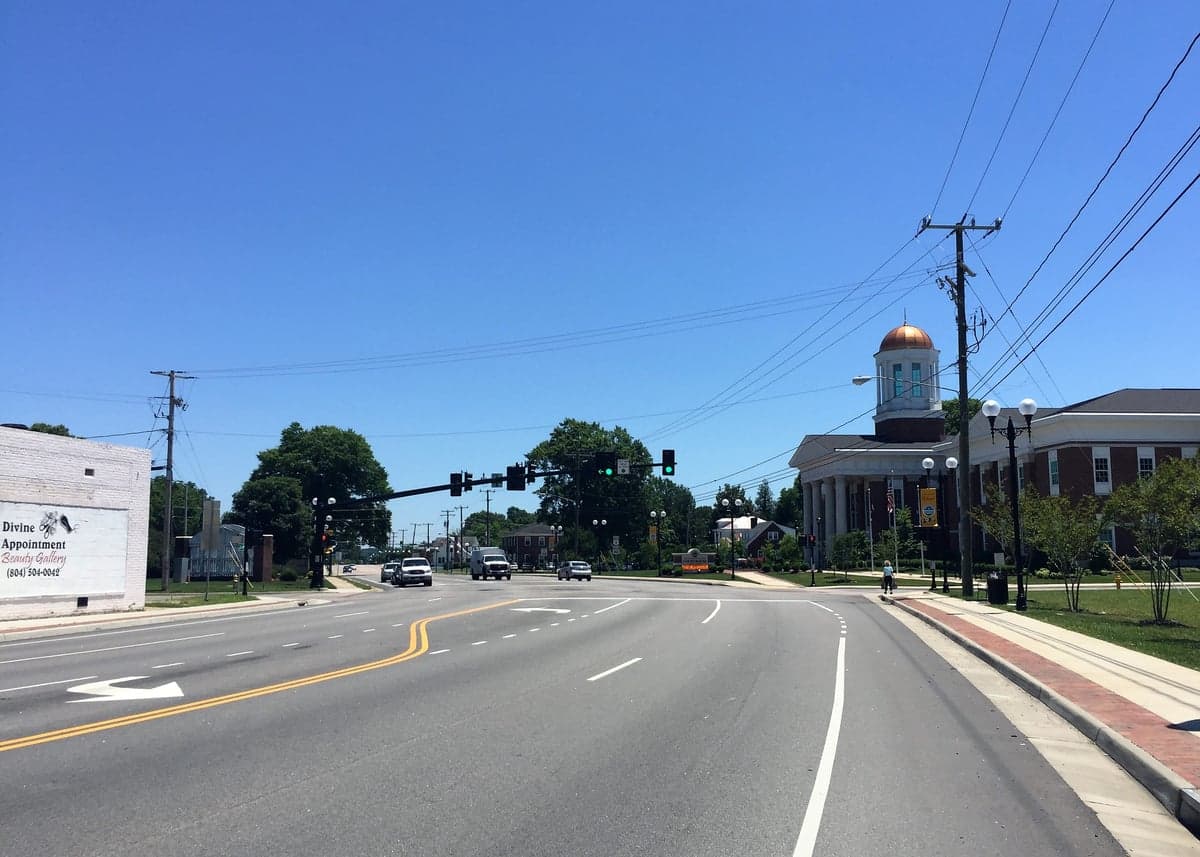
The people of Colonial Heights, Virginia, today number 18,210, forming a compact, predominantly white (67.0%) city with a notable Black minority (17.8%) and smaller Hispanic (7.6%) and East/Southeast Asian (2.3%) communities. The city’s foreign-born population is a low 3.1%, and 29.5% of adults hold a college degree, reflecting a stable, middle-class workforce tied to regional government, healthcare, and retail. Distinctive identity markers include a strong military-affiliated presence due to nearby Fort Gregg-Adams (formerly Fort Lee) and a self-image as a quieter, more conservative alternative to neighboring Richmond and Petersburg.
How the city was settled and grew
Colonial Heights was not a colonial-era settlement; its growth is almost entirely a 20th-century phenomenon. The area was originally part of Prince George County, with sparse farming and a few riverfront plantations along the Appomattox River. The first significant population wave came after the Civil War, when freed Black families established small communities on less desirable land near the river, forming the nucleus of what is now the Southside Estates neighborhood. The city’s name derives from a Confederate fortification on a hill overlooking Petersburg, but the modern population boom began in the 1920s with the construction of U.S. Route 1 and the Benjamin Harrison Bridge, which connected the area to Hopewell and Petersburg. Early white settlers—mostly of English and Scots-Irish descent—built modest homes in the Bollingbrook and Lakeview neighborhoods, drawn by jobs at the nearby DuPont Spruance plant and the expanding railroad hub in Petersburg. By 1940, the population had reached roughly 3,000, and the city incorporated in 1948 to control its own zoning and schools, a move that accelerated suburban-style development.
Modern era (post-1965)
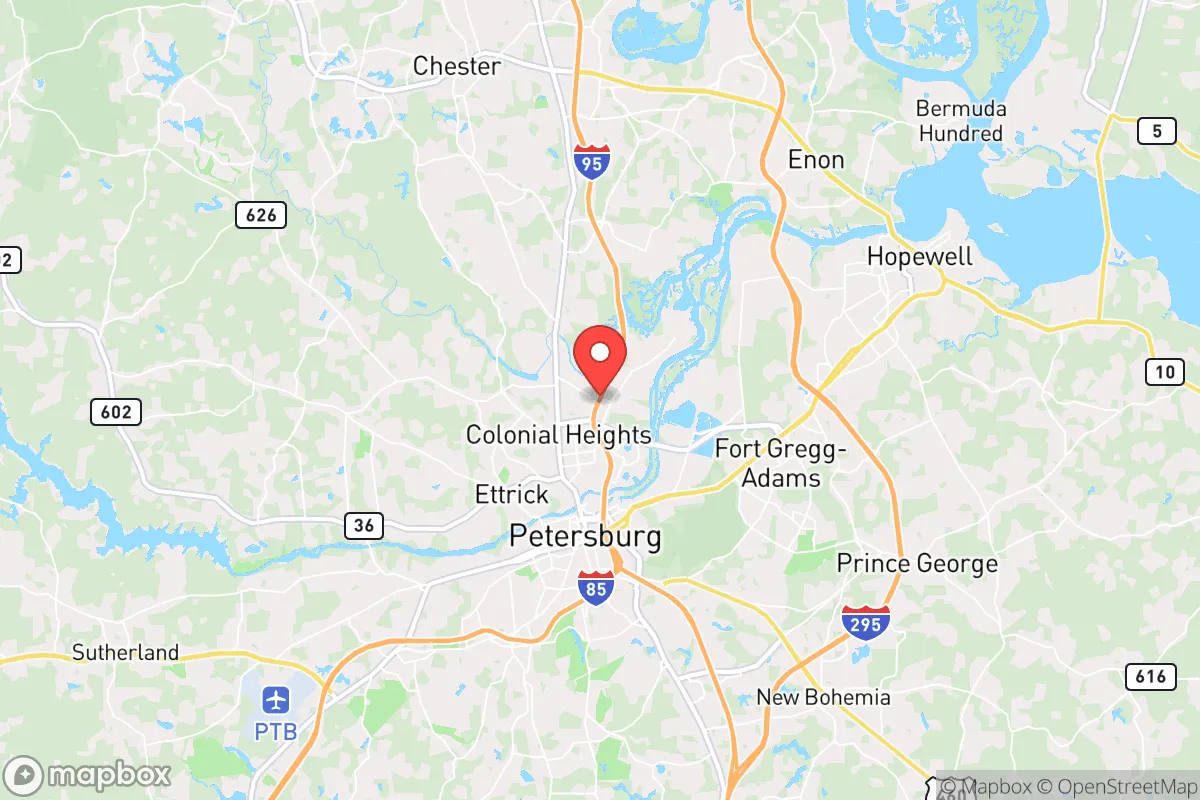
The post-1965 era reshaped Colonial Heights through suburbanization and white flight from Petersburg and Richmond. As Petersburg’s Black population grew and its schools desegregated under court order, many white families moved east into Colonial Heights, particularly into the Woodlawn and Dupont Heights subdivisions built in the 1970s. This in-migration solidified the city’s white majority and its reputation as a safe, low-tax enclave. The Black population that remained—descendants of the original post-Civil War families—concentrated in the Southside Estates and Battleground areas near the river, where older housing stock and lower property values persisted. The Hispanic share (7.6%) grew modestly after 2000, driven by construction and service jobs at Fort Gregg-Adams, with families settling in the Lakeview area and along the Boulevard corridor. East/Southeast Asian residents (2.3%) are largely Vietnamese and Filipino families connected to military and medical professions, clustered near the Southpark commercial district. The Indian-subcontinent population (1.1%) is small but growing, with professionals in IT and healthcare choosing newer apartments near the I-95 interchange. Notably, the city’s foreign-born share (3.1%) remains far below the national average, indicating limited recent immigration and a population that is primarily native-born and English-speaking.
The future
The population of Colonial Heights is slowly diversifying but remains on a trajectory of modest, stable growth. The white share has declined from roughly 80% in 2000 to 67% today, while Hispanic and Asian shares have inched upward. The Black population has held steady, suggesting neither significant out-migration nor new Black in-migration. The city is not tribalizing into distinct ethnic enclaves; rather, newer Hispanic and Asian residents are dispersing across existing neighborhoods, particularly in the Lakeview and Southpark areas, where rental housing is more available. The biggest demographic wildcard is the expansion of Fort Gregg-Adams, which could bring younger, more diverse military families over the next decade. However, the city’s limited housing stock—mostly single-family homes built before 1990—and its lack of large apartment complexes constrain rapid population growth. The college-educated share (29.5%) is below the state average, and without a major employer shift, the city will likely remain a predominantly white, middle-class suburb with a slowly growing Hispanic and Asian presence. For a conservative-leaning mover, this means a stable, low-crime environment with familiar cultural norms, but limited ethnic diversity and a population that skews older and more settled.
Colonial Heights is becoming a quieter, more stable version of its 1970s self—a predominantly white, native-born suburb with modest diversification driven by military and service-sector families. For someone moving in now, the city offers predictability, low taxes, and a conservative social fabric, but little of the demographic dynamism or immigrant-driven growth seen in larger Virginia cities. The next 10–20 years will likely see gradual aging of the white population, a slight uptick in Hispanic and Asian shares, and continued stability in the Black community, making it a reliable choice for those seeking continuity over change.

* Values derived from national, state, county, city and local statistics and may differ in a specific area. Last updated: 2026-05-01T18:41:27.000Z
Narrative content on this page is AI-generated and may contain mistakes. Verify any details that matter before acting on them.
ReloMaps may earn a commission from affiliate links at no extra cost to you.

