Demographics of Northwest Hills Planning Region County
Historical data isn't available for Northwest Hills Planning Region County. Trends shown are for Connecticut.
Affluence Level in Northwest Hills Planning Region County
A middle-class area roughly in line with national averages across income, home values, education, and employment.
People of Northwest Hills Planning Region County
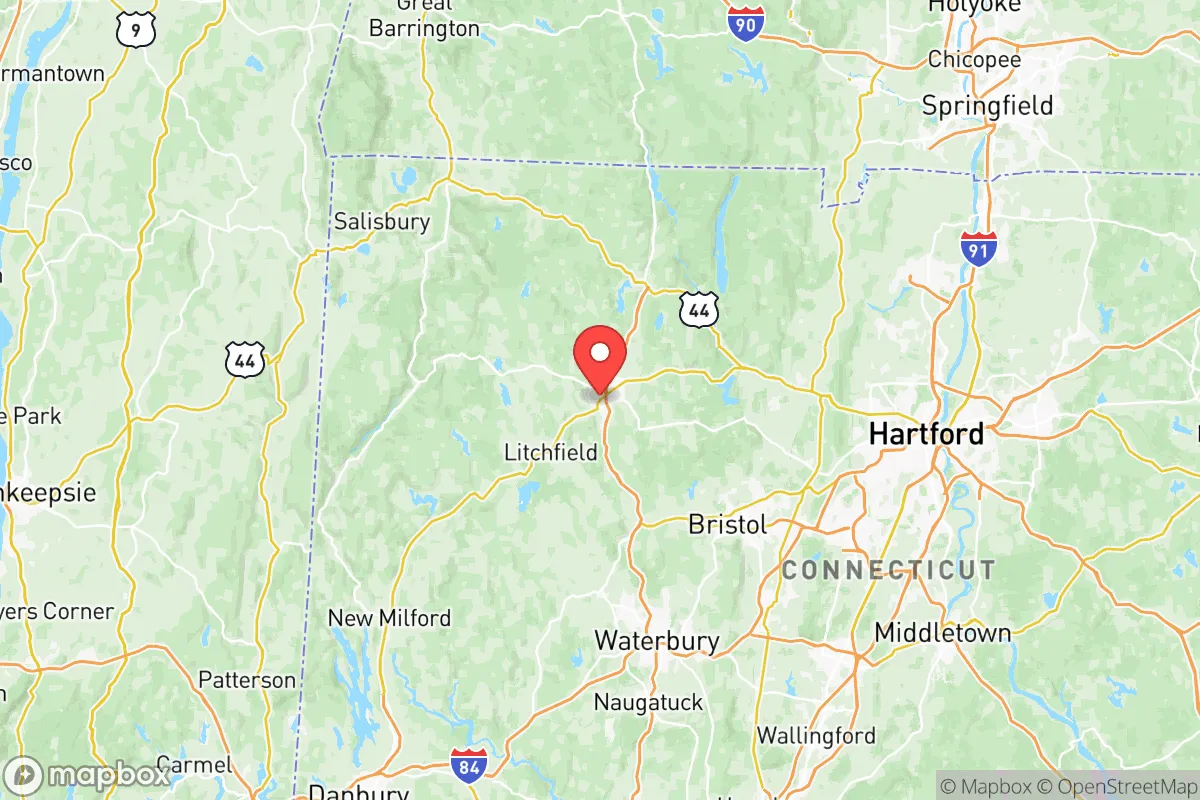
Northwest Hills Planning Region County, Connecticut, is a region of 112,848 residents defined by its rural character, historic New England villages, and a population that is 82.7% White, with a notable 8.4% Hispanic presence and a highly educated workforce—39.4% of adults hold a college degree. The county encompasses the towns of Torrington, Winsted, Litchfield, Kent, Cornwall, Salisbury, Canaan, Norfolk, Colebrook, Goshen, Harwinton, Barkhamsted, New Hartford, and Winchester, each contributing to a landscape of preserved farmland, forested hills, and historic town greens. Unlike Connecticut's more densely populated coastal counties, Northwest Hills remains a region of small towns and low-density settlement, where the population has been relatively stable for decades, with only a 3.5% foreign-born share reflecting its limited role as an immigrant destination.
Settlement & growth (pre-1960)
The human history of Northwest Hills begins with the Mohican and Wappinger peoples, Algonquian-speaking tribes who inhabited the Housatonic River valley and its tributaries for thousands of years before European contact. These groups practiced seasonal agriculture, hunting, and fishing, with village sites concentrated along the river floodplains in what are now Kent, Cornwall, and Salisbury. By the early 1700s, European colonists—primarily English Puritans from the Massachusetts Bay and Connecticut colonies—began pushing north and west from Hartford and New Haven, displacing Native populations through land purchases and treaties that were often unfavorable to the tribes.
The first permanent English settlements in the region date to the 1720s and 1730s, when families from coastal Connecticut established farming communities in Litchfield (founded 1719), New Hartford (1733), and Torrington (1737). These settlers were overwhelmingly of English descent, with a smaller number of Scots-Irish and Dutch families filtering in from New York's Hudson Valley. The economy was subsistence agriculture—wheat, corn, livestock—on rocky, glaciated soils that required intensive labor. Litchfield quickly emerged as the region's political and cultural hub, serving as the county seat of Litchfield County (established 1751) and home to the Litchfield Law School, the first formal law school in the United States, which trained figures like John C. Calhoun and Aaron Burr.
The 19th century brought industrialization, but on a smaller scale than in Connecticut's coastal cities. The region's rivers—the Naugatuck, the Housatonic, and the Farmington—powered mills in Torrington, Winsted, and New Hartford, producing brass, clocks, textiles, and hardware. These factories attracted a new wave of immigrants: Irish laborers arrived in the 1840s and 1850s, fleeing the Great Famine, and settled in mill villages like Winsted and Torrington, where they worked in the brass and woolen mills. German immigrants followed in the 1850s and 1860s, many of them skilled craftsmen who found work in the clock-making and tool industries. Italian immigrants arrived in large numbers between 1890 and 1920, concentrating in Torrington, Winsted, and Canaan, where they worked in the brass mills, foundries, and railroad yards. Polish and French Canadian families also settled in the mill towns during this period, adding to the ethnic diversity of what remained a predominantly Yankee Protestant countryside.
By 1900, the region's population had grown to roughly 60,000, with Torrington (population ~15,000) as the largest urban center. The decline of manufacturing began after World War I and accelerated after World War II, as mills closed or moved south. The region's population growth slowed dramatically; many young people left for jobs in Hartford, New Haven, or out of state. The 1950s saw the beginning of a counter-trend: affluent families from New York and coastal Connecticut began buying up old farms and estates in Litchfield, Kent, and Salisbury as weekend homes, a pattern that would reshape the region's economy and demographics in the decades to come.
Modern era (post-1965)
The 1965 Hart-Cellar Act, which abolished national-origin immigration quotas, had a relatively muted effect on Northwest Hills compared to urban Connecticut. The region's foreign-born population today stands at just 3.5%, far below the state average of 14.7%. The limited immigration that has occurred since the 1970s has been primarily Hispanic, with families from Puerto Rico, Mexico, and Central America settling in Torrington and Winsted, where they found work in the remaining light manufacturing, healthcare, and service industries. The Hispanic share of the county's population is now 8.4%, up from roughly 2% in 1980, with the largest concentrations in Torrington's South End and Winsted's downtown area.
Domestic migration has been the more significant demographic force since 1965. The region has attracted a steady stream of affluent second-home buyers and retirees from the New York metropolitan area, particularly to the scenic towns of Litchfield, Kent, Cornwall, Salisbury, and Norfolk. These newcomers are disproportionately White, college-educated, and politically liberal, and they have driven up property values while preserving the region's historic character. At the same time, the region has experienced a modest outflow of working-class families, particularly from Torrington and Winsted, as manufacturing jobs have continued to decline and younger residents move to Hartford or out of state for employment.
The Black population of the county is small—2.5%—and concentrated in Torrington, where a historic African American community dates to the 19th century, supplemented by more recent arrivals from the Caribbean and Africa. East/Southeast Asian residents make up 1.7% of the population, with small clusters in Torrington and Litchfield, many associated with the region's healthcare and educational institutions. The Indian subcontinent population is 0.5%, a very recent presence driven by professionals in healthcare and technology who work in Hartford or Danbury but choose to live in the scenic hills of New Hartford or Barkhamsted.
The region's racial and ethnic composition has shifted only modestly since 1965. In 1970, the county was approximately 98% White; today it is 82.7% White, with the change driven almost entirely by Hispanic growth and the departure of some White working-class families. The region remains one of the least diverse in Connecticut, a fact that reflects both its limited role as an immigrant gateway and its economic structure, which offers fewer entry-level jobs than the state's cities.
The future
The population of Northwest Hills is projected to remain stable or decline slightly over the next 10-20 years, as the region's birth rate is below replacement and in-migration from New York is unlikely to accelerate given high housing costs and limited job growth. The Hispanic share of the population is expected to continue rising slowly, reaching perhaps 12-14% by 2040, driven by natural increase and continued migration to Torrington and Winsted. The White population will likely shrink in absolute terms, as the region's older residents age and younger families move away.
The region is becoming slightly more diverse, but the pace of change is slow. New immigrant communities are not forming distinct enclaves; instead, Hispanic families are dispersing across Torrington and Winsted, while Asian and Indian professionals are scattered in the more affluent towns. The cultural identity of Northwest Hills is likely to remain rooted in its New England small-town character, with the tension between preservation and affordability—already visible in Litchfield and Kent—intensifying as housing prices continue to rise.
For someone moving in now, Northwest Hills offers a stable, safe, and scenic environment with excellent schools in towns like Litchfield, Salisbury, and Kent, but limited ethnic diversity and a job market that requires commuting to Hartford, Danbury, or New York. The region is becoming a place where the wealthy and the retired can afford to live, while working families—particularly those of color—find it increasingly difficult to stay. The next decade will test whether the region can maintain its character while becoming more inclusive.

* Values derived from national, state, county, city and local statistics and may differ in a specific area. Last updated: 2026-06-12T18:07:36.000Z
Narrative content on this page is AI-generated and may contain mistakes. Verify any details that matter before acting on them.
ReloMaps may earn a commission from affiliate links at no extra cost to you.

