Photo: Wikipedia
Demographics of Crown Point, IN
Affluence Level in Crown Point, IN
A middle-class area roughly in line with national averages across income, home values, education, and employment.
People of Crown Point, IN
Crown Point, Indiana, is a city of 34,042 residents that blends small-town Midwestern character with the pressures of suburban growth. Its population is predominantly white (74.6%), with a notable Hispanic community (12.0%) and a smaller Black population (8.6%), while foreign-born residents make up just 2.1% of the city. The city’s identity is shaped by its historic courthouse square, strong public schools, and a sense of civic pride that attracts families seeking a quieter alternative to Chicago’s sprawl. With 34.9% of adults holding a college degree, Crown Point leans educated and professional, yet retains a working-class foundation rooted in its agricultural and industrial past.
How the city was settled and grew
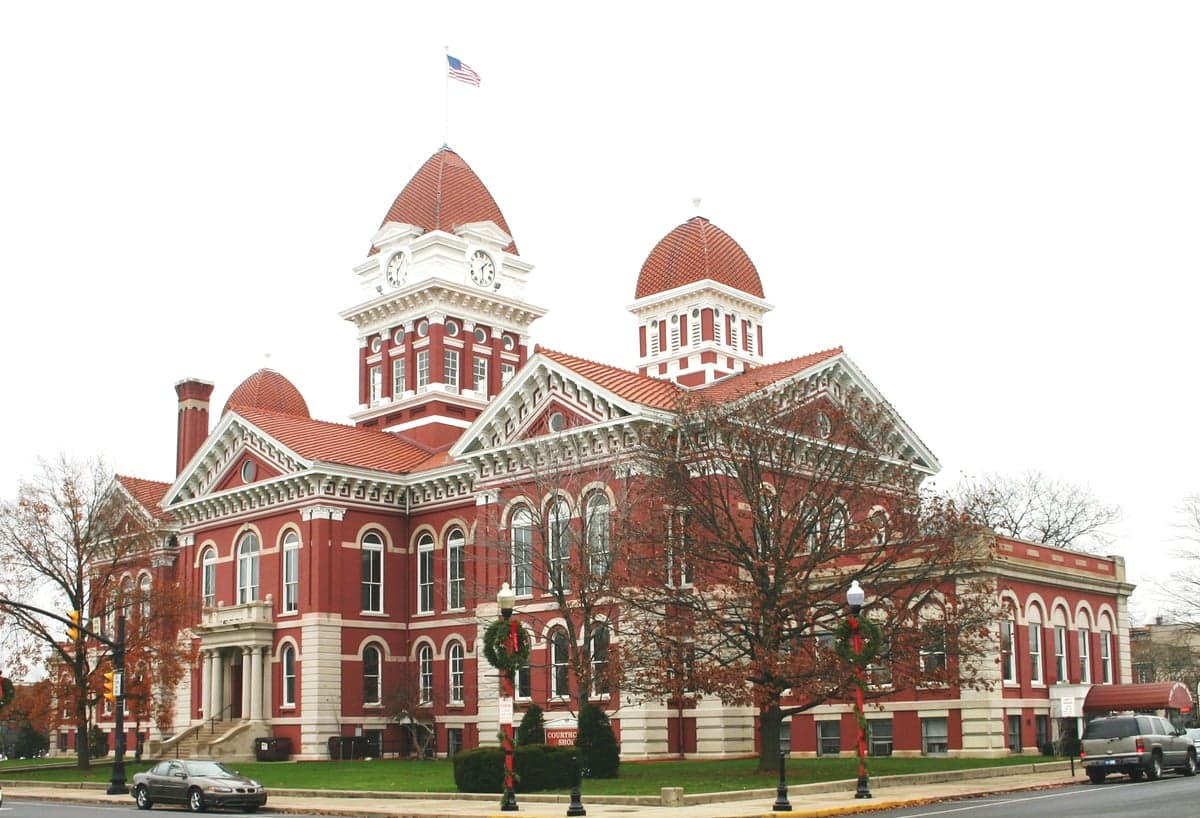
Crown Point was founded in 1834 as the seat of Lake County, drawing its first wave of settlers—primarily Yankee farmers from New England and New York—who were attracted by the fertile prairie land and the promise of government land grants under the 1820 Land Act. These early arrivals built the Historic Downtown Square area, centered on the 1878 courthouse, which remains the city’s social and commercial heart. A second wave came with the railroad in the 1850s, bringing German and Irish immigrants who worked on the tracks and established farms in what is now the West Crown Point neighborhood, where many of their descendants still live. By the early 20th century, the city’s population hovered around 2,000, with a third wave of Polish and Italian immigrants arriving to work in the region’s expanding steel mills and limestone quarries, settling in the Southlake Addition area near the rail lines. These groups built the city’s Catholic churches and ethnic social clubs, laying a foundation of ethnic diversity that remained largely white and European until the mid-20th century.
Modern era (post-1965)
The post-1965 era brought significant demographic change, driven by suburbanization from Chicago and the 1965 Immigration Act’s family reunification provisions. The 1970s and 1980s saw a wave of white middle-class families moving from Chicago’s South Side into subdivisions like Lakes of the Four Seasons (a large unincorporated area adjacent to Crown Point) and the Brookshire neighborhood, seeking larger homes and better schools. This domestic in-migration swelled the city’s population from 10,000 in 1970 to over 27,000 by 2010. The Hispanic population began growing in the 1990s, primarily Mexican-origin families drawn to construction and service jobs in the region, settling in the North Street Corridor near the city’s industrial edge. The Black population, historically small at under 3% in 2000, has grown to 8.6% as of 2024, with families moving from Gary and East Chicago into the Maple Lane and West 109th Avenue areas, attracted by Crown Point’s lower crime rates and better-funded schools. The East/Southeast Asian community (0.7%) and Indian subcontinent community (0.2%) remain tiny, concentrated among professionals in the medical and tech sectors near the Franciscan Health Crown Point hospital campus. The foreign-born share of 2.1% is well below the national average of 13.7%, reflecting the city’s limited draw for recent immigrants compared to larger Lake County cities like Hammond or East Chicago.
The future
Crown Point’s population is projected to grow modestly to around 38,000 by 2040, driven by continued suburban spillover from Chicago and the expansion of the I-65 corridor to the west. The white population is slowly declining as a share (from 82% in 2010 to 74.6% today), while the Hispanic and Black populations are growing steadily, though not at the explosive rates seen in neighboring Merrillville or Gary. The city is not tribalizing into distinct ethnic enclaves; instead, new subdivisions like Hidden Lake Estates and Prairie Crossing are attracting a mix of white, Hispanic, and Black families, reflecting a trend toward integration rather than segregation. The immigrant communities—Hispanic, East/Southeast Asian, and Indian—are small and assimilating quickly, with second-generation residents likely to identify as American first. The next decade will likely see Crown Point become slightly more diverse but remain a predominantly white, middle-class suburb, with the main demographic pressure being an aging population (median age 39.2) and the need to attract younger families to sustain school enrollment and tax base.
For someone moving in now, Crown Point is becoming a stable, moderately diverse suburb where the old ethnic divisions of the industrial era are fading, replaced by a common identity centered on schools, safety, and the courthouse square. The city offers a predictable, family-oriented environment with limited cultural friction, but those seeking a truly multicultural or immigrant-rich setting will find it elsewhere in Lake County. The bottom line: Crown Point is a place where the past is preserved in its historic neighborhoods, but the future is being built by families of all backgrounds who value the same things—good schools, low crime, and a sense of community.

* Values derived from national, state, county, city and local statistics and may differ in a specific area. Last updated: 2026-04-19T10:10:12.000Z
Narrative content on this page is AI-generated and may contain mistakes. Verify any details that matter before acting on them.
ReloMaps may earn a commission from affiliate links at no extra cost to you.

