
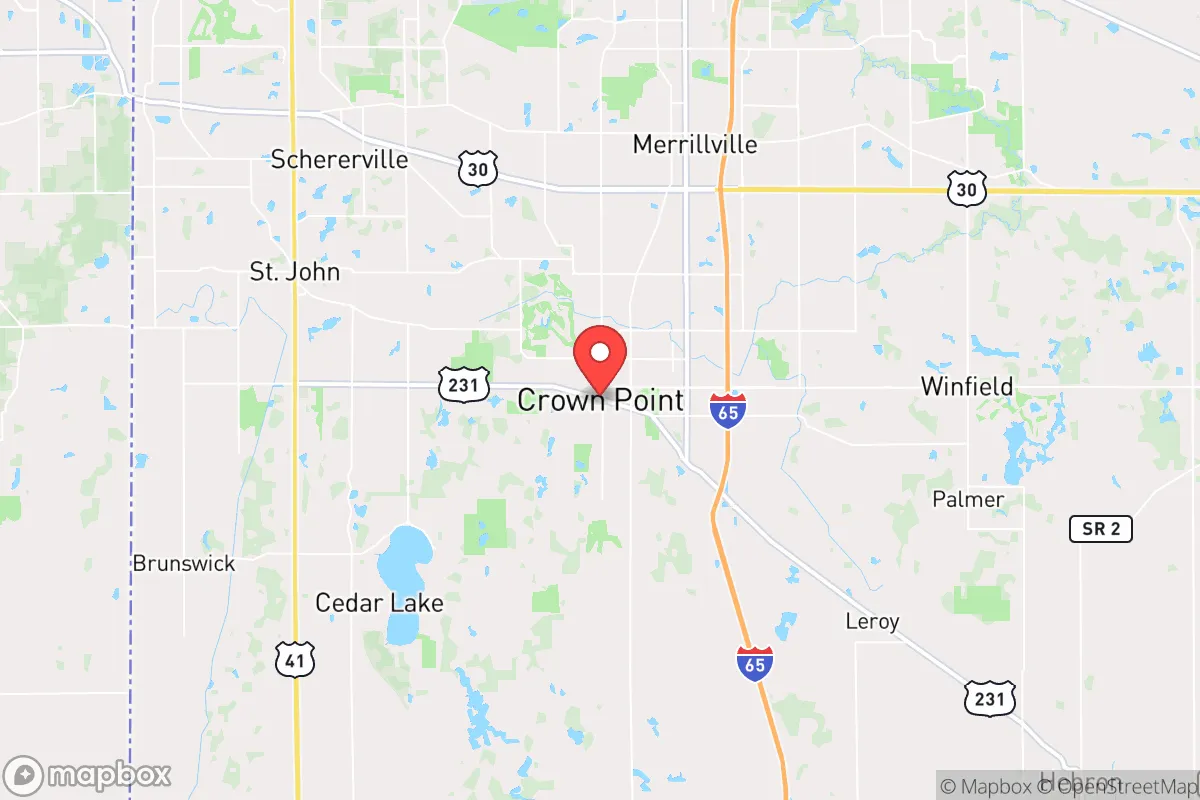
Photo: Wikipedia
Strategic Assessment of Crown Point, IN
Multiple tactical vulnerabilities. Population density, target proximity, or disaster risk are likely compounding. A retreat property and exit planning is required.
What does the Strategic Assessment tell us?
Our Strategic Assessment grades tactical survivability of an area. Major population centers, military targets, fallout zones, natural disasters, and border exposure all drive risk — lower exposure means a more defensible position in a crisis.
This is heavily inspired by Joel Skousen's Strategic Relocation book. Highly recommended you checkout the book ($)What does this tell us?
Our Strategic Assessment grades tactical survivability of an area. Major population centers, military targets, fallout zones, natural disasters, and border exposure all drive risk — lower exposure means a more defensible position in a crisis.
This is heavily inspired by Joel Skousen's Strategic Relocation book. Highly recommended you checkout the book ($)Strategic Pillars

Key Distances
Regional Safe Places
Below is our recommended "safe zones" in Indiana and the surrounding area based on our strategic heuristics. For most people, it's unrealistic to live in a “safe zone” full-time due to work, family or other personal reasons. They tend to be more rural. However, many of these areas are perfect for second homes and retreat properties that double as a vacation home or even a short-term rental.

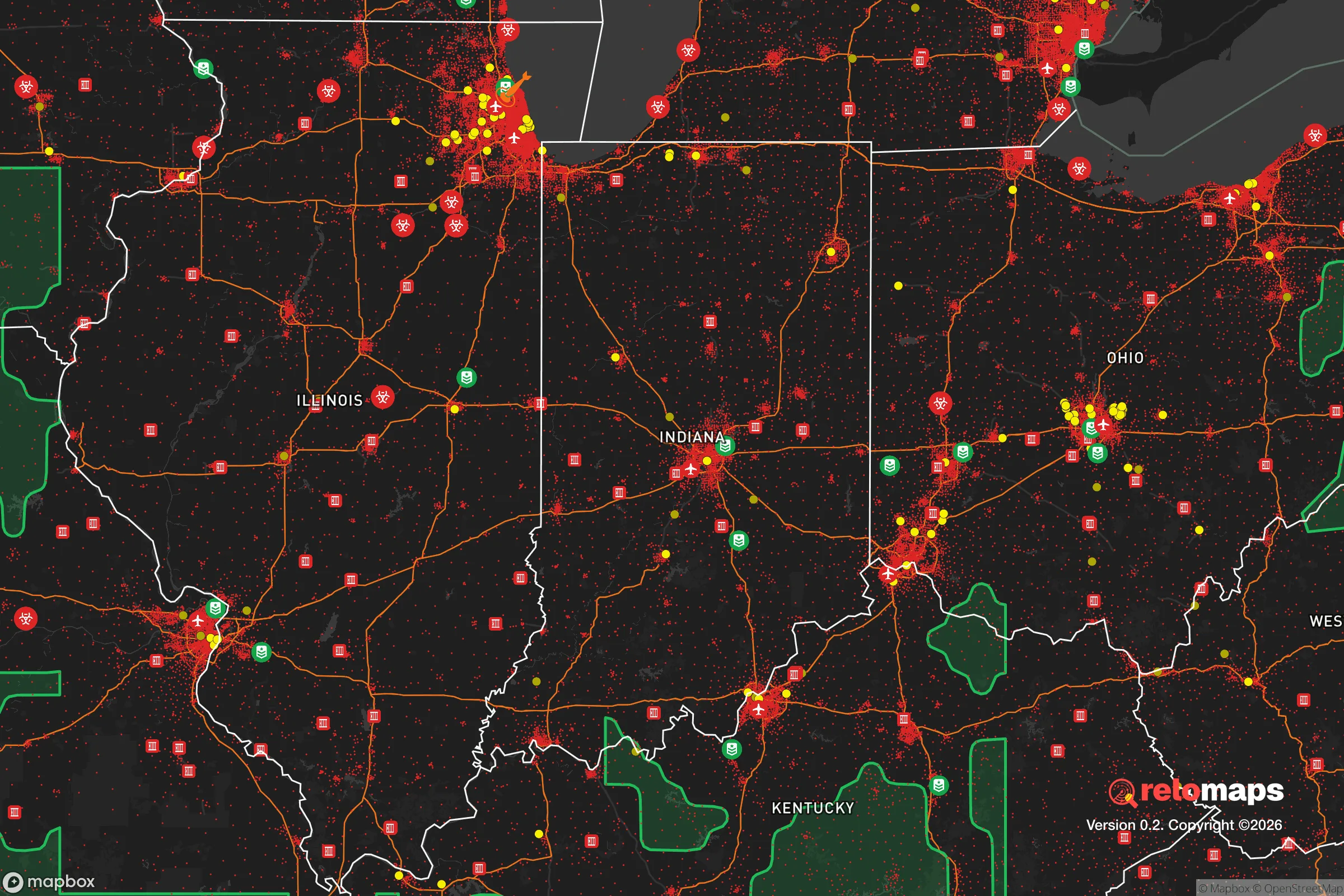


Important Note: For informational purposes only. This does not mean nothing bad ever happens in the green zones. Please use common sense. This is based on public data and modeled with AI. We tried to take a conservative approach but mistakes happen. We update this regularly as new information becomes available.
Solar Generator Recommendations
Backup power matters more here than in safer locations. We've picked three solar generators across budgets and capacity tiers — start with the budget unit if you only need a few essentials, or step up if you want to run a fridge and HVAC for days at a time.

Jackery Portable Power Station Explorer 300
Budget OptionPower on the Go: Weighing only 11 lbs, it's convenient to set up and store with book-sized foldable solar panels

BLUETTI Portable Power Station AC180
Designed for both indoor and outdoor scenarios, AC180 is highly capable as it has a robost capacity and continuous output power.

EF ECOFLOW DELTA Pro Ultra Power Station
Upgraded PickEcoFlow DELTA Pro Ultra is a whole-home energy system designed to grow with your family. Integrated with the Smart Home Panel 2, it scales to meet your evolving energy needs — keeping your home powered, intelligent, and secure through every stage of life.
We earn a commission, at no additional cost to you.
Strategic Assessment Analysis
Crown Point, Indiana, offers a surprisingly resilient strategic position for those prioritizing preparedness and stability, sitting roughly 35 miles southeast of Chicago’s urban core while maintaining a distinct small-town character. Its location in Lake County places it within the Chicago metropolitan area’s economic orbit, but the town itself—with a population around 30,000—retains a slower pace and a more self-reliant culture. For the conservative-minded relocator concerned with civic unrest, mass casualty events, or cascading disasters, Crown Point’s key advantage is its ability to function as a buffer zone: close enough to access resources and medical infrastructure, yet far enough to avoid the immediate fallout of a major urban crisis. The area’s historical resilience, rooted in its agricultural past and growing exurban development, makes it a pragmatic choice for those seeking a balance between connectivity and security.
Geographic position and natural advantages for long-term stability
Crown Point sits on the relatively flat, fertile terrain of the Kankakee Outwash Plain, a region that historically supported farming and now offers decent drainage and soil quality for small-scale food production. Its elevation—around 750 feet above sea level—is modest but provides a slight advantage over flood-prone areas along the Lake Michigan shoreline, which is about 15 miles north. The town is not situated on any major fault lines, and tornado risk, while present, is comparable to much of the Midwest; the area averages about 5-7 tornado warnings per year, with most being weak EF0-EF1 events. Crown Point’s most significant natural advantage is its access to the Kankakee River Basin and the Grand Kankakee Marsh, a vast wetland system that acts as a natural water filter and flood buffer. This marshland, though partially drained for agriculture, still provides a substantial groundwater recharge zone, meaning private wells in the area are generally reliable. For a prepper, this translates to a lower risk of water scarcity during a prolonged grid-down scenario compared to more arid regions. The surrounding countryside also offers numerous small lakes and ponds, such as Cedar Lake and Lake of the Four Seasons, which can serve as emergency water sources if properly treated.
Risks, exposures, and proximity to fallout-relevant landmarks
The most glaring vulnerability for Crown Point is its proximity to Chicago, a major population center and a likely flashpoint for civil unrest, mass casualty events, or infrastructure collapse. In a worst-case scenario involving a nuclear detonation or large-scale terrorist attack on Chicago’s downtown or O’Hare International Airport, Crown Point lies within the moderate fallout zone for prevailing winds from the west or northwest. Depending on yield and wind direction, radioactive particles could reach the area within 2-4 hours, requiring shelter-in-place protocols for at least 48 hours. The town is also within 20 miles of the BP Whiting Refinery—one of the largest oil refineries in the Midwest—which is a high-value target for both state and non-state actors. A major industrial accident or sabotage at that facility could release toxic clouds of hydrogen fluoride or sulfur dioxide, potentially drifting southeast toward Crown Point. Additionally, the nearby Gary/Chicago International Airport and the extensive rail yards in East Chicago and Hammond are choke points for supply chains; a disruption there would immediately affect fuel and food deliveries to the region. On the positive side, Crown Point is far enough from the Lake Michigan shoreline to avoid direct tsunami or storm surge risks, and its inland position reduces exposure to lake-effect snow extremes that can paralyze communities closer to the water.
Practical resilience for a relocator: food, water, energy, and defensibility
For a relocator serious about self-sufficiency, Crown Point offers a mixed but workable environment. Water is the strongest asset: the area’s high water table and abundant private wells mean that with a hand pump or solar-powered pump, a household can maintain water access even during a prolonged power outage. Municipal water from the Indiana American Water system is treated and reliable, but a prepper should plan for a backup well or rainwater catchment system, as the city’s supply is vulnerable to contamination from upstream industrial sites. Food production is feasible but requires effort: the growing season runs roughly from April to October, with fertile loam soils that support vegetables, fruits, and small grains. Local farmers’ markets and U-pick operations are common, but for long-term storage, relocators should consider building a root cellar or investing in freeze-drying equipment, as the humid summers can spoil stored goods quickly. Energy resilience is moderate—natural gas is widely available for heating and cooking, but the grid is tied to the larger PJM Interconnection, which has faced reliability concerns in recent years. Solar panels are a viable option, as the area receives about 200 sunny days per year, though winter cloud cover can reduce output. Defensibility is Crown Point’s weakest point: the town is flat, with open fields and suburban sprawl that offer little natural cover or chokepoints for perimeter security. The historic downtown square, with its courthouse and brick buildings, could serve as a rally point, but most residential neighborhoods are exposed. For a relocator, the best strategy is to secure a property on the outskirts—preferably with a wooded buffer or near the marshlands—to create a more defensible position. Community ties are strong in Crown Point, with a conservative-leaning population that values self-reliance and neighborly cooperation, which can be a force multiplier in a crisis.
The overall strategic picture for Crown Point is one of calculated trade-offs. It is not a remote survivalist retreat—it is too close to Chicago and its associated risks for that. But for the conservative relocator who wants to maintain a professional career or access to urban amenities while building a resilient homestead, it offers a viable middle ground. The key is to treat Crown Point as a base of operations, not a final redoubt: stockpile supplies for at least 90 days, develop a bug-out plan for a more rural location in southern Indiana or Michigan if the situation deteriorates, and invest in community relationships that can provide mutual aid. The town’s schools, hospitals, and local government are functional and generally aligned with traditional values, which reduces the friction of daily life. In a world where the next crisis could be a cyberattack on the grid, a pandemic resurgence, or a breakdown of civil order in major cities, Crown Point offers a defensible, resource-rich, and culturally compatible option for those who refuse to be caught unprepared.

* Values derived from national, state, county, city and local statistics and may differ in a specific area. Last updated: 2026-04-19T10:10:12.000Z
Narrative content on this page is AI-generated and may contain mistakes. Verify any details that matter before acting on them.
ReloMaps may earn a commission from affiliate links at no extra cost to you.

