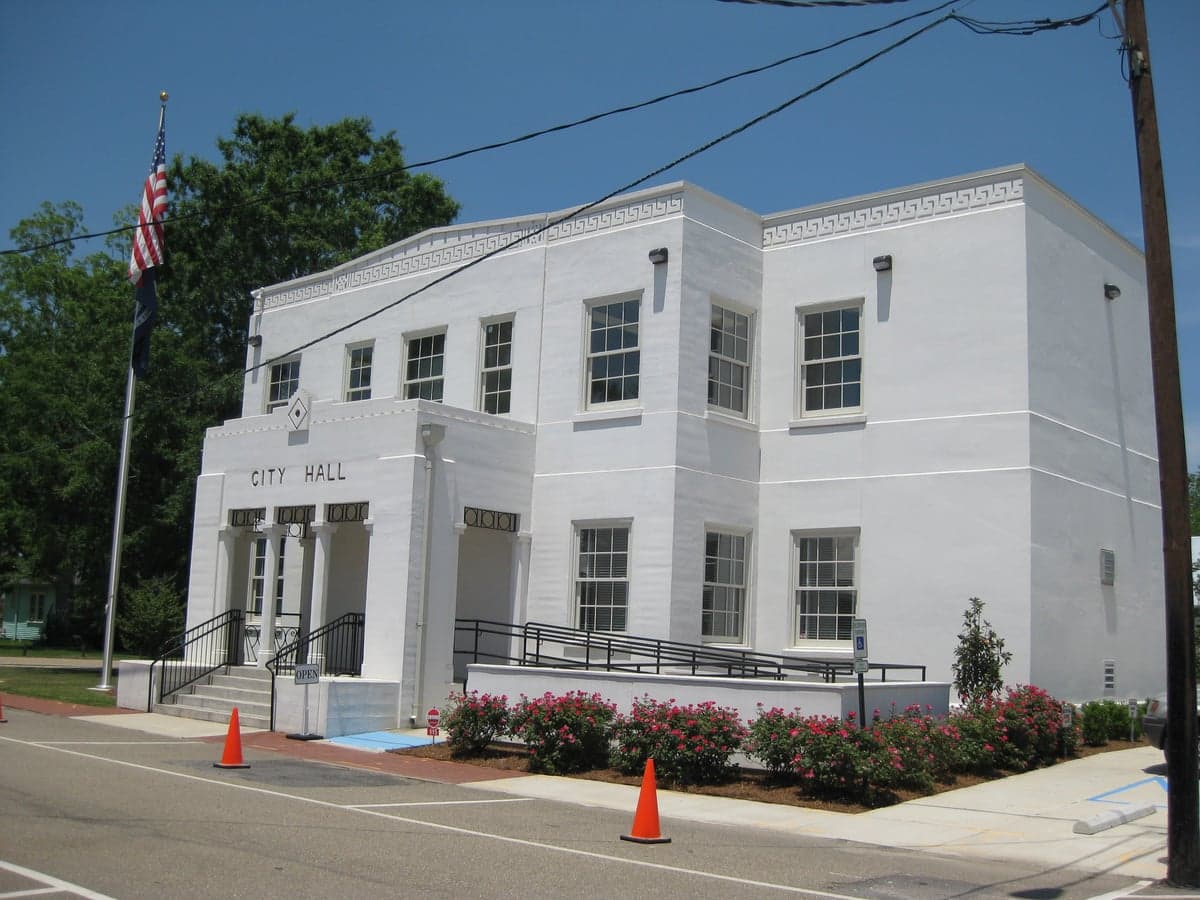
Photo: Wikipedia
Demographics of Denham Springs, LA
Affluence Level in Denham Springs, LA
A middle-class area roughly in line with national averages across income, home values, education, and employment.
People of Denham Springs, LA
The people of Denham Springs, Louisiana today number 9,362, forming a predominantly white (73.1%) community with a notable Hispanic minority (12.0%) and a Black population of 11.7%. The city’s identity is rooted in its small-town, family-oriented character, with a foreign-born share of 8.7% and a college-educated rate of 22.7% that reflects a mix of working-class and professional households. Residents often describe the city as a quieter, more affordable alternative to Baton Rouge, with a strong sense of local tradition and a growing diversity that is reshaping its historic character.
How the city was settled and grew
Denham Springs was founded in the early 19th century as a small farming and timber community along the Amite River. The original settlers were primarily Anglo-American families from the Upland South—Tennessee, Kentucky, and the Carolinas—who were drawn by cheap land grants and the region’s abundant pine forests. By the 1850s, the arrival of the railroad spurred a modest population of merchants and laborers, many of whom built homes in what is now the Historic District along Range Avenue. The city’s early economy revolved around sawmills, cotton ginning, and subsistence farming, with a small number of German and Irish immigrants arriving in the late 1800s to work in the timber industry. These groups settled in the Old Mill neighborhood, near the river, where their descendants still live today. Denham Springs remained a rural hamlet of fewer than 1,000 residents until the mid-20th century, when the expansion of the Baton Rouge petrochemical industry began drawing workers southward.
Modern era (post-1965)
The post-1965 period transformed Denham Springs from a sleepy river town into a suburban bedroom community for Baton Rouge. The 1965 Voting Rights Act and the subsequent desegregation of Baton Rouge schools prompted a wave of white flight from the capital city, with many families relocating to Denham Springs for its lower taxes and perceived safety. This domestic in-migration concentrated in new subdivisions like South Park and Riverbend, which were developed in the 1970s and 1980s on former farmland. The city’s population more than doubled between 1970 and 1990, reaching 6,000, as the local economy shifted from timber to retail and services. The Hispanic population began to grow in the 1990s, driven by construction and service-sector jobs in the Baton Rouge metro area. These families settled primarily in the Spring Park area, near the interstate, where a small cluster of Hispanic-owned businesses now operates. The Black population, historically small due to the city’s rural origins and white-flight dynamics, has remained relatively stable at around 11-12% since 2000, with most Black residents living in the North Range neighborhood, an older area near the city’s original core. The Asian population is effectively zero, with no East/Southeast Asian or Indian-subcontinent communities recorded in the data.
The future
Denham Springs is likely to continue its slow, steady growth as a lower-cost alternative to Baton Rouge, but demographic shifts are modest. The Hispanic share, currently 12.0%, is the fastest-growing segment, driven by both domestic migration from other Louisiana cities and limited foreign-born arrivals. This group is concentrated in the Spring Park and South Park neighborhoods, where they are gradually integrating into the broader community through schools and local churches. The white population, while still the majority, is aging and declining slightly as younger families move to newer subdivisions in nearby Walker or Watson. The Black population is plateauing, with little new in-migration from Baton Rouge. The foreign-born share (8.7%) is likely to remain stable or grow slowly, as Denham Springs lacks the industrial or agricultural jobs that attract larger immigrant flows. Over the next 10-20 years, the city is expected to become slightly more Hispanic and slightly less white, but it will remain a predominantly white, middle-class suburb with a strong local identity. The city is not tribalizing into distinct enclaves; rather, it is slowly homogenizing as newer residents of all backgrounds adopt the area’s small-town norms.
For someone moving in now, Denham Springs offers a stable, family-oriented community with a growing Hispanic presence and a largely white, conservative-leaning population. The city is becoming more diverse at a gradual pace, but its core character—quiet, affordable, and rooted in local tradition—is likely to persist. New residents should expect a place where change is slow and community ties remain strong, with the Baton Rouge metro’s amenities just a short drive away.

* Values derived from national, state, county, city and local statistics and may differ in a specific area. Last updated: 2026-04-21T01:25:21.000Z
Narrative content on this page is AI-generated and may contain mistakes. Verify any details that matter before acting on them.
ReloMaps may earn a commission from affiliate links at no extra cost to you.

