Photo: Wikipedia
Demographics of Destin, FL
Affluence Level in Destin, FL
An upper-middle-class area. Household wealth, education levels, and homeownership run ahead of national benchmarks.
People of Destin, FL
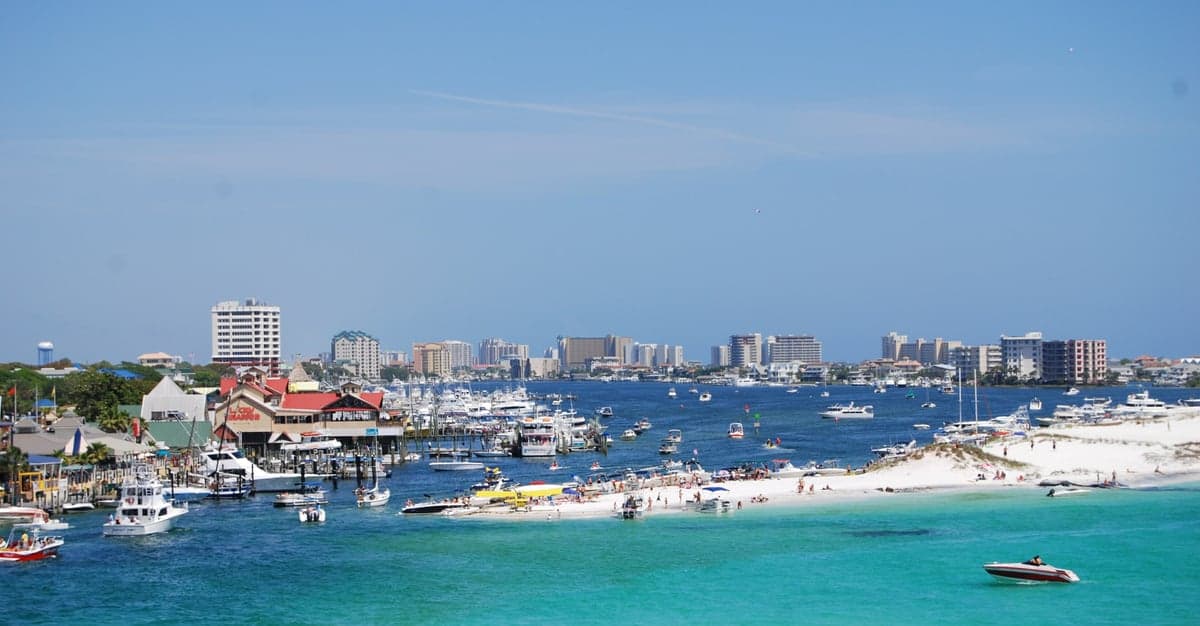
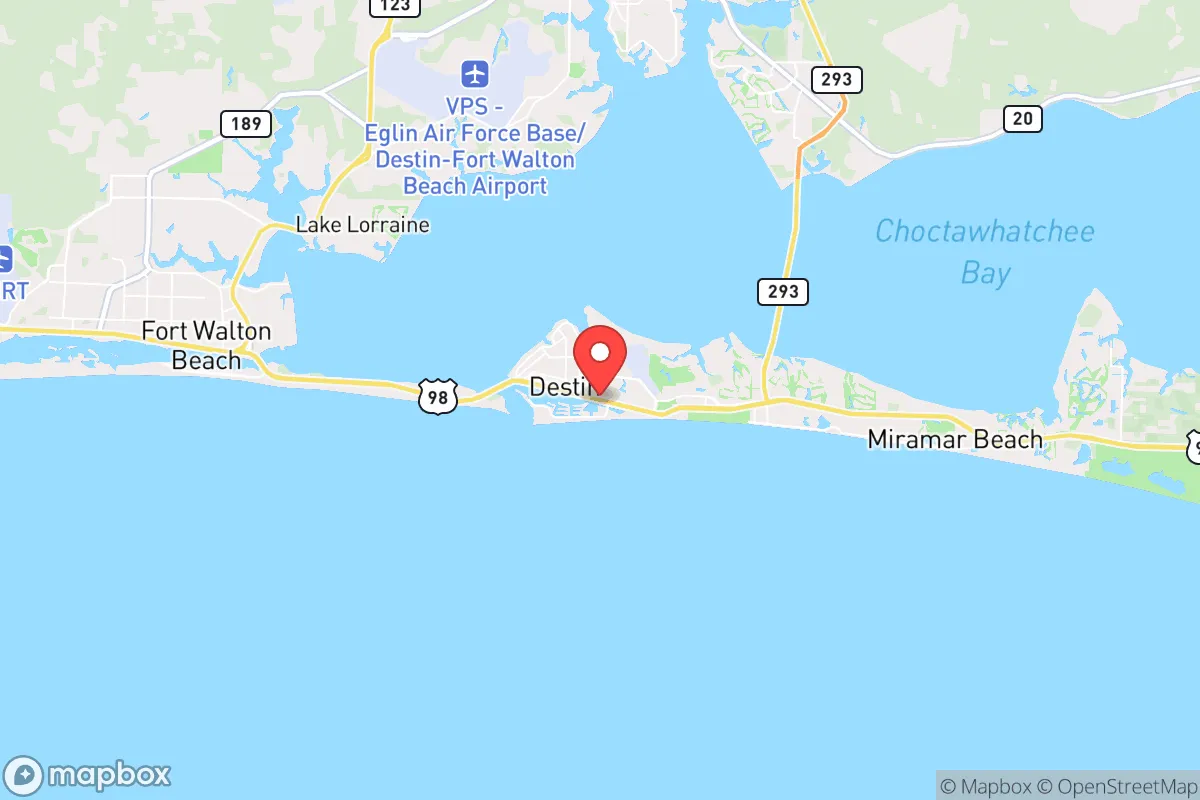
The people of Destin, Florida today form a predominantly white, college-educated population of 14,018, with a notable 9.2% foreign-born share and a distinctive identity shaped by tourism, military service, and second-home ownership. The city ranks as one of the most affluent in the Florida Panhandle, with a median household income well above the state average, driven by a concentration of professionals in hospitality, real estate, and remote work. Its character is defined by a transient yet stable mix: longtime fishing families, military retirees from nearby Eglin Air Force Base, and seasonal residents who maintain vacation homes along the Emerald Coast. The population density is moderate for a beach town, with most development clustered along U.S. Highway 98 and the harbor area.
How the city was settled and grew
Destin’s human history begins not with colonial settlement but with a single family. In the 1830s, Captain Leonard Destin, a New England fisherman, established a seasonal fishing camp on the eastern end of what is now the city, drawn by the abundant red snapper and mackerel in the Gulf. His descendants, along with a handful of other fishing families, formed the core of the original settlement, which remained an isolated, all-white hamlet of fewer than 100 people through the early 1900s. The area lacked a formal land grant system; instead, families simply built on the sandy peninsula, and the first permanent homes appeared in what is now Destin Harbor, the historic heart of the community. The fishing industry dominated until the 1930s, when the construction of the Marler Bridge (1935) connected Destin to the mainland and opened the door to summer visitors. The original population was entirely native-born white, with no recorded Black or immigrant presence until after World War II.
Modern era (post-1965)
The post-1965 era transformed Destin from a fishing village into a resort town. The Immigration and Nationality Act of 1965 had little direct effect here—the foreign-born share remains modest at 9.2%—but domestic in-migration surged. The opening of the Mid-Bay Bridge in 1993 accelerated growth, and the city’s population more than doubled between 1990 and 2010. The dominant influx came from the Midwest and Southeast: retirees, military personnel stationed at Eglin Air Force Base and Hurlburt Field, and entrepreneurs drawn to the tourism economy. These newcomers settled primarily in Sandestin, a master-planned golf-and-beach resort community that began development in the 1970s, and in Crystal Beach, a neighborhood of vacation rentals and second homes west of the harbor. The Hispanic population, now 8.6%, grew steadily from the 1990s onward, largely through service-industry workers—hotel staff, restaurant workers, and construction laborers—who found affordable rentals in Kelly Plantation and along the U.S. 98 corridor. The Black population remains small at 3.3%, concentrated in scattered pockets near the harbor and in older mobile-home parks. East/Southeast Asian residents (0.7%) are primarily Filipino and Vietnamese families connected to the military, living near Eglin’s gate areas rather than within Destin proper. The Indian-subcontinent population is effectively zero (0.0%), consistent with the city’s lack of tech or medical-research employment. The college-educated share of 46.0% reflects the influx of professionals and retirees, though it masks a sharp divide: the native-born fishing families often have high-school-only educations, while newcomers in Sandestin and Crystal Beach are overwhelmingly degree-holders.
The future
Destin’s population is heading toward further homogenization in income and education, but with a subtle tribalization by lifestyle. The city is essentially built out—land constraints on the peninsula mean little new housing can be added—so future growth will come from densification and redevelopment of older properties. The Hispanic share is likely to plateau around 10-12%, as service jobs are increasingly filled by commuters from Okaloosa County’s inland towns rather than new immigrants. The white share (80.4%) will remain dominant, but the character of that population is splitting: Destin Harbor and Old Destin retain a working-fishing identity, while Sandestin and Crystal Beach are becoming enclaves of wealthy seasonal residents and remote workers. The military-connected population will remain stable as long as Eglin and Hurlburt remain active. No significant growth is expected for Black or Asian communities, as the local economy offers few middle-class jobs outside tourism and real estate. The city is not tribalizing along racial lines but along economic and lifestyle ones: permanent locals versus part-time residents, a divide that will deepen as property values rise and affordable housing shrinks.
For someone moving in now, Destin offers a stable, predominantly white, college-educated community with a strong military and tourism identity. The city is becoming more affluent and more seasonal, with a growing gap between longtime residents and newcomers. The population is not diversifying rapidly, and the foreign-born share is modest and service-oriented. New arrivals should expect a place where social circles are shaped by occupation (military, fishing, hospitality) and by neighborhood (harbor-side versus resort-side), rather than by race or ethnicity. The bottom line: Destin is a mature, built-out resort town where the population is consolidating into two distinct groups—those who work the water and those who vacation beside it.

* Values derived from national, state, county, city and local statistics and may differ in a specific area. Last updated: 2026-04-19T06:57:33.000Z
Narrative content on this page is AI-generated and may contain mistakes. Verify any details that matter before acting on them.
ReloMaps may earn a commission from affiliate links at no extra cost to you.

