Photo: Wikipedia
Demographics of Downers Grove, IL
Affluence Level in Downers Grove, IL
An upper-middle-class area. Household wealth, education levels, and homeownership run ahead of national benchmarks.
People of Downers Grove, IL
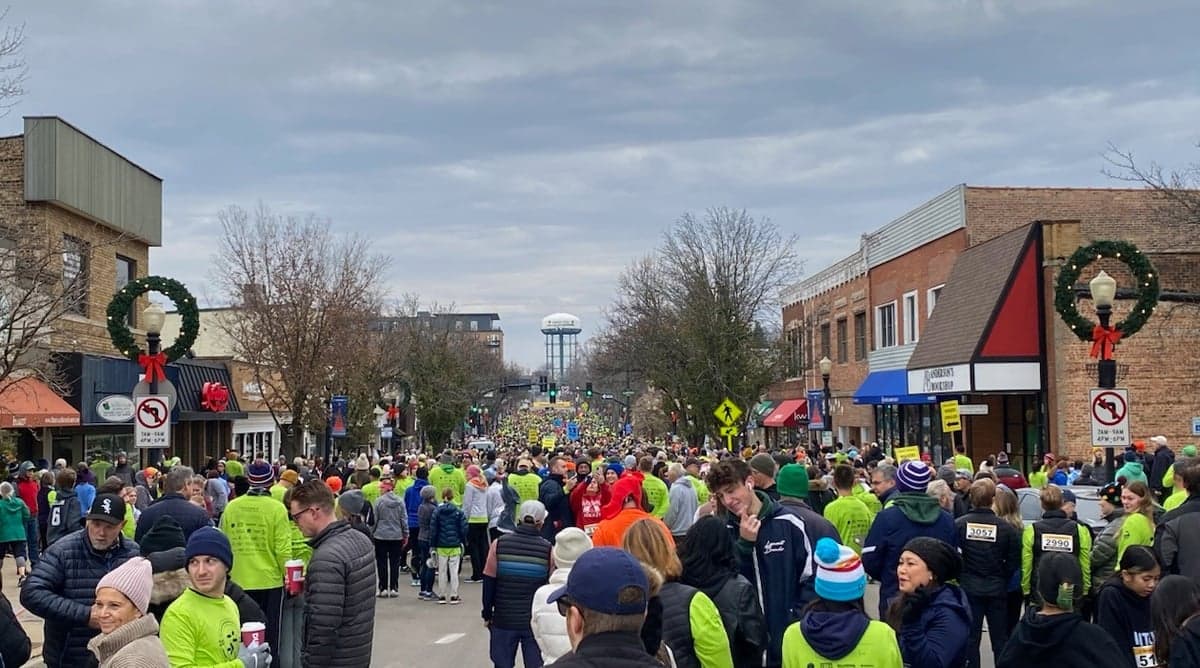
The people of Downers Grove, Illinois, today form a predominantly white, highly educated, and family-oriented community of roughly 50,000 residents. With 82.1% of the population identifying as white and nearly 59% holding a college degree, the city carries a distinctly professional, upper-middle-class character. Its identity is rooted in historic railroad suburbs, strong public schools, and a civic culture that values preservation and stability, making it a deliberate choice for families seeking a traditional suburban environment within commuting distance of Chicago.
How the city was settled and grew
Downers Grove was originally settled in the 1830s by Yankee and German farmers drawn to the fertile prairie land along the St. Joseph River. The arrival of the Chicago, Burlington and Quincy Railroad in 1864 transformed the farming hamlet into a commuter suburb, attracting a wave of middle-class Chicago businessmen and their families. The original village center, now known as Downtown Downers Grove, grew up around the train depot and remains the historic heart of the community. A second wave of settlement came in the 1880s and 1890s, when Swedish and Irish immigrants arrived to work on the railroad and in local brickyards. These groups established themselves in the Fairview Avenue corridor and the area around Grove Street, building modest homes and founding churches that still anchor those neighborhoods today. By 1900, the population had reached roughly 2,500, and the town had a stable, Protestant, largely Northern European character that would persist for decades.
Modern era (post-1965)
The post-1965 period saw Downers Grove continue its trajectory as a predominantly white, affluent suburb, but with notable infill and diversification. The 1970s and 1980s brought a wave of domestic in-migration from the city of Chicago and other Midwest states, drawn by the construction of I-355 and the expansion of corporate office parks along the I-88 corridor. New subdivisions like Belle Aire and Prentiss Creek were built on former farmland in the western and southern parts of town, attracting young families and professionals. The foreign-born population remains low at just 3.6%, but the composition has shifted. East and Southeast Asian communities (3.4% of the population) have concentrated in the newer, larger homes of Belle Aire and the Highland Park area, drawn by the reputation of Downers Grove North and South high schools. The Indian-subcontinent population (2.4%) has also grown, settling primarily in the Prentiss Creek and Maple Grove neighborhoods, where larger lots and newer construction are common. The Hispanic population (5.7%) is more dispersed, with a visible presence in the older, more affordable housing stock near Fairview Avenue and along the Ogden Avenue corridor. The Black population remains very small at 2.7%, concentrated in no single neighborhood. Overall, the city has not experienced the rapid ethnic succession seen in closer-in suburbs; instead, it has absorbed modest diversity through selective, high-skill immigration and domestic relocation.
The future
The demographic trajectory of Downers Grove points toward slow, incremental diversification rather than rapid change. The white population share, while still dominant at 82.1%, is likely to continue a gradual decline as older residents age in place and younger, more diverse families move into newer subdivisions. The East/Southeast Asian and Indian populations are expected to grow modestly, driven by professional employment in the nearby tech and pharmaceutical corridors, but they are unlikely to reach the concentrations seen in suburbs like Naperville or Schaumburg. The Hispanic population may grow slightly faster, particularly in the rental and older housing stock near the train station, but will remain a minority. The city is not tribalizing into distinct ethnic enclaves; rather, it is experiencing a slow assimilation pattern where new residents, regardless of background, tend to adopt the community's established norms of high educational attainment, civic engagement, and property investment. The next 10-20 years will likely see Downers Grove remain a stable, majority-white, highly educated suburb with a slowly expanding middle-class and upper-middle-class diversity.
For someone moving in now, Downers Grove represents a deliberate choice for stability, strong schools, and a traditional suburban lifestyle. It is not a place of rapid demographic upheaval or ethnic clustering, but a community where new residents are expected to integrate into an existing, well-defined culture. The city's future is one of gradual, managed change, making it a reliable option for families and professionals who prioritize continuity and quality of life over diversity or urban energy.

* Values derived from national, state, county, city and local statistics and may differ in a specific area. Last updated: 2026-04-23T09:37:46.000Z
Narrative content on this page is AI-generated and may contain mistakes. Verify any details that matter before acting on them.
ReloMaps may earn a commission from affiliate links at no extra cost to you.

