
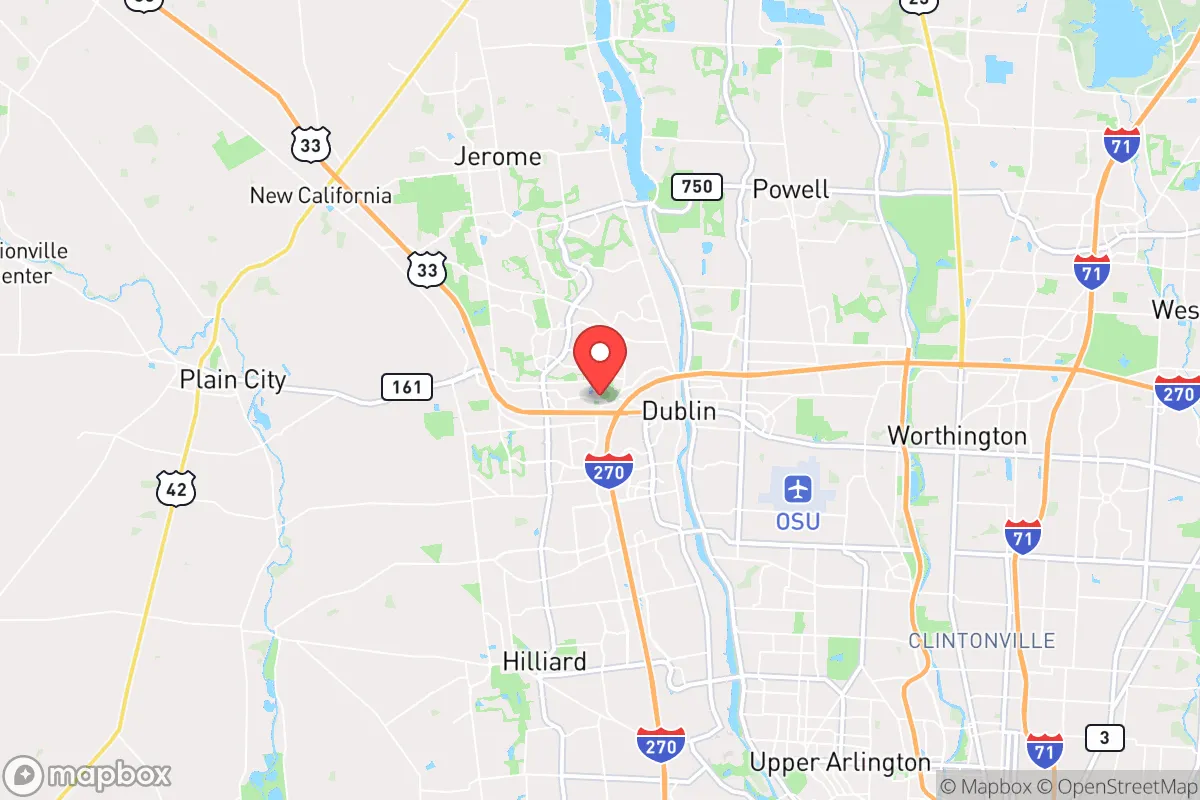
Photo: Wikipedia
Quality of Life in Dublin, OH
A high quality of life with strong walkability, manageable living costs, healthy neighborhood signals, and solid amenity access.
What does Quality of Life tell us?
Quality of Life blends cost of living, nearby amenities, socioeconomic signals, and neighborhood character. City-level scores represent the whole municipality; individual neighborhoods can differ.
What does this tell us?
Quality of Life blends cost of living, nearby amenities, socioeconomic signals, and neighborhood character. City-level scores represent the whole municipality; individual neighborhoods can differ.
Cost of Living
55% above national average
The Real Cost of Living in Dublin, OH for 2026
| Tier | Individual | Family (4) |
|---|---|---|
| Survival | $25k | $48k |
| Comfortable | $100k | $147k |
| Luxury | $248k+ | $385k+ |
| Elite (Top 5%) | $292k+ | $453k+ |
106%
The Area Signal
A metric tracking the socioeconomic signals of the area.


Hobbies
Explore the areaGroceries
1 within 10 miles
Gas
0 within 10 miles
Hospital
3 within 20 miles
Airport
John Glenn Columbus International Airport
Post Office
USPS — Dublin, OH
Critical Amenities
Quality-of-Life Analysis
Dublin, Ohio, is a high-affluence suburb northwest of Columbus where the cost of living index sits at 155 (55% above the U.S. average), reflecting a community built around top-tier schools, corporate headquarters, and master-planned neighborhoods. The population skews heavily toward educated professionals and families with children, drawn by a blend of tech-sector employment (Wendy’s, Cardinal Health, IGS Energy) and a nationally recognized public school system. Median household income in Dublin exceeds $120,000, placing it among the wealthiest suburbs in central Ohio.
Cost of living, housing, and how Dublin compares to nearby suburbs
Dublin’s housing market is the primary driver of its elevated cost of living. The median home value of $514,900 is roughly double the national median and significantly higher than neighboring suburbs such as Hilliard (median ~$380,000) or Upper Arlington (~$450,000). For renters, the median monthly rent of $1,596 is about 30% above the Columbus metro average, though still below the rents in comparable upscale suburbs like New Albany ($1,800+). The average commute of 23.9 minutes is slightly longer than the national average but shorter than many outer-ring suburbs, as Dublin’s job base—anchored by the Bridge Park mixed-use district and the Avery Road office corridor—keeps many residents working within the city itself. Property taxes in Dublin run roughly 1.8% of assessed value, which is moderate for Ohio but high relative to the national average, a trade-off that funds the district’s top-ranked schools.
What daily life is like for families: amenities, schools, and recreation
Daily life in Dublin revolves around the Dublin City School District, which consistently ranks among Ohio’s top 10 public districts and sends over 90% of graduates to four-year colleges. The district’s three high schools—Dublin Coffman, Jerome, and Scioto—each offer robust Advanced Placement and International Baccalaureate programs. Beyond academics, the city’s 60+ parks and the 1,200-acre Glacier Ridge Metro Park provide extensive trail networks, sports fields, and the Dublin Community Recreation Center. The Bridge Park development along the Scioto River functions as the city’s de facto downtown, with restaurants, a farmers market, and the Dublin Link pedestrian bridge connecting to the historic district. For daily errands, the intersection of Sawmill Road and Frantz Road is lined with grocery stores, pharmacies, and retail, though residents often commute to the Polaris Fashion Place or Easton Town Center for major shopping. The city also hosts the annual Dublin Irish Festival, one of the largest of its kind in the U.S., drawing over 100,000 visitors each August.
Dublin is best suited for families and professionals who prioritize school quality, low crime rates, and a suburban lifestyle with walkable pockets. Singles and young couples without children may find the social scene limited compared to Columbus’s Short North or German Village, and the high housing costs can be a barrier for first-time buyers. Retirees are present but less common, as the city lacks the age-restricted communities found in Sun Belt suburbs. For those who can afford the premium, Dublin offers a stable, amenity-rich environment with strong property value appreciation and direct access to Columbus’s job market via I-270 and State Route 33.

Crime in Dublin, OH
Lower crime rates than 86% of comparable U.S. locations.
Violent CrimeViolent Crime Analysis
Property CrimeProperty Crime Analysis
Crime Analysis
Dublin, Ohio, consistently ranks as one of the safest cities in the state, with violent and property crime rates that are a fraction of both the national average and the averages for the Columbus metropolitan area. The city’s overall crime rate is roughly 780 per 100,000 residents, compared to the U.S. average of approximately 2,300 per 100,000. This low crime environment is a major factor in Dublin’s reputation as a top-tier suburb for families and professionals, though residents should remain aware of localized property crime trends and the broader regional context of a large metro area.
Crime in context
Dublin’s violent crime rate of 90.9 per 100,000 residents is dramatically lower than the national average of roughly 380 per 100,000 and well below the Ohio state average of about 300 per 100,000. Property crime in Dublin stands at 689.1 per 100,000, compared to the U.S. average of approximately 1,950 per 100,000. These figures place Dublin among the safest municipalities in Ohio. However, as a suburb of Columbus—a large, growing metro area—Dublin is not immune to spillover effects. The broader Franklin County justice system, which includes judges and district attorneys in Columbus who have adopted progressive policies such as bail reform and reduced prosecution for certain non-violent offenses, can lead to higher recidivism and more criminals cycling back onto the streets. This regional dynamic means that while Dublin itself is safe, residents should be aware that the surrounding metro area’s justice philosophy can indirectly affect local safety through increased transient crime and property offenses.
What residents experience
For the typical Dublin resident, crime is a rare concern in daily life. The city’s violent crime rate is so low that the chance of becoming a victim of a violent offense is less than 1 in 1,000. Property crime, while more common, is still infrequent, with theft from vehicles and package theft being the most reported incidents. Dublin’s police department maintains a strong community presence and proactive approach, including neighborhood watch programs and regular patrols in commercial and residential areas. The city’s well-lit streets, extensive trail system, and active civic engagement further contribute to a sense of security. However, residents living near major corridors like Sawmill Road or the Bridge Street District may experience slightly higher rates of car break-ins and shoplifting, reflecting the transient traffic from the larger metro area.
Neighborhood-level variation
Safety in Dublin is remarkably consistent across neighborhoods, but some variation exists. The older, established neighborhoods near the historic district and Muirfield Village tend to have the lowest crime rates, with virtually no violent incidents. Newer developments on the city’s periphery, such as those near Avery Road or the northern edge close to Powell, also report very low crime. The most notable variation is in areas with higher commercial density and apartment complexes, where property crime rates can be double the city average. For example, the area around the Dublin-Sawmill Road corridor sees more thefts from vehicles and retail crime. Overall, Dublin’s neighborhood-level safety is uniformly high, and no area should be considered a significant concern for violent crime.
* Values derived from national, state, county, city and local statistics and may differ in a specific area. Last updated: 2026-04-19T06:47:41.000Z
Narrative content on this page is AI-generated and may contain mistakes. Verify any details that matter before acting on them.
ReloMaps may earn a commission from affiliate links at no extra cost to you.

