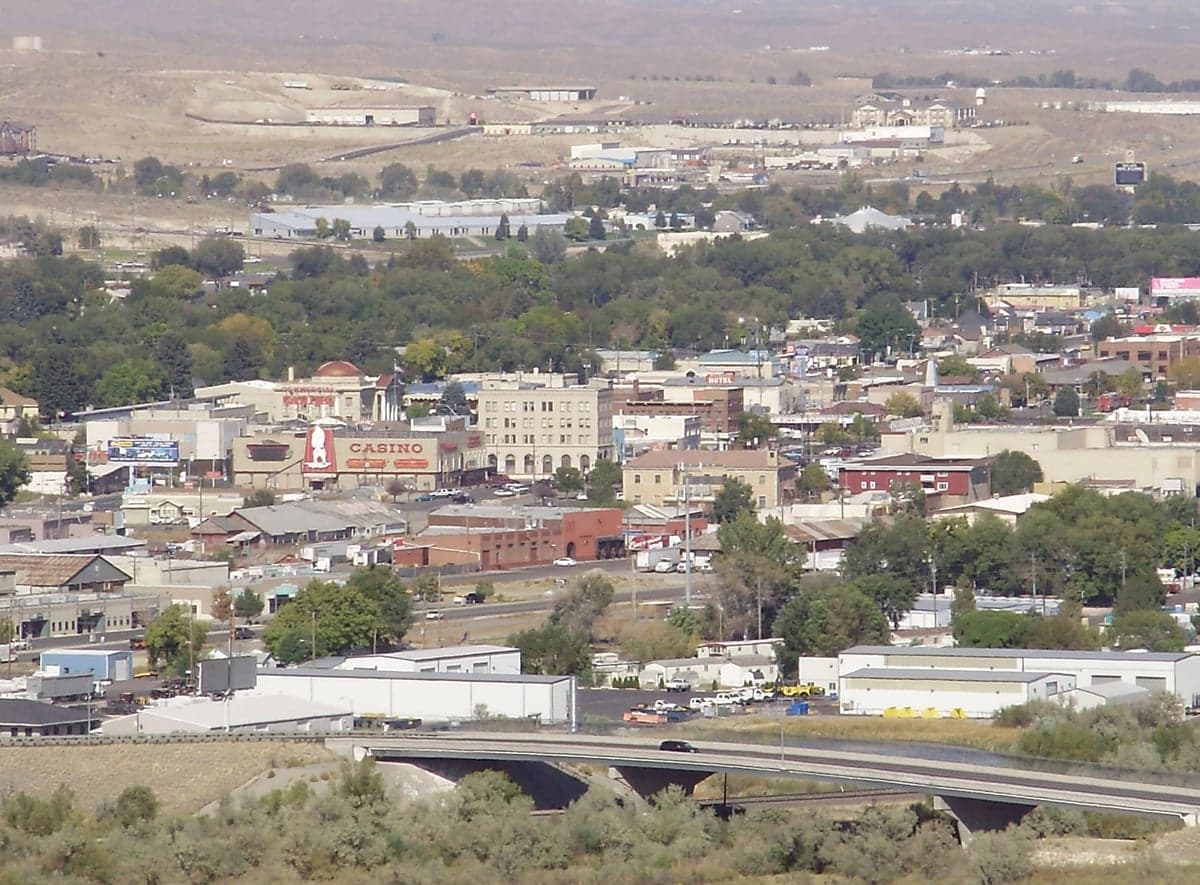
Photo: Wikipedia
Strategic Assessment of Elko, NV
Workable tactical position. Some exposure to population density or targets, but generally defensible in a crisis.
What does the Strategic Assessment tell us?
Our Strategic Assessment grades tactical survivability of an area. Major population centers, military targets, fallout zones, natural disasters, and border exposure all drive risk — lower exposure means a more defensible position in a crisis.
This is heavily inspired by Joel Skousen's Strategic Relocation book. Highly recommended you checkout the book ($)What does this tell us?
Our Strategic Assessment grades tactical survivability of an area. Major population centers, military targets, fallout zones, natural disasters, and border exposure all drive risk — lower exposure means a more defensible position in a crisis.
This is heavily inspired by Joel Skousen's Strategic Relocation book. Highly recommended you checkout the book ($)Strategic Pillars

Key Distances
Regional Safe Places
Below is our recommended "safe zones" in Nevada and the surrounding area based on our strategic heuristics. For most people, it's unrealistic to live in a “safe zone” full-time due to work, family or other personal reasons. They tend to be more rural. However, many of these areas are perfect for second homes and retreat properties that double as a vacation home or even a short-term rental.
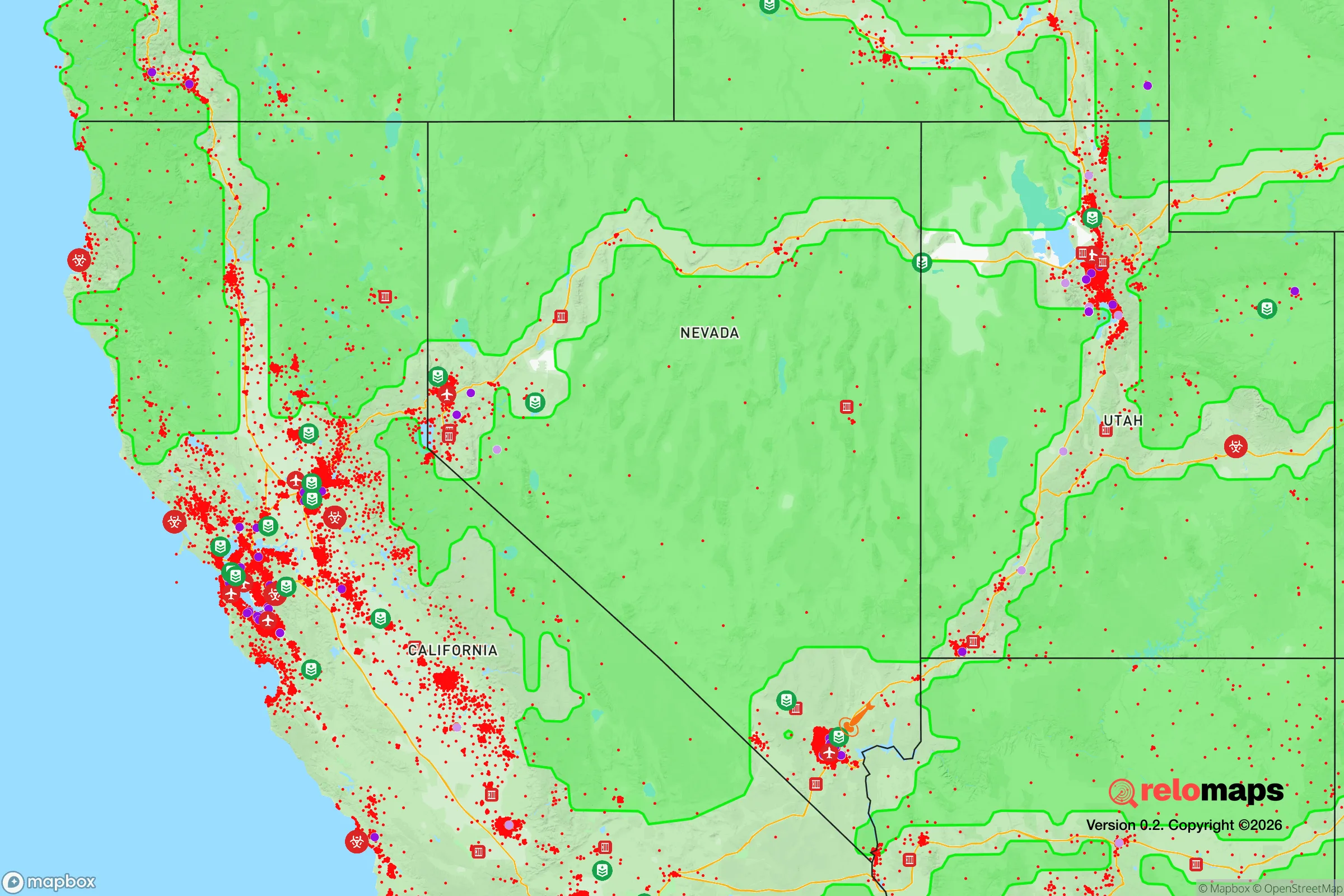
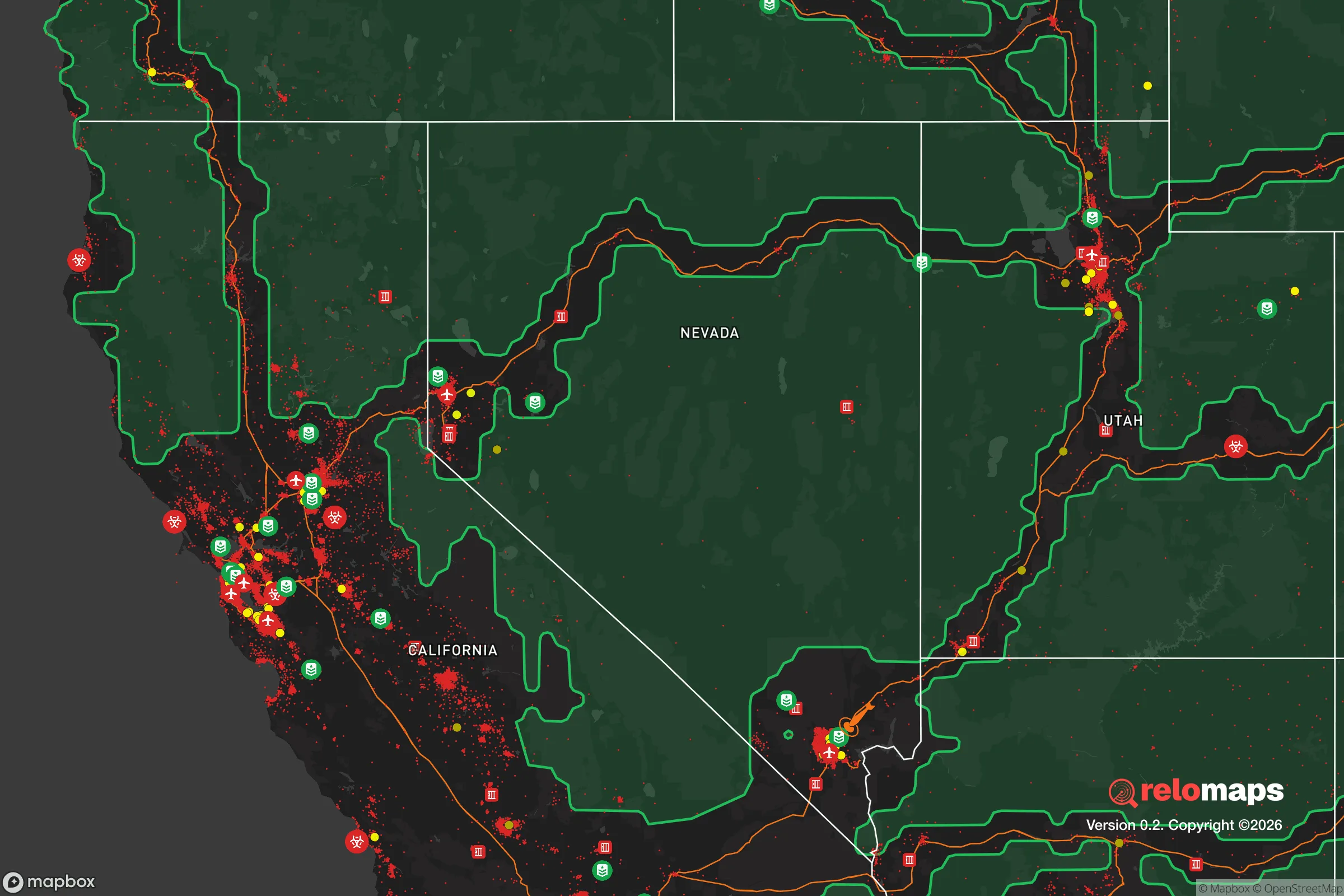


Important Note: For informational purposes only. This does not mean nothing bad ever happens in the green zones. Please use common sense. This is based on public data and modeled with AI. We tried to take a conservative approach but mistakes happen. We update this regularly as new information becomes available.
Solar Generator Recommendations
Backup power matters more here than in safer locations. We've picked three solar generators across budgets and capacity tiers — start with the budget unit if you only need a few essentials, or step up if you want to run a fridge and HVAC for days at a time.

Jackery Portable Power Station Explorer 300
Budget OptionPower on the Go: Weighing only 11 lbs, it's convenient to set up and store with book-sized foldable solar panels

BLUETTI Portable Power Station AC180
Designed for both indoor and outdoor scenarios, AC180 is highly capable as it has a robost capacity and continuous output power.

EF ECOFLOW DELTA Pro Ultra Power Station
Upgraded PickEcoFlow DELTA Pro Ultra is a whole-home energy system designed to grow with your family. Integrated with the Smart Home Panel 2, it scales to meet your evolving energy needs — keeping your home powered, intelligent, and secure through every stage of life.
We earn a commission, at no additional cost to you.
Strategic Assessment Analysis
Elko, Nevada, sits as one of the most strategically resilient locations in the lower 48, offering a rare combination of geographic isolation, economic self-sufficiency, and a deeply ingrained culture of independence that makes it a serious contender for anyone looking to put distance between themselves and the fragility of coastal metros. Its position along the Humboldt River corridor, far from the seismic fault lines of the West Coast and the political powder kegs of the interior, provides a natural buffer against both natural disasters and the cascading effects of civic unrest. For the prepper or survivalist who values hard assets, community competence, and a low-probability target profile, Elko represents a practical, not theoretical, relocation option.
Geographic isolation and natural buffer zones from major threats
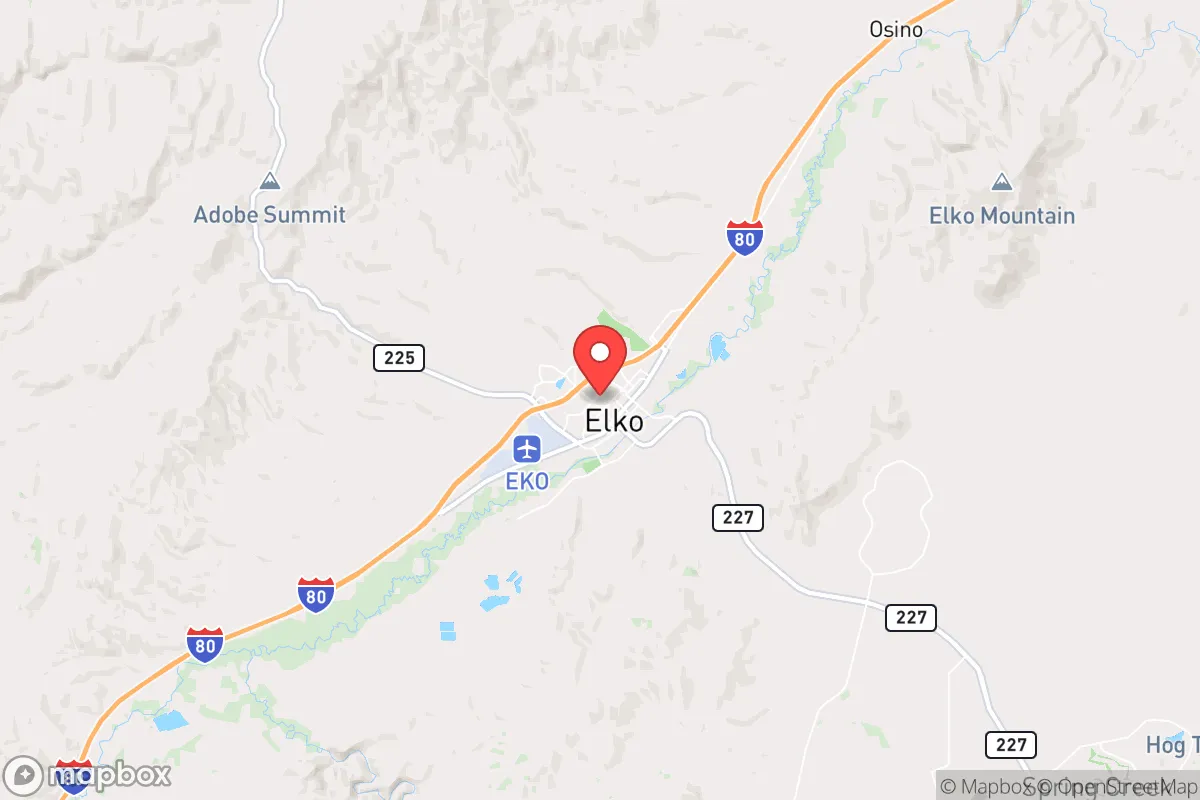
Elko’s primary strategic advantage is its location in the high desert of northeastern Nevada, roughly 230 miles from Salt Lake City and 290 miles from Reno. This distance is not just mileage—it’s a buffer of empty, rugged terrain that includes the Ruby Mountains, the Jarbidge Wilderness, and vast stretches of Bureau of Land Management (BLM) land. There are no major interstate highways running directly through Elko; I-80 passes through town, but it is a single corridor easily monitored and, if necessary, controlled. The surrounding topography—mountain ranges running north-south with intervening valleys—creates natural chokepoints and defensible positions. For someone concerned with mass casualty events originating from population centers, Elko’s isolation means you are not in the blast radius, not in the fallout plume, and not in the immediate path of a panicked exodus. The nearest major military or strategic target is Hill Air Force Base near Ogden, Utah, over 200 miles east—well outside the primary danger zone for a conventional or limited nuclear exchange. The area’s low population density (roughly 2 people per square mile in Elko County) further reduces the likelihood of being caught in a secondary wave of unrest or resource competition.
Risks, exposures, and proximity to fallout-relevant landmarks
No location is without risk, and Elko has specific vulnerabilities that a serious relocator must weigh. The most immediate concern is the Newmont and Barrick gold mining operations, which are industrial-scale facilities with their own logistical footprints. While these mines are not high-value military targets in a conventional sense, they do represent a concentration of heavy equipment, fuel storage, and chemicals (cyanide, ammonium nitrate) that could become hazards in a prolonged grid-down scenario. The Carlin Trend, one of the world’s richest gold deposits, runs directly through the area, meaning the local economy is tied to a single extractive industry—a vulnerability if global markets collapse or supply chains sever. Additionally, Elko sits within the Basin and Range seismic province. While major earthquakes are rare, the region has experienced moderate tremors (magnitude 4-5) and the Humboldt River floodplain can produce localized flooding during heavy snowmelt years. The more pressing risk is the potential for a cascading failure of the electrical grid; Elko is served by a single major transmission line from the southwest, and a prolonged outage would strain local backup generation capacity. For the prepper, these risks are manageable with proper planning—they are not existential threats like proximity to a major port or military base.
Practical resilience for a relocator: food, water, energy, and defensibility
Elko’s practical resilience is where it truly shines for the survivalist mindset. Water is the first concern in any arid environment, and the Humboldt River provides a perennial, if modest, surface water source. Groundwater is accessible via wells in the valley floors, and the Ruby Mountains watershed offers reliable snowmelt runoff. For a relocator, securing a property with a well and a backup solar pump is a realistic goal—land prices remain reasonable compared to the Front Range or Pacific Northwest. Food resilience is more challenging. The growing season is short (roughly 100 frost-free days) and the soil is alkaline, but small-scale market gardening and greenhouse operations are viable with effort. The real strength is in livestock: Elko County is cattle country, and a network of ranchers and farmers means that protein is locally produced and culturally valued. For the prepper, establishing barter relationships with local producers is a straightforward path to food security. Energy is a mixed picture. The area has excellent solar insolation (over 300 sunny days per year) and decent wind potential in the passes, but winter cloud cover and snow can reduce solar output significantly. Wood heating is common and practical, with ample BLM land for firewood collection. Defensibility is excellent: the town itself is compact, with a single main artery (Idaho Street) and limited ingress points. The surrounding terrain offers numerous retreat options into the Ruby Mountains or the Jarbidge, where a small group could remain undetected indefinitely. The local culture is armed and competent—Nevada is a constitutional carry state, and Elko County has a strong tradition of self-reliance and mutual aid among neighbors. For the relocator, this means you are not a lone wolf; you are joining a community that already understands the value of preparedness.
The overall strategic picture for Elko is one of high reward with manageable, specific risks. It is not a bug-out location for a weekend—it is a permanent relocation for those who want to live in a place where the default assumption is that you handle your own problems. The isolation that makes it unattractive to the average suburbanite is exactly what makes it valuable to the strategic relocator. The gold mining industry provides a stable economic base and a pool of skilled labor familiar with heavy equipment, explosives, and remote operations. The local government is small, conservative, and generally non-intrusive. The downsides—harsh winters, limited medical infrastructure (the nearest trauma center is in Salt Lake City), and a single-point-of-failure power grid—are real but can be mitigated with planning, capital, and community integration. For the individual or family looking to build a life that is not dependent on the stability of the federal government, the coastal supply chain, or the goodwill of a dense urban population, Elko offers a rare combination of natural defense, resource access, and cultural alignment. It is not a fantasy—it is a working model of American resilience, still functioning in 2026.

* Values derived from national, state, county, city and local statistics and may differ in a specific area. Last updated: 2026-04-23T04:08:37.000Z
Narrative content on this page is AI-generated and may contain mistakes. Verify any details that matter before acting on them.
ReloMaps may earn a commission from affiliate links at no extra cost to you.

