Photo: Wikipedia
Demographics of Elko, NV
Affluence Level in Elko, NV
A below-average socioeconomic profile. Incomes, home values, and educational attainment trail the U.S., with higher poverty and unemployment.
People of Elko, NV
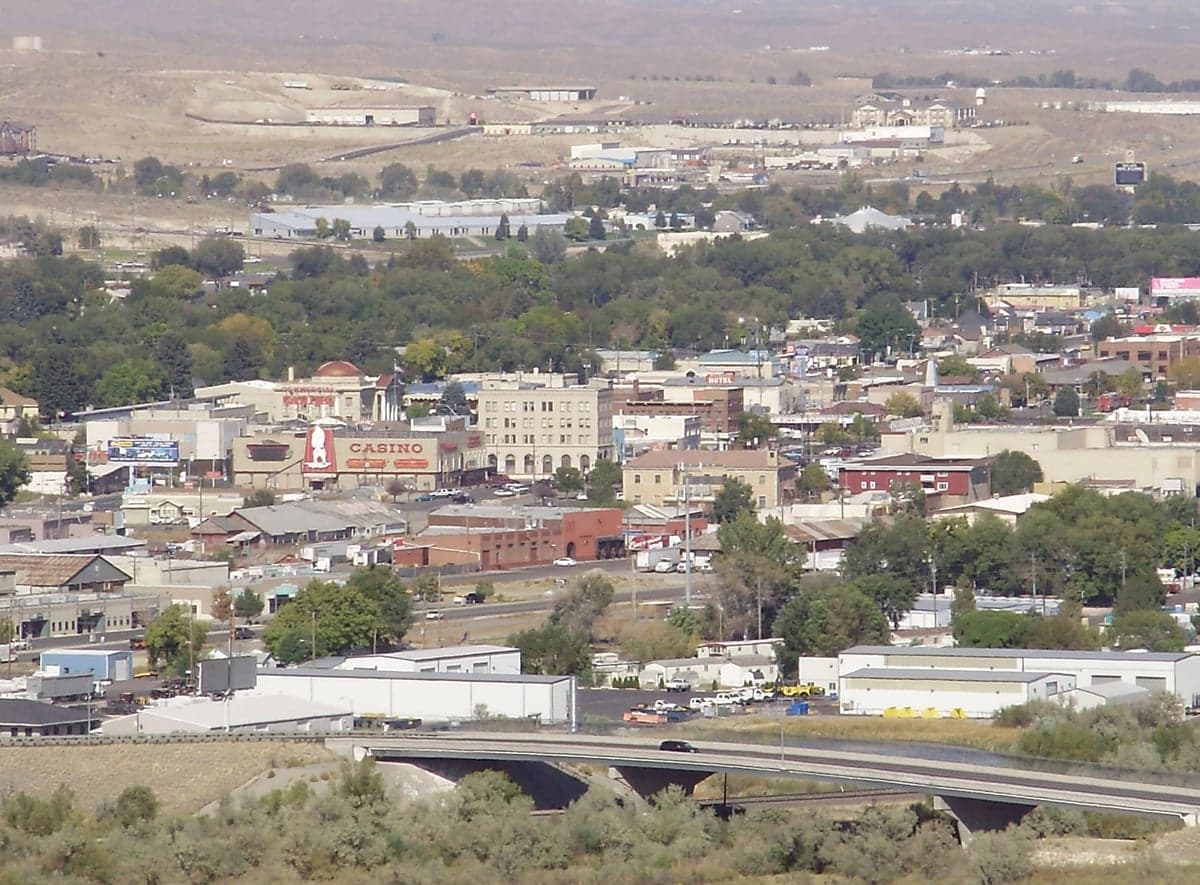
Elko, Nevada is a working-class city of 20,624 residents defined by its ranching and mining heritage, with a population that is 61.0% White and 27.7% Hispanic. The city’s character remains rooted in the rural West, shaped by successive waves of Basque sheepherders, railroad laborers, and gold-mining families. Today, Elko is notably less diverse than Nevada as a whole, with a foreign-born population of just 4.0% and a college attainment rate of 18.9%, reflecting its blue-collar identity and relatively low in-migration from outside the region.
How the city was settled and grew
Elko was founded in 1868 as a railroad town along the Central Pacific Railroad, part of the transcontinental line. The original population was overwhelmingly White, drawn by railroad construction jobs and later by the discovery of gold in the surrounding hills. The first significant non-White group to arrive were Basque immigrants from the Pyrenees, who came in the late 19th and early 20th centuries to work as sheepherders on the vast rangelands east of the Ruby Mountains. These Basque families settled in what is now the Downtown Elko district, building boarding houses and the iconic Star Hotel, which still operates as a Basque restaurant. By the 1920s, a small Chinese community had formed near the railroad depot in the Railroad District, working as cooks and laundrymen, though their numbers dwindled after the Chinese Exclusion Act. The city’s growth remained slow through the mid-20th century, with the population hovering around 5,000 until the 1960s, sustained by ranching and the seasonal rhythms of the mining industry.
Modern era (post-1965)
The modern demographic shift in Elko began after the 1965 Immigration and Nationality Act, but the change was gradual compared to other Western cities. The most transformative event was the opening of the Carlin Trend gold mines in the 1980s, which triggered a mining boom that drew workers from across the rural West. This wave was predominantly White, with many families moving into newer subdivisions like Spring Creek, a planned community 12 miles southeast of Elko that grew from a few hundred residents in the 1980s to over 1,500 by 2000. The Hispanic population began rising in the 1990s, driven by construction and service jobs tied to the mining economy. These families concentrated in the Mountain View neighborhood on the city’s south side, where a cluster of Mexican grocery stores and Spanish-language churches emerged. Today, East/Southeast Asian residents make up 2.0% of the population, largely Filipino and Korean families who arrived in the 2000s to work in healthcare and hospitality, settling in the Elko Hills area near the new hospital. The Indian subcontinent population remains negligible at 0.2%, and the Black population is 1.4%, reflecting the city’s limited draw for non-White professionals. The foreign-born share of 4.0% is less than half the national average, indicating that Elko has not been a major immigrant destination.
The future
Elko’s population is projected to grow slowly, driven by continued mining employment and the expansion of the Great Basin College, which anchors the College District near the city’s north end. The Hispanic share is likely to rise gradually, as younger Hispanic families have higher birth rates and remain in the area for service-sector jobs, but the city is not experiencing rapid ethnic turnover. The White population, while still the majority at 61.0%, is aging, with many retirees staying in place in established neighborhoods like Downtown Elko and Spring Creek. The city is not tribalizing into distinct ethnic enclaves; rather, neighborhoods remain largely mixed, with the exception of the Hispanic concentration in Mountain View. The East/Southeast Asian and Indian communities are too small to form separate enclaves and are assimilating into the broader population. The college-educated share of 18.9% is low, but the expansion of Great Basin College’s four-year programs may slowly increase that figure, attracting a slightly more diverse professional class over the next decade.
For someone moving to Elko now, the city offers a stable, predominantly White and Hispanic working-class environment with a strong ranching and mining identity. The population is not diversifying rapidly, and the low foreign-born share means that English is the dominant language in daily life. The city’s future is one of modest, incremental change rather than dramatic demographic transformation, making it a predictable choice for those seeking a traditional rural Western community.

* Values derived from national, state, county, city and local statistics and may differ in a specific area. Last updated: 2026-04-23T04:08:37.000Z
Narrative content on this page is AI-generated and may contain mistakes. Verify any details that matter before acting on them.
ReloMaps may earn a commission from affiliate links at no extra cost to you.

