Photo: Wikipedia
Demographics of Ely, NV
Affluence Level in Ely, NV
A middle-class area roughly in line with national averages across income, home values, education, and employment.
People of Ely, NV
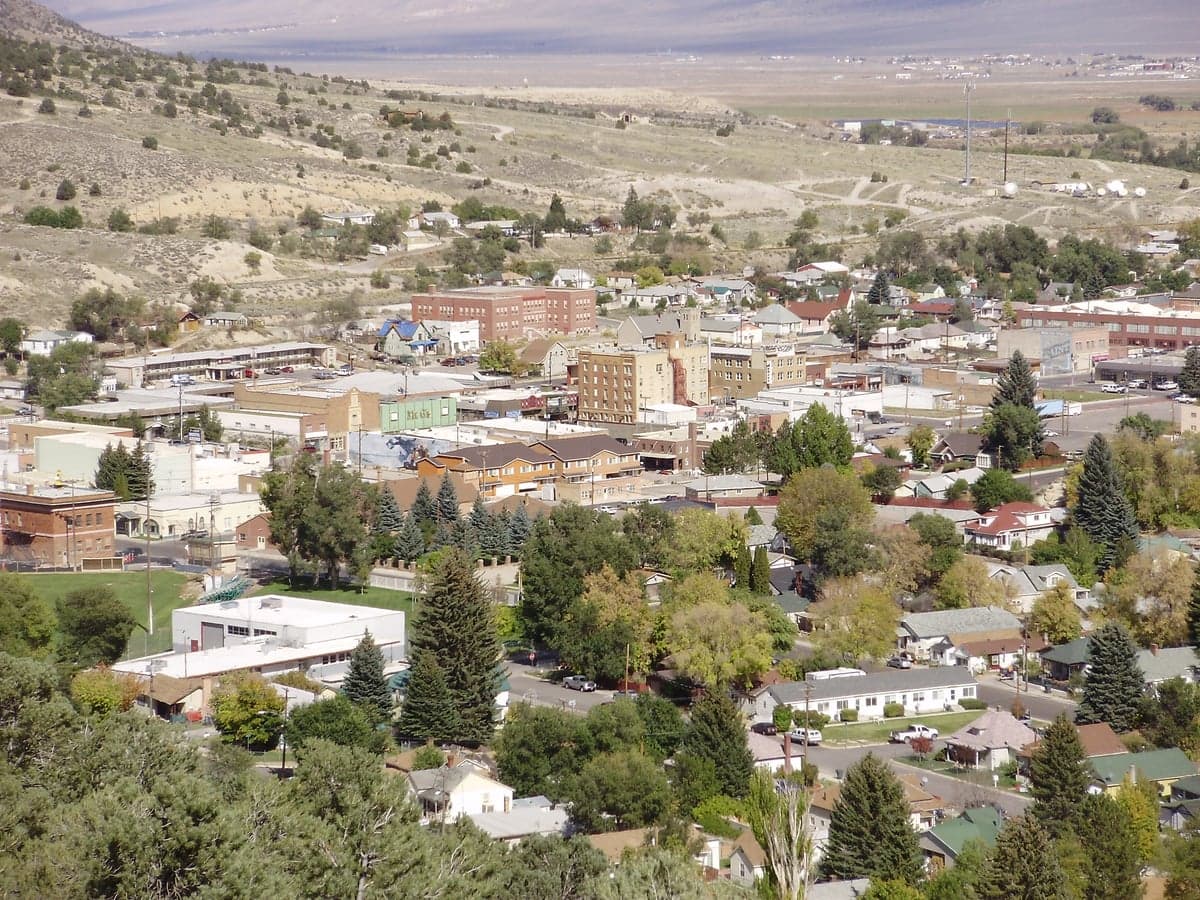
The people of Ely, Nevada, today form a small, predominantly white community of roughly 3,941 residents, characterized by a strong working-class identity rooted in mining and railroad history. With a foreign-born population of just 0.1%, Ely is one of the least ethnically diverse cities in the state, though a Hispanic minority of 16.1% adds a growing cultural layer. The city’s population density is low, and its residents are notably less college-educated than the national average (18.4%), reflecting a community built on blue-collar trades rather than professional services. Distinctive markers include a deep sense of self-reliance, a conservative political tilt, and a social fabric woven from generations of families who stayed after the mines closed.
How the city was settled and grew
Ely’s human history begins not with pioneers but with the Western Shoshone people, who used the surrounding Steptoe Valley for seasonal hunting and gathering. The city itself was founded in 1878 as a stagecoach stop, but its explosive growth came after the discovery of rich copper deposits in the nearby Robinson Mining District in 1900. The original population wave was overwhelmingly white, drawn from the American Midwest and the British Isles—Cornish miners, Irish laborers, and Scandinavian timber workers—who built the first permanent homes in what is now the Central Business District and along Aultman Street. By the 1910s, the Kennecott Copper Corporation had turned Ely into a company town, and the McGill area (a separate company-built community just north) housed many of the skilled smelter workers and their families. A smaller wave of Italian and Greek immigrants arrived to work the underground shafts, settling in the East Ely neighborhood, where modest bungalows and boarding houses still stand. The city’s population peaked at over 8,000 in the 1950s, sustained entirely by copper—when the price dropped, so did the people.
Modern era (post-1965)
The 1965 Hart-Cellar Act had virtually no effect on Ely’s demographics, as the city’s remote location and declining industrial base attracted almost no new foreign immigration. Instead, the modern era has been defined by domestic out-migration and a slow, steady whitening of the remaining population. The closure of the Kennecott smelter in 1978 and the final shutdown of the Robinson Mine in 1999 triggered a population decline of nearly 50%, with many younger families leaving for Reno or Salt Lake City. Those who stayed—largely older white retirees and a core of mining holdouts—consolidated in the Veterans Memorial Park area and the West Ely subdivision, where newer manufactured homes replaced aging company housing. The Hispanic population, which was negligible before 1990, began to grow modestly as a few Mexican-heritage families moved in to work at the reopened Robinson Mine (now operated by KGHM) and in service jobs. Today, Hispanic residents are concentrated in the South Ely corridor near Highway 50, where older rental properties offer affordable entry points. The Black and East/Southeast Asian populations remain tiny (1.4% and 1.3%, respectively), mostly individuals employed by the Nevada Department of Corrections at the Ely State Prison or by the U.S. Forest Service.
The future
Ely’s population trajectory points toward continued slow decline and homogenization. The city’s birth rate is below replacement, and the median age (roughly 45) is rising as younger adults leave for college and never return. The Hispanic share is likely to grow gradually—perhaps reaching 20-22% by 2040—as families in the South Ely area have higher birth rates and some new arrivals take agricultural or prison jobs. However, the foreign-born share will remain near zero, meaning this growth comes from U.S.-born Hispanic residents, not new immigration. The white population will continue to age in place, with the McGill area and East Ely becoming increasingly senior-heavy. There is no sign of tribalization into distinct ethnic enclaves; the city is too small and too economically fragile for that. Instead, Ely is likely to become a quieter, older, and slightly more Hispanic version of itself—a place where the mining past still defines the present, but the future belongs to those who can adapt to a tourism-and-corrections economy.
For someone moving in now, Ely offers a stable, safe, and politically conservative community where neighbors know each other and the pace of life is slow. The trade-off is limited economic opportunity, a shrinking tax base, and a social scene that revolves around the VFW hall and high school sports. It is becoming a retirement and government-service hub rather than a growing frontier town—a place for those who value quiet and continuity over diversity and dynamism.

* Values derived from national, state, county, city and local statistics and may differ in a specific area. Last updated: 2026-04-29T17:54:36.000Z
Narrative content on this page is AI-generated and may contain mistakes. Verify any details that matter before acting on them.
ReloMaps may earn a commission from affiliate links at no extra cost to you.

