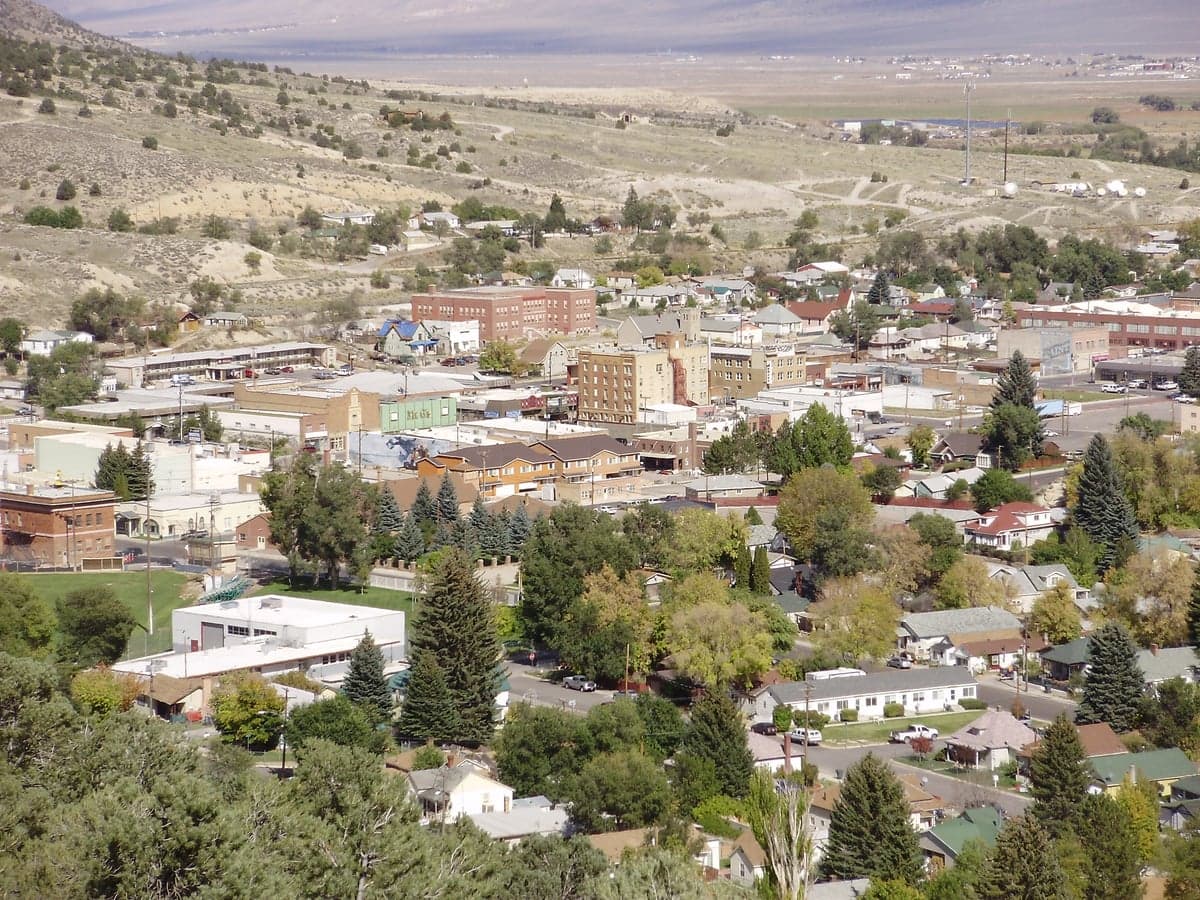
Photo: Wikipedia
Strategic Assessment of Ely, NV
Workable tactical position. Some exposure to population density or targets, but generally defensible in a crisis.
What does the Strategic Assessment tell us?
Our Strategic Assessment grades tactical survivability of an area. Major population centers, military targets, fallout zones, natural disasters, and border exposure all drive risk — lower exposure means a more defensible position in a crisis.
This is heavily inspired by Joel Skousen's Strategic Relocation book. Highly recommended you checkout the book ($)What does this tell us?
Our Strategic Assessment grades tactical survivability of an area. Major population centers, military targets, fallout zones, natural disasters, and border exposure all drive risk — lower exposure means a more defensible position in a crisis.
This is heavily inspired by Joel Skousen's Strategic Relocation book. Highly recommended you checkout the book ($)Strategic Pillars

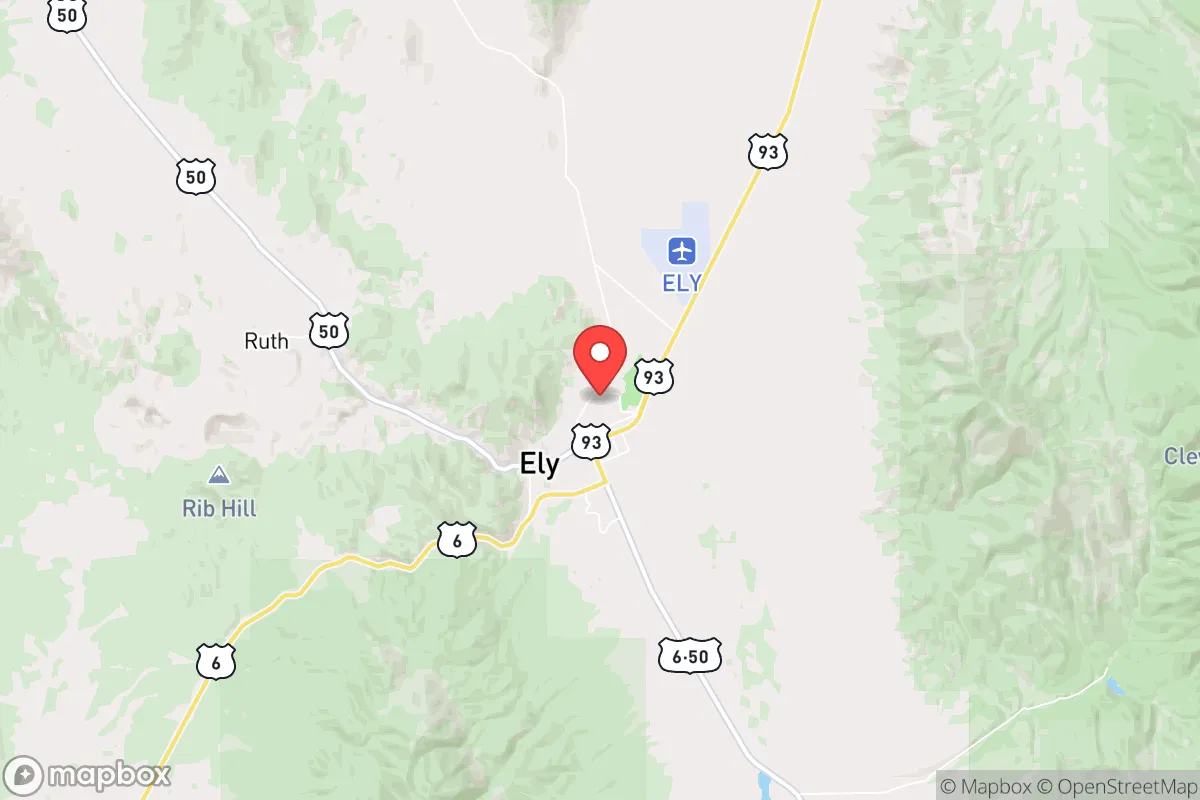
Key Distances
Regional Safe Places
Below is our recommended "safe zones" in Nevada and the surrounding area based on our strategic heuristics. For most people, it's unrealistic to live in a “safe zone” full-time due to work, family or other personal reasons. They tend to be more rural. However, many of these areas are perfect for second homes and retreat properties that double as a vacation home or even a short-term rental.
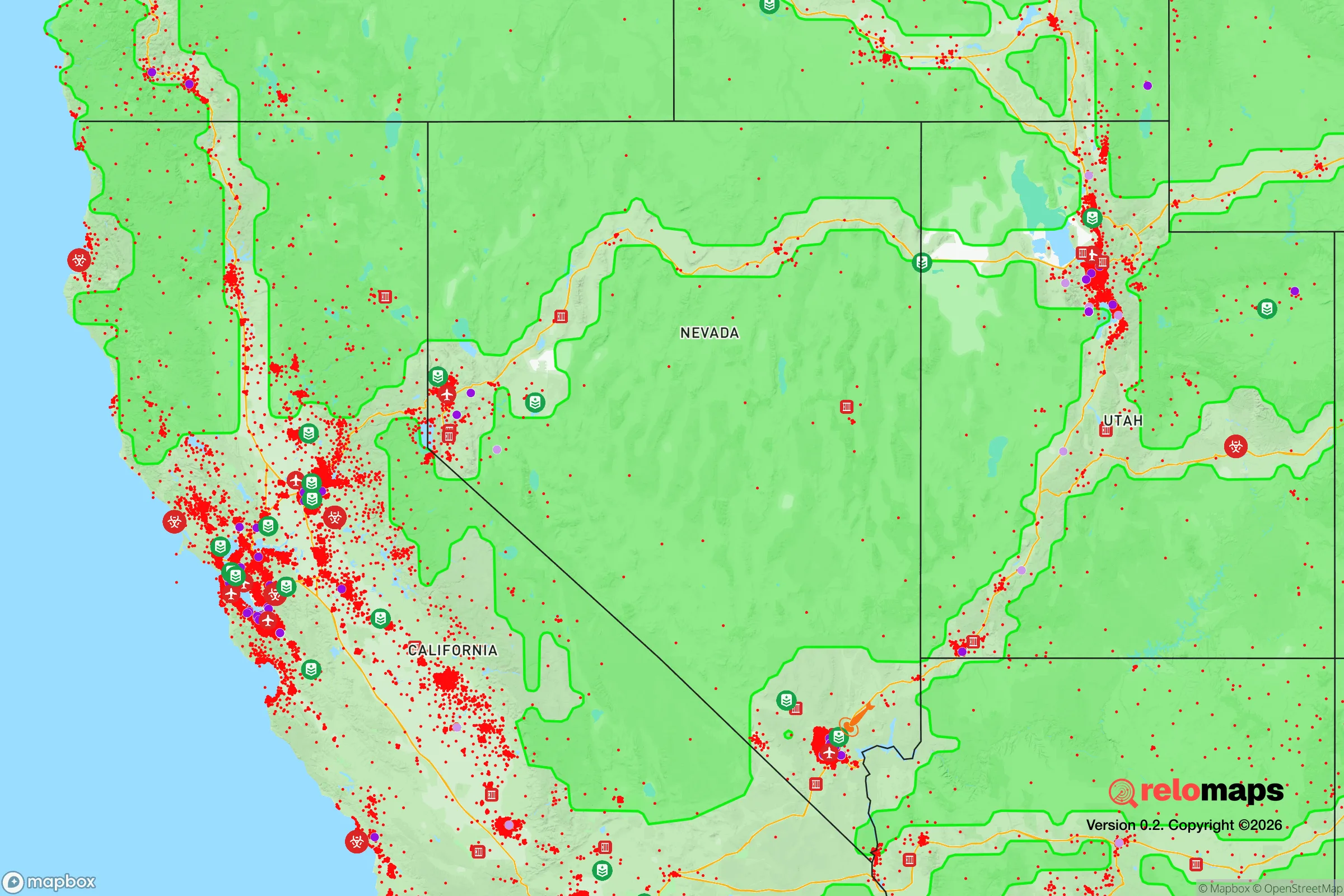
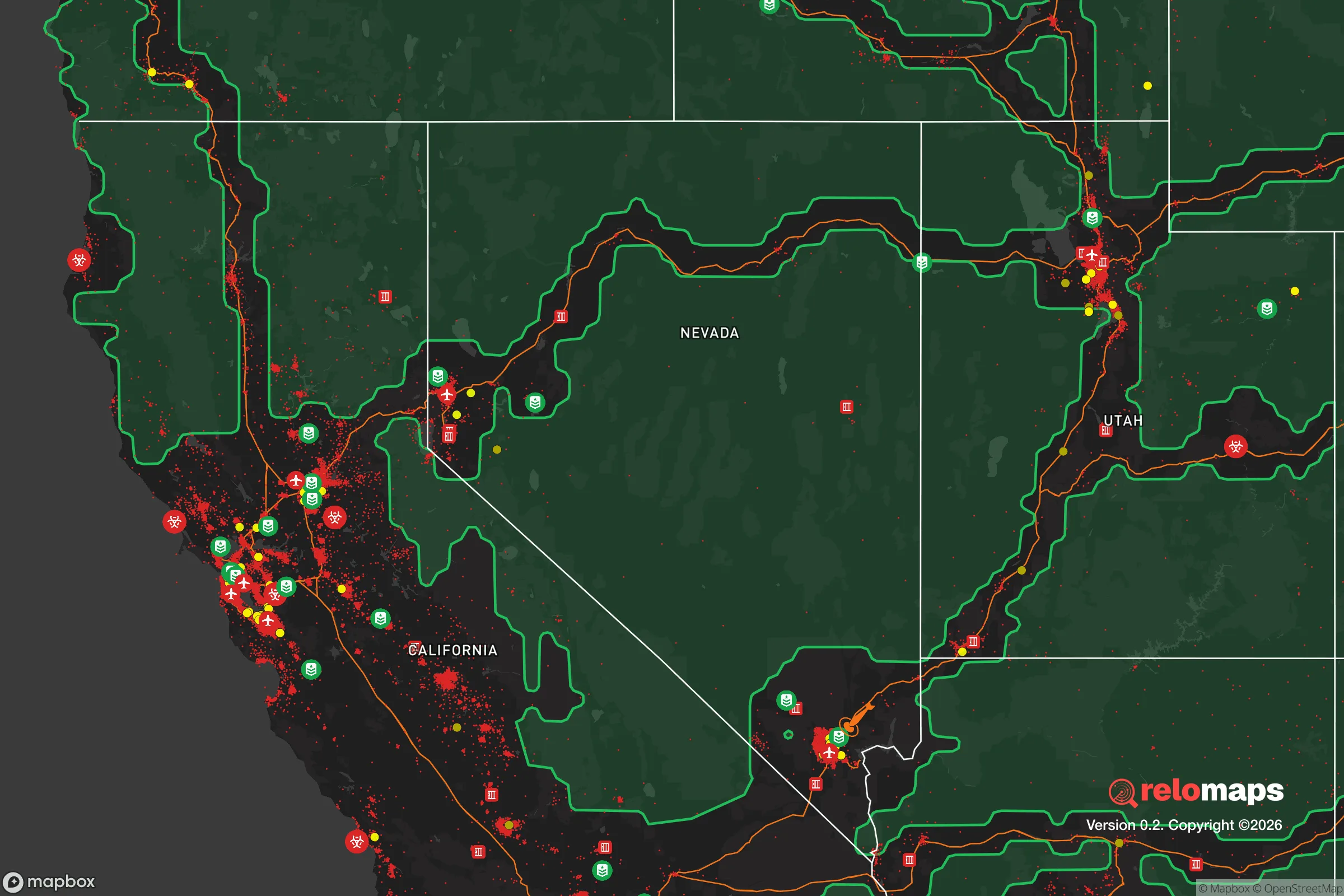


Important Note: For informational purposes only. This does not mean nothing bad ever happens in the green zones. Please use common sense. This is based on public data and modeled with AI. We tried to take a conservative approach but mistakes happen. We update this regularly as new information becomes available.
Solar Generator Recommendations
Backup power matters more here than in safer locations. We've picked three solar generators across budgets and capacity tiers — start with the budget unit if you only need a few essentials, or step up if you want to run a fridge and HVAC for days at a time.

Jackery Portable Power Station Explorer 300
Budget OptionPower on the Go: Weighing only 11 lbs, it's convenient to set up and store with book-sized foldable solar panels

BLUETTI Portable Power Station AC180
Designed for both indoor and outdoor scenarios, AC180 is highly capable as it has a robost capacity and continuous output power.

EF ECOFLOW DELTA Pro Ultra Power Station
Upgraded PickEcoFlow DELTA Pro Ultra is a whole-home energy system designed to grow with your family. Integrated with the Smart Home Panel 2, it scales to meet your evolving energy needs — keeping your home powered, intelligent, and secure through every stage of life.
We earn a commission, at no additional cost to you.
Strategic Assessment Analysis
Ely, Nevada, sits as one of the most strategically resilient locations in the Intermountain West, offering a rare combination of geographic isolation, resource independence, and low population density that appeals to those planning for long-term stability. At roughly 7,000 feet in the remote White Pine County, this former mining hub of about 4,000 people is over 200 miles from the nearest major metro (Las Vegas or Salt Lake City), placing it well outside the likely blast zones, fallout plumes, and civil unrest corridors of larger population centers. For a relocator with a prepper or survivalist mindset, Ely’s primary advantage is its position as a hard-to-reach, self-contained community that has already weathered economic booms and busts, making it a practical base for those who value autonomy over convenience.
Geographic position and natural advantages for long-term security
Ely’s location in eastern Nevada, near the Utah border, places it in the Great Basin’s high desert, a region defined by vast open spaces, limited through-traffic, and a climate that is harsh but manageable with preparation. The surrounding Humboldt-Toiyabe National Forest and the Schell Creek Range provide ample timber, water sources, and game for those with the skills to harvest them. The area’s elevation means cooler summers than the low desert, reducing heat-related survival risks, while the dry air minimizes mold and rot in stored supplies. Critically, Ely is not on any major interstate highway—U.S. Route 50, the “Loneliest Road in America,” runs through town, but it sees minimal traffic compared to I-80 or I-15. This isolation is a double-edged sword: it makes resupply difficult in normal times, but in a crisis, it means fewer refugees, less looting, and a lower chance of military checkpoints or FEMA camps being established nearby. The nearest significant military installation is the Nevada Test and Training Range (near Las Vegas), over 200 miles south, and the Utah Test and Training Range is roughly 150 miles northeast—both are distant enough that fallout from a nuclear exchange would likely be diluted by the time it reached Ely, though prevailing winds from the south could pose a risk.
Risks, exposures, and proximity to fallout-relevant landmarks
While Ely’s isolation is a strength, it is not immune to the risks that preppers must account for. The primary concern is the Nevada National Security Site (formerly the Nevada Test Site), about 180 miles south-southwest, which has historically been used for nuclear testing. In a full-scale conflict, this facility could be a target, and while Ely is far enough to avoid direct blast effects, prevailing winds from the south could carry fallout toward the area. Similarly, the nearby Dugway Proving Ground in Utah (about 150 miles northeast) and the Tooele Army Depot (chemical weapons storage) are potential targets. However, Ely’s position in a valley surrounded by mountain ranges offers some natural shielding from windborne contaminants, and the low population density means that even a moderate fallout event would affect far fewer people than in a suburban setting. The bigger risk is probably economic: Ely’s economy relies heavily on mining (copper, gold) and government services (the Nevada Department of Corrections runs a prison nearby), both of which could collapse in a prolonged crisis. For a relocator, this means you cannot depend on local employment or supply chains—you must bring your own skills, tools, and provisions. The nearest major hospital is in Elko (150 miles north), and the local hospital (William Bee Ririe Hospital) is small and under-resourced, so medical self-sufficiency is non-negotiable.
Practical resilience for a relocator: food, water, energy, and defensibility
For those serious about self-reliance, Ely offers several practical advantages that are hard to find in more populated areas. Water is the most critical resource, and while the region is arid, the surrounding mountains receive significant snowfall, feeding several perennial streams and the Steptoe Creek that runs through town. A well-drilled property with a hand pump or solar-powered pump is ideal, but even rainwater collection from a metal roof can yield enough for a small family in this dry climate—plan for 10-15 gallons per 1,000 square feet of roof per inch of rain, which averages about 10 inches annually. Food production is challenging but possible: the short growing season (May to September) limits crops to cold-hardy varieties like potatoes, carrots, and kale, but the abundant public lands support livestock grazing, and hunting (mule deer, elk, antelope) is excellent with a license. Energy independence is straightforward—Ely averages over 300 sunny days per year, making solar panels a reliable choice, and the low population means minimal grid competition. Wood heating is also viable, with firewood permits available from the Forest Service for a nominal fee. Defensibility is where Ely truly shines: the town is compact, with a single main road (U.S. 50) providing the only easy access from the east and west. The surrounding terrain—steep canyons, sagebrush flats, and mountain passes—makes it easy to monitor approaches and difficult for large groups to move through undetected. For a family or small group, a rural property a few miles outside town offers both privacy and a natural buffer zone, while still being close enough to town for occasional supply runs or community networking. The local population is largely conservative, self-reliant, and accustomed to hardship, which means you are more likely to find like-minded neighbors than in a coastal city—but also that you should expect to earn trust through demonstrated competence, not just talk.
The overall strategic picture for Ely is one of high potential reward paired with significant upfront effort. It is not a place for someone looking for a comfortable retirement or easy access to amenities—the nearest Walmart is 150 miles away, and the local grocery store is small and expensive. But for a relocator who values true isolation from the chaos of urban collapse, who is willing to invest in off-grid infrastructure, and who has the skills to hunt, garden, and repair equipment, Ely offers a rare combination of natural resources, defensible terrain, and a community that will not panic at the first sign of trouble. The risks—fallout from distant targets, economic fragility, harsh winters—are real but manageable with preparation. In a world where the most dangerous places are the ones with the most people, Ely’s emptiness is its greatest asset. If you can handle the loneliness and the work, this is one of the few places in the lower 48 where you can truly disappear and build a life that depends on no one but yourself.

* Values derived from national, state, county, city and local statistics and may differ in a specific area. Last updated: 2026-04-29T17:54:36.000Z
Narrative content on this page is AI-generated and may contain mistakes. Verify any details that matter before acting on them.
ReloMaps may earn a commission from affiliate links at no extra cost to you.

