Photo: Wikipedia
Demographics of Erlanger, KY
Affluence Level in Erlanger, KY
A middle-class area roughly in line with national averages across income, home values, education, and employment.
People of Erlanger, KY
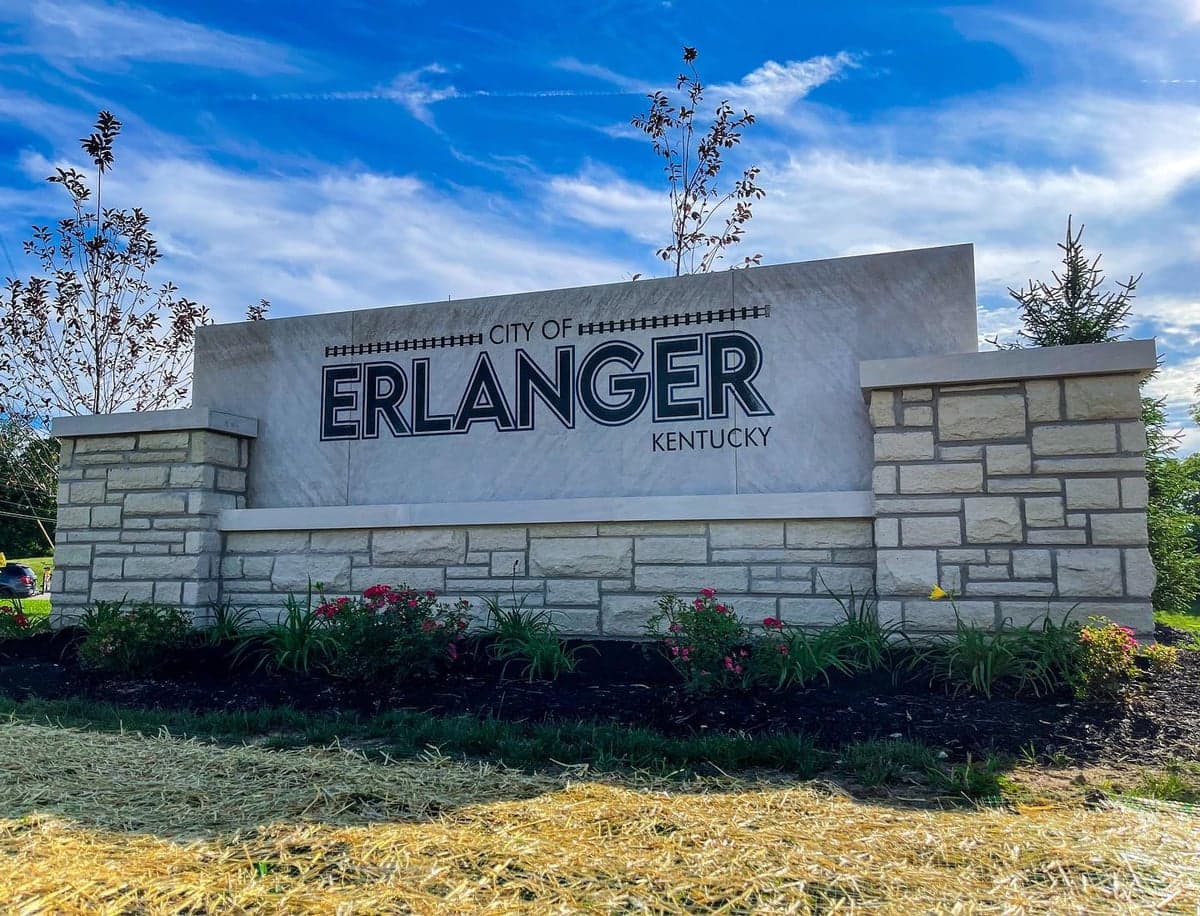
Erlanger, Kentucky, is a predominantly white, middle-class suburban city of 19,677 residents, characterized by a strong sense of local identity and a population that is notably less diverse than the national average. With 85.5% of residents identifying as white and only 1.3% foreign-born, Erlanger’s people are overwhelmingly native-born and rooted in the region. The city’s character is shaped by its history as a railroad and manufacturing hub, with a population that has remained remarkably stable in its ethnic composition even as the broader Cincinnati metro area has diversified.
How the city was settled and grew
Erlanger’s population history begins not with colonial settlement but with the railroad. The city was founded in the 1880s as a planned railroad town along the Cincinnati Southern Railway, named after the railroad’s president, Emile Erlanger. The original population was drawn by jobs in rail yards and related industries, with the first wave of residents being largely German and Irish immigrants who built the rail lines and settled in the Brentwood and Hillside neighborhoods near the tracks. These working-class families established the city’s early character: Catholic, union-oriented, and tightly knit. A second wave came during the World War II era, when manufacturing plants like the Erlanger Machine Works and nearby General Electric in Evendale attracted Appalachian migrants from eastern Kentucky and Tennessee. These families settled in the Lorraine Park and South Fort Thomas Avenue areas, adding a distinct Southern Appalachian cultural layer to the city’s German-Irish base. By 1960, Erlanger was a solidly white, blue-collar suburb of roughly 8,000 people.
Modern era (post-1965)
The post-1965 era brought only modest demographic change to Erlanger. Unlike many Northern suburbs that saw significant Black in-migration during the Great Migration’s later waves, Erlanger remained overwhelmingly white. The city’s Black population today stands at just 3.8%, a figure that has grown slowly from near-zero in 1970, with most Black residents concentrated in the Dixie Highway corridor near the city’s southern edge. The Hispanic population, now 5.0%, began growing in the 1990s as Latino workers moved into construction and landscaping jobs tied to the region’s warehouse boom. These families settled primarily in the Kentucky Route 236 area and the Erlanger Industrial Park vicinity, where affordable housing stock and proximity to work drew them. East/Southeast Asian residents (0.7%) and Indian-subcontinent residents (0.5%) are present in very small numbers, largely professionals working at nearby corporate campuses like Toyota Motor Manufacturing Kentucky in Georgetown or St. Elizabeth Healthcare. These groups are scattered across the Woods of Erlanger subdivision, a newer development built in the 2000s that attracted some of the city’s few college-educated newcomers. The foreign-born share of 1.3% is a fraction of the national average of 13.7%, underscoring how little international migration has shaped the city.
The future
Erlanger’s population is likely to remain predominantly white and native-born for the foreseeable future. The city’s housing stock—largely single-family homes built between 1950 and 1980—offers limited new construction, and the lack of rental density discourages the kind of immigrant gateway dynamics seen in Cincinnati’s urban core. The Hispanic share may continue a slow climb, potentially reaching 7-8% by 2040, as second-generation families remain in the area and new arrivals fill service-sector jobs. The Black population is expected to plateau near 4%, as most regional Black growth is occurring in Boone County to the south and in Cincinnati’s West Side. East/Southeast Asian and Indian populations will likely remain tiny, as Erlanger lacks the tech-sector employment base or top-tier school district that draws these groups to suburbs like Mason or West Chester, Ohio. The city is not tribalizing into distinct ethnic enclaves; rather, it is homogenizing as a white, middle-American suburb with a modest Hispanic minority.
For someone moving to Erlanger today, the city offers a stable, low-diversity environment where the population is aging slowly and the schools are solid but not elite. The people are predominantly long-term residents or Kentucky-born newcomers, and the cultural texture is one of quiet, family-oriented suburban life with little of the ethnic dynamism found in larger metros. This is a place where the population is not changing much—and for many conservative-leaning movers, that stability is precisely the draw.

* Values derived from national, state, county, city and local statistics and may differ in a specific area. Last updated: 2026-04-21T09:45:34.000Z
Narrative content on this page is AI-generated and may contain mistakes. Verify any details that matter before acting on them.
ReloMaps may earn a commission from affiliate links at no extra cost to you.

