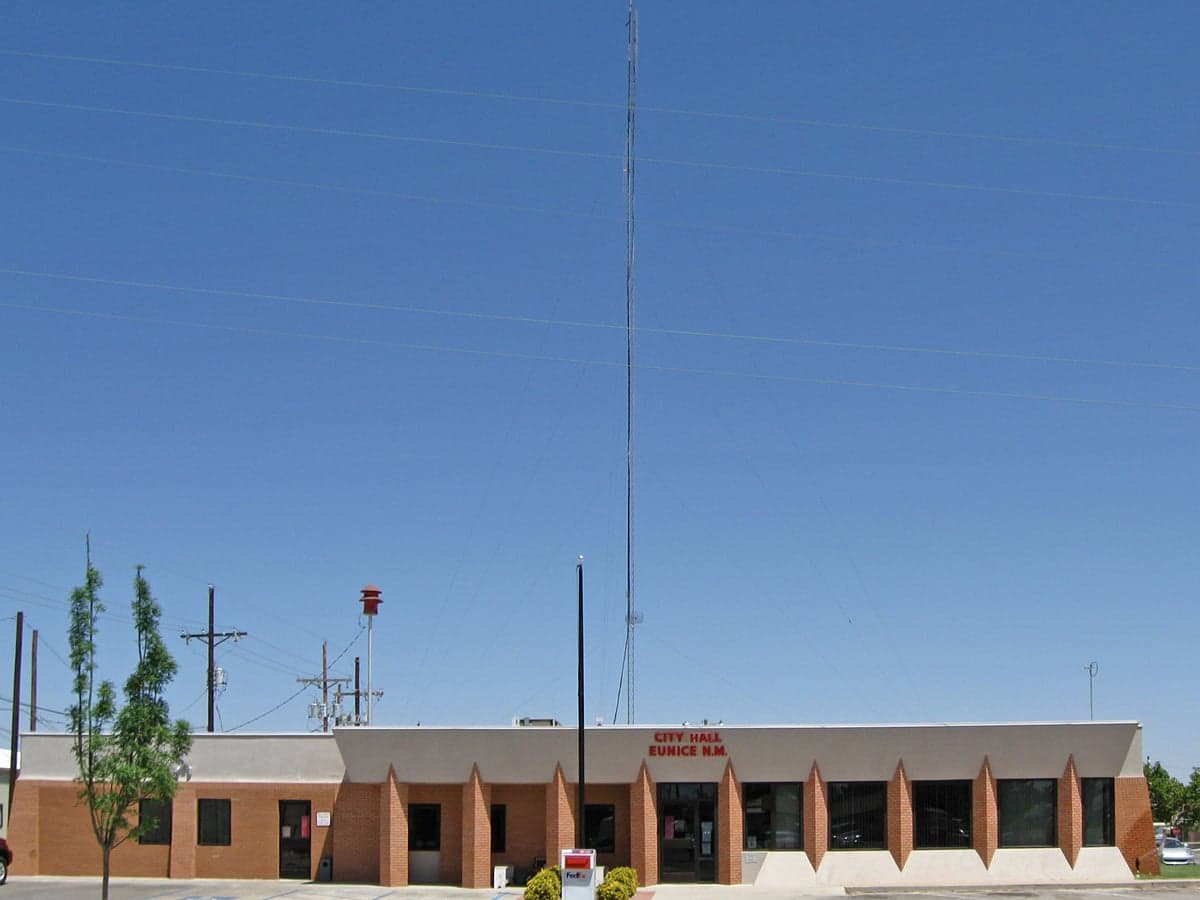
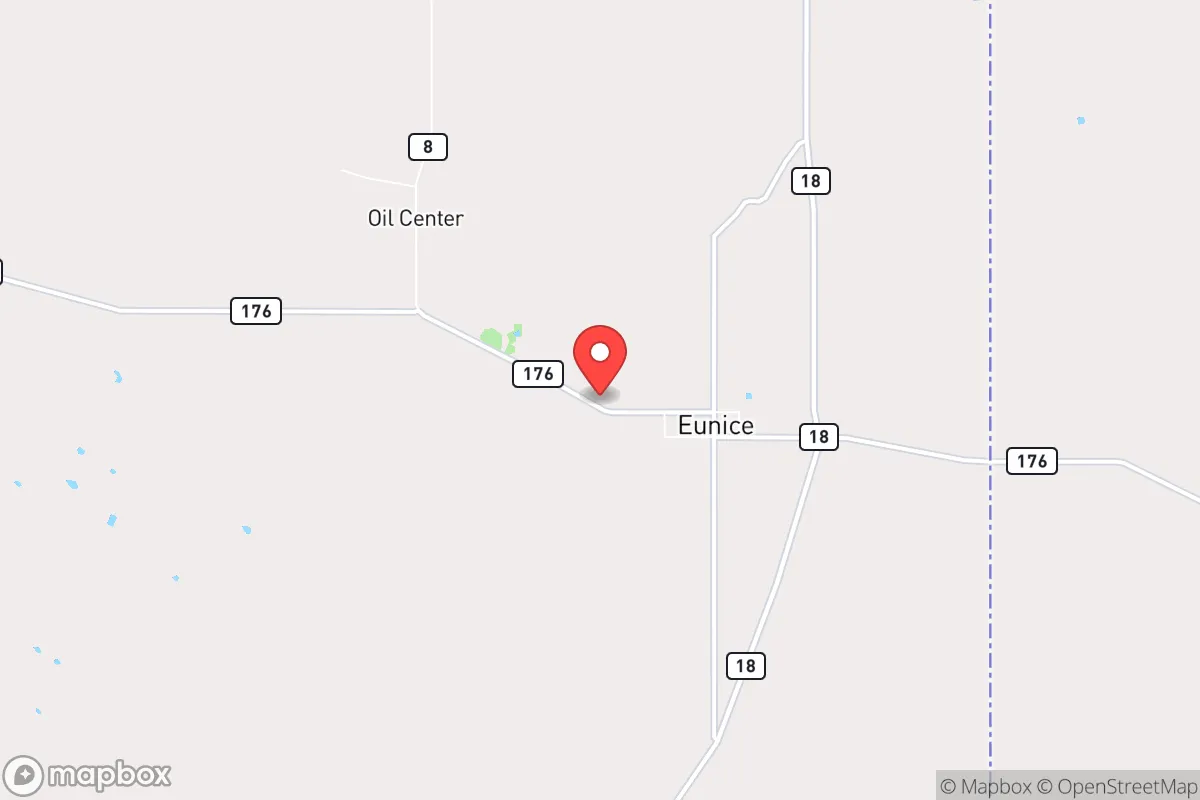
Photo: Wikipedia
Demographics of Eunice, NM
Affluence Level in Eunice, NM
A below-average socioeconomic profile. Incomes, home values, and educational attainment trail the U.S., with higher poverty and unemployment.
People of Eunice, NM
The people of Eunice, New Mexico, today form a compact, working-class community of just under 3,000 residents, defined by a strong Hispanic majority (57.7%) and a substantial White non-Hispanic minority (41.6%). The city is notably homogeneous in other respects—Black, Asian, and Indian-subcontinent populations are effectively zero—and its foreign-born share of 9.4% is modest but meaningful. With only 3.5% of adults holding a college degree, Eunice is a blue-collar oil-patch town where family roots run deep and newcomers are typically drawn by energy-sector wages rather than lifestyle amenities.
How the city was settled and grew
Eunice was founded in 1909 as a railroad stop on the Chicago, Rock Island and Pacific line, but its real growth began with the discovery of oil in the nearby Hobbs field in the late 1920s. The original population was overwhelmingly White Anglo homesteaders and roughnecks from Texas and Oklahoma, who built the first homes in what is now Old Town Eunice, the original grid of streets around the railroad depot. During the 1930s and 1940s, the oil boom drew a second wave: Hispanic laborers from the Rio Grande Valley and northern New Mexico, who settled in the Southside neighborhood, south of the tracks, in modest company-built housing. By 1950, Eunice had reached roughly 2,500 residents, with the Hispanic share already approaching one-third. The city’s historic cemetery, Eunice Cemetery, contains the graves of both Anglo oil pioneers and early Hispanic families, reflecting the segregated but interdependent character of the early community.
Modern era (post-1965)
The post-1965 period brought no major immigration wave from outside the United States; Eunice’s foreign-born population today (9.4%) is almost entirely composed of Mexican nationals who arrived for oil-field work in the 1970s and 1980s. These families concentrated in the Westside neighborhood, a cluster of mobile-home parks and small ranch-style homes west of Main Street. The 1980s oil bust caused a population decline from a peak of 3,200 in 1982 to 2,700 by 1990, but the city rebounded during the Permian Basin boom of the 2010s. During this period, the Hispanic share rose from roughly 45% to 57.7%, driven by higher birth rates and continued in-migration of Hispanic workers from Texas and southern New Mexico. The North Eunice area, developed in the 1990s and 2000s, attracted younger Anglo families with newer, larger homes, but the overall population has remained stable at around 3,000 since 2010. The Black and Asian populations have remained at zero throughout this period, reflecting Eunice’s location in a region with historically low non-Hispanic, non-White diversity outside the Hispanic community.
The future
Eunice’s demographic trajectory points toward continued Hispanicization and slow overall growth. The Hispanic share is likely to approach 65-70% by 2040, driven by natural increase and the ongoing attraction of oil-field jobs for Hispanic workers from the broader Permian Basin. The White non-Hispanic population is aging and declining, as younger Anglos tend to leave for college or larger cities and are not replaced by new Anglo in-migration. The foreign-born share may plateau or decline slightly as second- and third-generation Hispanic families assimilate and become native-born. The city is not tribalizing into distinct ethnic enclaves—neighborhoods like Southside and Westside are becoming more mixed as older Anglo residents move out and Hispanic families move in. The Eunice Industrial Park area, near the oil-field service companies, will likely remain a magnet for transient workers, but permanent residents will continue to cluster in the established residential neighborhoods. No significant growth in Asian, Black, or Indian-subcontinent populations is expected, given the city’s remote location and lack of economic diversity beyond energy.
For someone moving in now, Eunice is becoming a predominantly Hispanic, working-class oil town with a stable population and a clear cultural identity. The community is tight-knit, family-oriented, and politically conservative, with a strong sense of local pride. The lack of racial diversity beyond the Hispanic-Anglo dynamic means newcomers should expect a culturally homogeneous environment, but one where the oil economy provides steady, well-paying jobs for those without college degrees. The city is not gentrifying or diversifying; it is consolidating around its existing character.

* Values derived from national, state, county, city and local statistics and may differ in a specific area. Last updated: 2026-05-01T01:36:12.000Z
Narrative content on this page is AI-generated and may contain mistakes. Verify any details that matter before acting on them.
ReloMaps may earn a commission from affiliate links at no extra cost to you.

