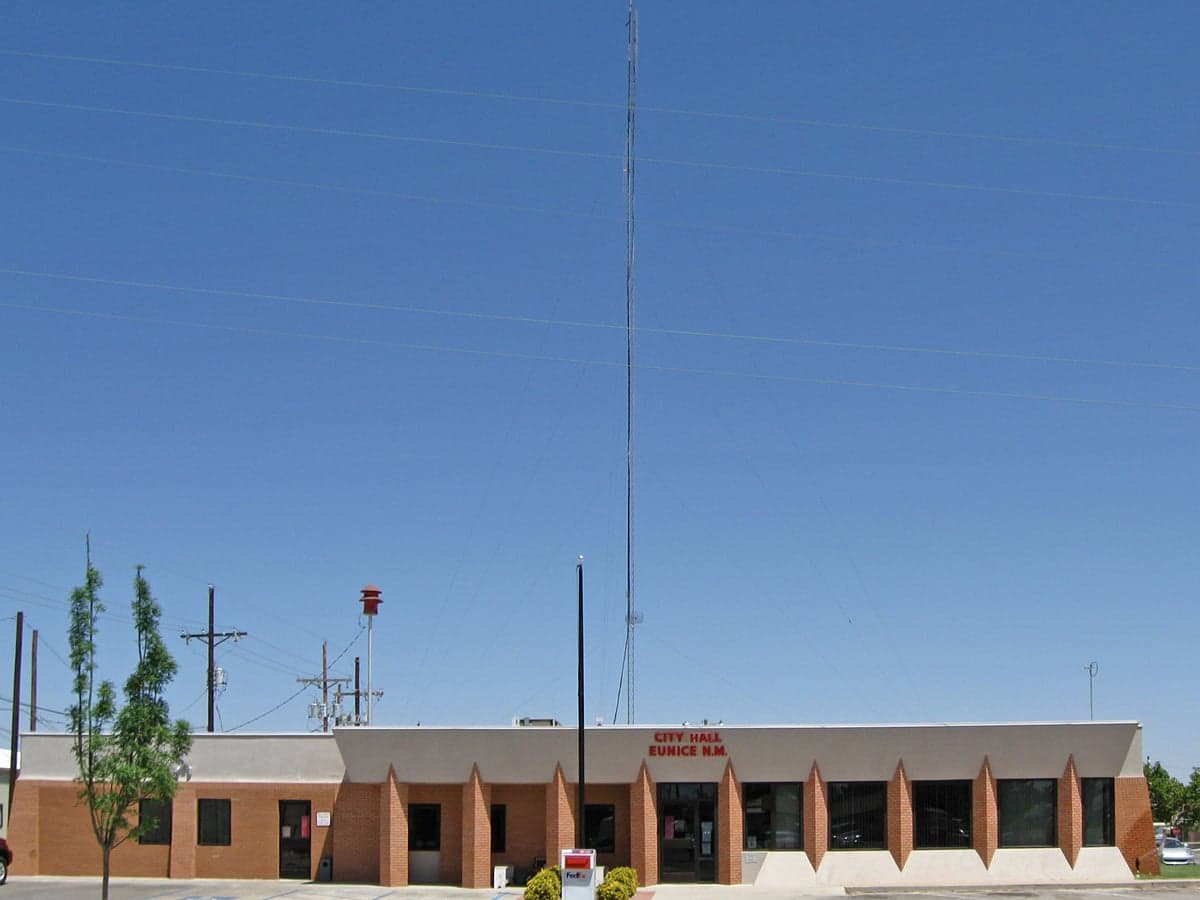
Photo: Wikipedia
Political ClimatePolitical Climate in Eunice, NM
District shown is the primary district for this city’s centroid. Cities may span multiple districts.
Local Political AnalysisPolitical Analysis of Eunice, NM
Eunice, New Mexico, sits in a unique political pocket. While the state as a whole has trended blue in recent years, this small oil-and-gas town in Lea County remains a staunchly conservative stronghold. The Cook PVI rating of EVEN for the area is a bit misleading on the surface—it reflects the broader congressional district, but when you zoom in on Eunice itself, you’re looking at a community that has voted reliably Republican for decades. The real story here is how Eunice has held the line against the progressive shifts seen in places like Santa Fe or Albuquerque, and how that’s shaping daily life for folks who value personal freedom and limited government.
How it compares
Drive thirty miles west to Hobbs, and you’ll find a similar conservative vibe, though Hobbs has seen a bit more demographic churn and some subtle political drift. Head north to Lovington, and it’s more of the same—solid red. But the real contrast is with cities like Las Cruces or Albuquerque, where progressive policies on taxes, energy regulation, and land use have taken hold. In Eunice, the local government has consistently pushed back against state-level overreach, especially when it comes to the oil and gas industry. The town’s economy depends on it, and most residents see any attempt to restrict drilling or impose new environmental mandates as a direct threat to their livelihoods and way of life. Compared to the rest of Lea County, Eunice is actually one of the more politically homogeneous spots—you won’t find many yard signs for progressive candidates here, and the local school board and city council elections tend to be decided by who’s most committed to keeping government small and taxes low.
What this means for residents
For the people who live here, the political climate translates into a tangible sense of autonomy. There’s no heavy-handed zoning board telling you what you can do with your property, and the local police aren’t enforcing the kind of “public health” mandates that became common in bigger cities during the pandemic. The downside is that state-level policies—like New Mexico’s push for renewable energy mandates and higher fuel taxes—still trickle down. Residents here feel like they’re constantly fighting a rear-guard action against Santa Fe bureaucrats who don’t understand rural life. The long-term concern is that if the state continues to shift left, Eunice could find itself increasingly at odds with the capital, facing preemption on everything from gun rights to school curriculum. For now, though, the community’s political cohesion means that most folks feel they can live their lives without too much interference from outside.
Culturally, Eunice stands apart from the rest of New Mexico in a few key ways. The town has a strong “live and let live” ethos, but it’s also deeply rooted in traditional values—church attendance is high, and there’s a palpable skepticism of anything that smacks of progressive social engineering. You won’t see the kind of diversity initiatives or “equity” programs that are common in larger districts. Instead, the focus is on practical matters: keeping the streets paved, the water running, and the schools focused on basics. The biggest policy distinction is probably the town’s hands-off approach to business regulation. There’s no local minimum wage hike, no paid leave mandates, and no special permitting hurdles for small entrepreneurs. If you’re looking for a place where the government stays out of your way and you can keep what you earn, Eunice is about as close as you’ll get in New Mexico. But keep an eye on the state legislature—if they keep pushing progressive agendas, this town’s way of life could be under real pressure in the next decade.

State Political ClimatePolitical Climate in New Mexico
State Political AnalysisPolitical Environment in the State
New Mexico has long been a reliably blue state in presidential elections, but its political landscape is far more nuanced than a simple partisan label suggests. The state’s overall lean is Democratic, driven by a powerful coalition of urban progressives in Albuquerque and Santa Fe, combined with a large Hispanic electorate that historically votes Democratic but is increasingly up for grabs. Over the last 10-20 years, the state has shifted leftward on cultural and economic issues, but a strong rural conservative counterweight—particularly in the eastern and southern counties—keeps the state from becoming a one-party monopoly. For a conservative considering relocation, the key takeaway is that New Mexico is a state of stark contrasts, where your experience will depend heavily on which county you choose to call home.
Urban vs. rural divide
The political map of New Mexico is a textbook study in the urban-rural divide. The state’s two dominant population centers—Albuquerque (Bernalillo County) and Santa Fe (Santa Fe County)—are deep blue strongholds. Santa Fe County, in particular, is one of the most progressive jurisdictions in the entire Southwest, with a heavy concentration of government workers, artists, and retirees from California. Albuquerque, home to roughly a third of the state’s population, reliably delivers Democratic margins of 15-20 points in statewide races. In contrast, the eastern plains—counties like Curry (Clovis), Roosevelt (Portales), and Lea (Hobbs)—vote Republican by margins of 30-40 points. These are oil-and-gas country, with a strong ranching and agricultural heritage. The southern tier, including Las Cruces (Doña Ana County), is a swing area; Doña Ana has trended blue in recent cycles but still elects conservative Democrats and Republicans at the local level. The state’s most politically distinct suburb is Rio Rancho, a fast-growing exurb of Albuquerque that leans Republican and is a key battleground in state legislative races. If you’re looking for a conservative-friendly environment, the eastern and southeastern counties are your best bet, while Santa Fe and the North Valley of Albuquerque are best avoided.
Policy environment
New Mexico’s policy environment has shifted decisively leftward over the past decade, particularly since Democrats gained full control of the statehouse in 2019. The state has a progressive income tax with rates up to 5.9%, and while there is no state sales tax on groceries, local options can push the combined rate above 8% in some cities. The regulatory posture is mixed: the oil and gas industry in the Permian Basin (Lea and Eddy counties) is still booming, thanks to federal and state leases, but the state has imposed new methane-emission rules that industry groups call burdensome. Education policy is a flashpoint: the state has a universal school voucher program (the “Opportunity Scholarship”), but it’s administered through the public system, and private-school choice remains limited compared to states like Arizona. Healthcare is dominated by the state’s Medicaid expansion, which covers nearly 40% of the population, and the state has enacted some of the nation’s strongest abortion protections, including a 2023 law that shields providers from out-of-state lawsuits. Election laws are a concern for conservatives: New Mexico has no voter ID requirement (though you must provide a signature), and the state implemented automatic voter registration in 2024. The combination of these policies creates an environment where personal freedom is heavily circumscribed in some areas (education choice, election integrity) while being expansive in others (abortion access, marijuana legalization).
Trajectory & freedom
On the freedom index, New Mexico is trending in a concerning direction for conservatives. The most significant recent legislation is the 2021 repeal of the state’s preemption law on firearms, which had previously prevented cities from enacting their own gun ordinances. Since then, Albuquerque and Santa Fe have passed local restrictions on carrying firearms in public parks and government buildings. In 2023, the state passed a red-flag law (HB 129), allowing courts to temporarily seize firearms from individuals deemed a threat—a measure that gun-rights advocates argue lacks due process. On the parental rights front, the state has moved in the opposite direction of Texas and Florida: in 2024, the legislature defeated a bill that would have required schools to notify parents of changes in a child’s gender identity. Meanwhile, property rights have been eroded by the state’s 2023 “Housing First” law, which effectively decriminalized camping on public property in Albuquerque, leading to visible encampments and a rise in property crime. The one bright spot for liberty-minded residents is the state’s full legalization of recreational cannabis in 2021, which has created a thriving industry but also brought concerns about impaired driving and youth access. Overall, the trajectory is toward more government control over guns, education, and property, while expanding personal autonomy in areas like drugs and reproductive health.
Civil unrest & political movements
New Mexico has seen its share of political flashpoints. The most visible is the ongoing immigration debate: the state is a sanctuary state (by executive order since 2019), and the border city of Sunland Park has been a hotspot for migrant crossings and federal-local tensions. In 2023, the state’s attorney general sued a local sheriff in Otero County for refusing to enforce a state law that limited cooperation with federal immigration authorities—a case that galvanized conservative activists. The 2020 election integrity controversy was particularly acute in Otero County, where the county commission initially refused to certify the 2022 primary results over concerns about voting machines, leading to a state supreme court intervention. On the left, the “Abolish ICE” movement has a strong presence in Santa Fe, and protests over police brutality in Albuquerque in 2020 led to the city council defunding the police department by 10% (later partially restored). The “New Mexico Civil Guard”, a right-wing militia, has been active in border-area protests, though its influence is limited. For a new resident, the most visible sign of political tension is the proliferation of campaign signs and the heated rhetoric on local social media groups, particularly in swing areas like Doña Ana County.
Projection
Looking ahead 5-10 years, New Mexico is likely to continue its leftward drift, but the pace will be moderated by demographic and economic realities. The state’s population is aging and growing slowly, with net out-migration to Texas and Arizona among younger workers. The Hispanic population, which makes up nearly 50% of the state, is becoming more politically diverse—younger Hispanic voters in the eastern plains are trending Republican, while urban Hispanics remain solidly Democratic. The oil and gas boom in the Permian Basin (Lea and Eddy counties) is bringing in conservative-leaning workers from Texas, which could shift the southeastern part of the state even further right. However, the political power of Albuquerque and Santa Fe will likely grow as rural counties lose population. The most realistic projection is a state that remains blue at the top of the ticket but with a more competitive state legislature, as Republicans pick up seats in the southeast and exurbs like Rio Rancho. For a conservative moving in now, expect to see continued battles over education choice, gun rights, and election integrity, with the outcome depending heavily on which party turns out in the next two election cycles.
For a conservative relocating to New Mexico, the bottom line is this: you can find a community that aligns with your values, but you have to choose carefully. The eastern and southeastern counties—places like Hobbs, Clovis, and Carlsbad—offer a low-tax, pro-business, gun-friendly environment with strong community ties. The urban centers of Albuquerque and Santa Fe will feel like a different country, with high taxes, progressive social policies, and visible homelessness. If you’re a parent, the lack of robust school choice and the erosion of parental rights in the blue areas are real concerns. But if you’re willing to live in a red county and drive to the city for work, New Mexico offers stunning landscapes, a lower cost of living than neighboring states, and a slower pace of life. Just don’t expect the state government to have your back—your best protection will be your local community and county commission.
* Values derived from national, state, county, city and local statistics and may differ in a specific area. Last updated: 2026-05-01T01:36:12.000Z
Narrative content on this page is AI-generated and may contain mistakes. Verify any details that matter before acting on them.
ReloMaps may earn a commission from affiliate links at no extra cost to you.

