Photo: Wikipedia
Demographics of Fort Smith, AR
Affluence Level in Fort Smith, AR
A below-average socioeconomic profile. Incomes, home values, and educational attainment trail the U.S., with higher poverty and unemployment.
People of Fort Smith, AR
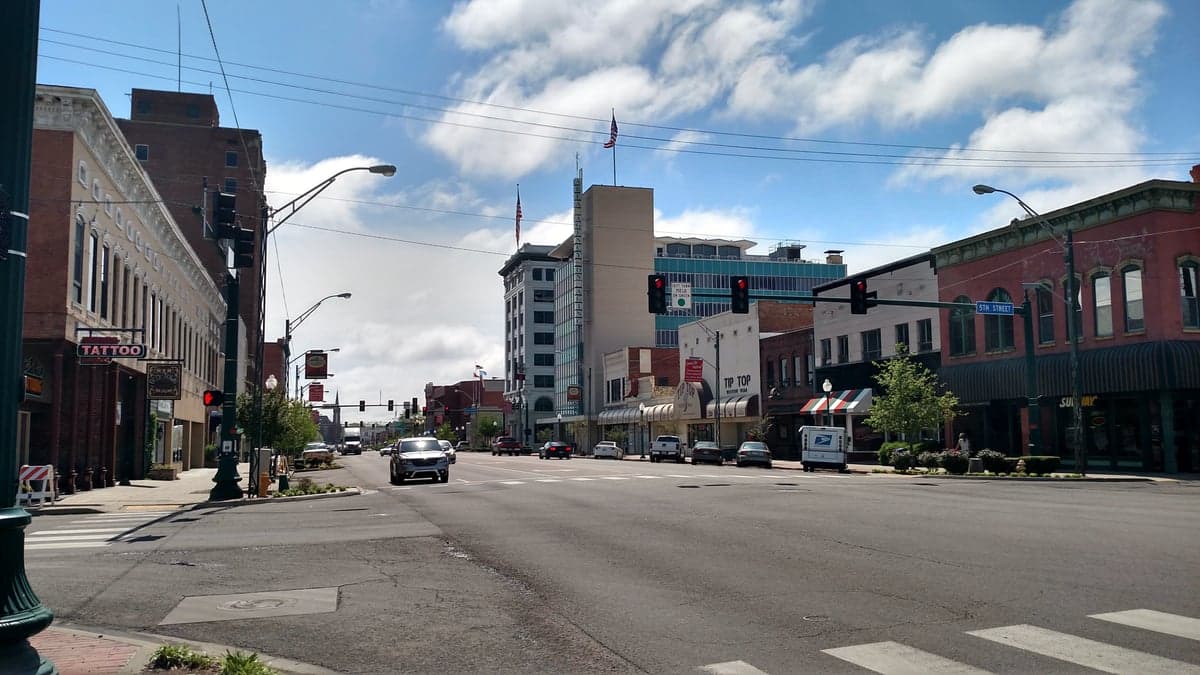
The people of Fort Smith, Arkansas, today number 89,496, forming a community that is predominantly white (58.4%) with a substantial and growing Hispanic population (20.0%) and smaller Black (7.7%) and East/Southeast Asian (5.1%) communities. The city’s character is shaped by its history as a frontier military post and industrial river town, now transitioning into a regional healthcare and logistics hub. With a foreign-born share of 7.0% and a college-educated rate of 25.3%, Fort Smith is less diverse and less educated than the national average, but its population is notably younger and more family-oriented than many peer cities in the region. The city’s identity remains rooted in a pragmatic, working-class conservatism, with a growing Hispanic presence reshaping neighborhoods and schools.
How the city was settled and grew
Fort Smith’s human history begins with its 1817 establishment as a U.S. Army post on the Arkansas River, built to keep peace between the Osage and Cherokee tribes. The original population was a mix of soldiers, traders, and frontier families, with the first civilian settlement clustering around Belle Grove, a historic district that still contains some of the city’s oldest homes. The 1840s brought a wave of German and Irish immigrants who worked as laborers on the riverfront and in the early lumber mills, settling in the Northside area near the railroad yards. After the Civil War, the city boomed as a manufacturing center for furniture and glass, drawing white migrants from the rural Ozarks and Appalachia, who filled the Southside neighborhoods around what is now the Fort Smith National Historic Site. By 1900, the population was overwhelmingly native-born white, with a small Black community concentrated in the Rogers Avenue corridor, working as domestic servants and in the factories. The early 20th century saw a second wave of European immigrants—Italians and Poles—who settled in the Midland Heights area, building the Catholic churches and ethnic clubs that still anchor the neighborhood.
Modern era (post-1965)
The post-1965 immigration reforms reshaped Fort Smith’s demographics more gradually than in coastal cities. The most significant shift began in the 1980s, when the poultry processing industry—led by Tyson Foods and OK Foods—recruited workers from Mexico and Central America. These new arrivals settled primarily in the South 46th Street corridor and the Moffett area, a low-income neighborhood near the processing plants. By 2000, the Hispanic share had risen to 8%, and by 2020 it had reached 20.0%, making Fort Smith one of the most Hispanic cities in Arkansas. The East/Southeast Asian community (5.1%) arrived later, starting in the 1990s, with Vietnamese and Filipino families drawn by manufacturing jobs at Whirlpool and Rheem; they concentrated in the Chaffee Crossing area, a former army base redeveloped into industrial parks and new subdivisions. The Black population (7.7%) has remained stable, with most families living in the historic Rogers Avenue district and newer subdivisions near Zero Street. The white population has declined from 75% in 1990 to 58.4% today, driven by out-migration of younger families to the suburbs of Van Buren and Greenwood, while older white residents remain in the Belle Grove and Southside historic districts. The Indian subcontinent population (0.4%) is tiny and consists mostly of professionals working in healthcare at Baptist Health and Mercy Hospital, with no distinct ethnic enclave.
The future
Fort Smith’s population is heading toward greater Hispanic plurality, with projections suggesting the Hispanic share could reach 30% by 2040, driven by continued immigration and higher birth rates. The white population will likely continue its slow decline, while the Black and East/Southeast Asian shares remain stable. The city is not tribalizing into distinct enclaves—most neighborhoods are already mixed, with the exception of the heavily Hispanic South 46th Street corridor and the predominantly white Belle Grove historic district. The immigrant communities are assimilating economically, with second-generation Hispanics moving into white-collar jobs and the suburbs, but retaining cultural ties through churches and festivals. The next decade will likely see continued growth in the Chaffee Crossing area, which is attracting both white and Hispanic families seeking newer housing and proximity to the interstate. The college-educated share (25.3%) is rising slowly, driven by the University of Arkansas at Fort Smith and the expansion of the medical sector, but remains below the national average.
Fort Smith is becoming a more Hispanic, younger, and slightly more educated city, but it retains a strong working-class, conservative character. For someone moving in now, the city offers a stable, family-oriented environment with affordable housing and a growing job market, but with limited racial diversity outside the Hispanic community and a population that is still adjusting to its demographic shift. The neighborhoods to watch are Chaffee Crossing for new development and South 46th Street for the city’s most dynamic cultural change.

* Values derived from national, state, county, city and local statistics and may differ in a specific area. Last updated: 2026-04-23T02:18:26.000Z
Narrative content on this page is AI-generated and may contain mistakes. Verify any details that matter before acting on them.
ReloMaps may earn a commission from affiliate links at no extra cost to you.

