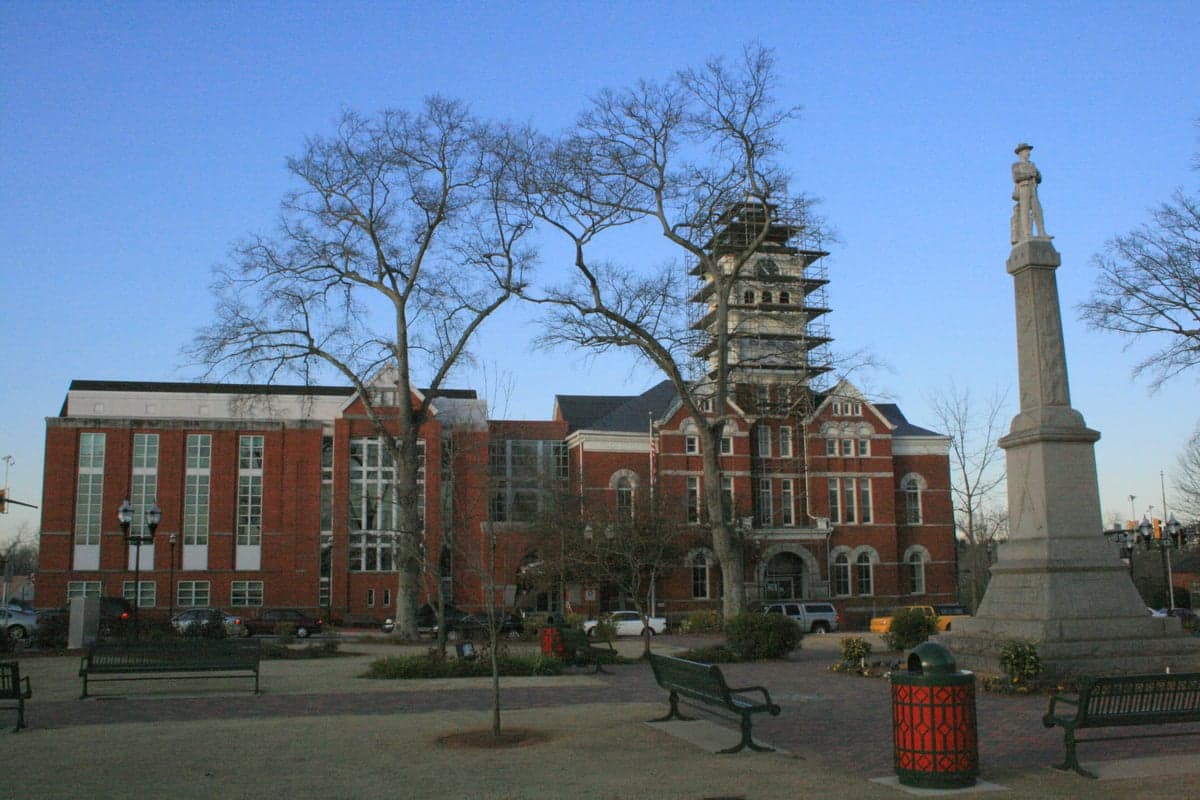
Photo: Wikipedia
Demographics of Henry County
Affluence Level in Henry County
A middle-class area roughly in line with national averages across income, home values, education, and employment.
People of Henry County
Today, Henry County is a predominantly suburban, family-oriented county of 245,417 residents at the southern edge of the Atlanta metropolitan area. Its population is majority Black (49.8%) — a distinction shared by few metro Atlanta counties — with a substantial White minority (34.6%) and a growing Hispanic community (8.0%) alongside small but visible East/Southeast Asian (2.3%) and Indian (1.0%) groups. Characterized by high homeownership, active evangelical churches, and a conservative political leaning, the county bridges old rural Georgia roots with new metro Atlanta suburban growth, creating a place where traditional values coexist with rapid demographic change.
Settlement & growth (pre-1960)
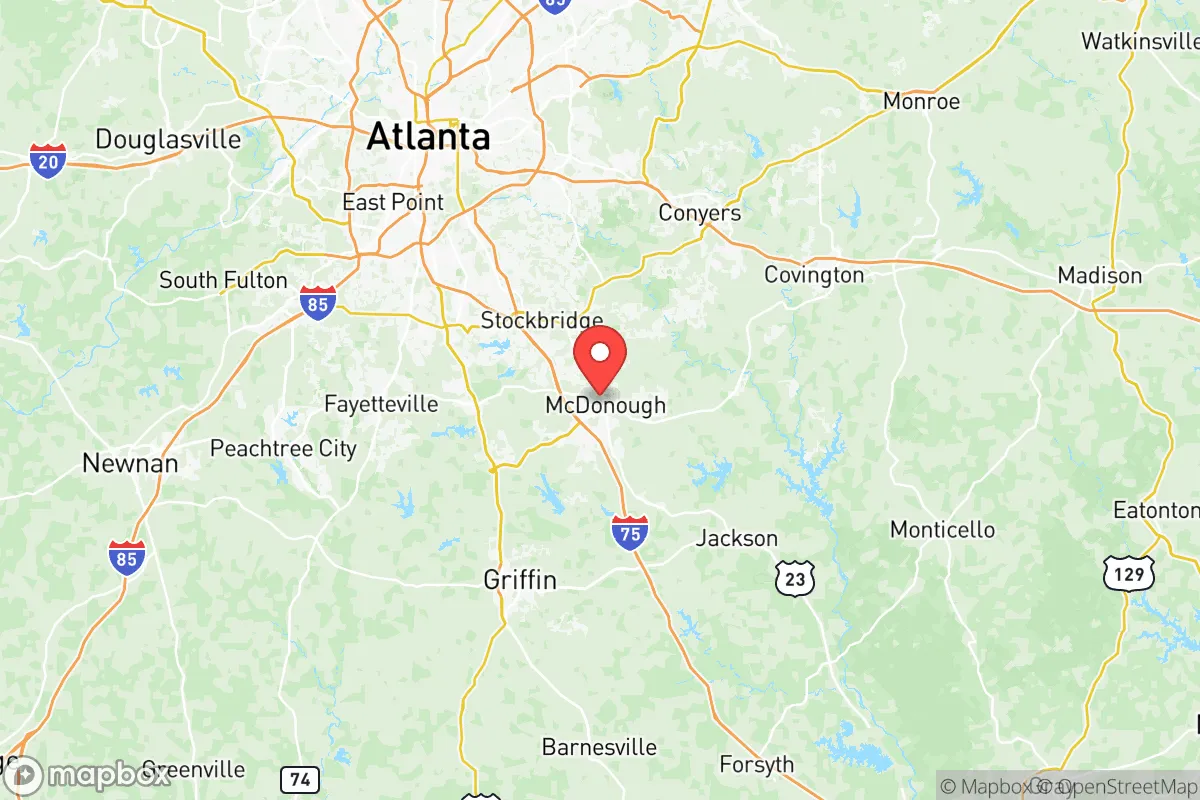
Before European settlement, the area now called Henry County was the heart of Creek Indian territory, specifically the domains of the Coweta and Kasihta towns. Creek villages lined the Towaliga and Ocmulgee river bottoms, and the region served as a buffer zone between Creek and Cherokee lands. After the Creek cessions of 1821 and 1825, the state of Georgia created Henry County in 1821 from Creek lands, carving out a grid of land lots that attracted its first permanent settlers: Scots-Irish and English farmers from the Piedmont of Virginia and the Carolinas, seeking cheap cotton land. They arrived via the Fall Line Road and settled along the ridgelines of what became McDonough (the county seat, founded in 1823) and the crossroads of Stockbridge (established 1840s).
Cotton cultivation defined the economy through the antebellum period, and the county's population was roughly one-third enslaved by 1860. After the Civil War, freed people established independent communities on former plantation lands, concentrating in the rural areas around Hampton (chartered 1873) and the southern part of the county near Locust Grove (founded 1850s as a railroad depot). These early Black settlements — such as the Sandtown and Flippen communities — became the nucleus of the county's African American population that persists today. The post-Reconstruction era saw some out-migration of Black families to industrial cities, but many remained as sharecroppers and small farmers.
From 1880 to 1940, the population stagnated as the boll weevil devastated cotton and the Great Depression pushed rural families off the land. White population actually declined slightly, while Black population held steady in the rural southern and eastern portions of the county. The railroad lines through McDonough and Locust Grove provided some connectivity, but Henry County remained a sleepy agricultural district until after World War II. The first suburban inklings came in the 1950s, when a few Atlanta commuters began building homes along the U.S. 23 corridor, but the county's population was still under 20,000 at mid-century — overwhelmingly native-born, rural, and divided roughly evenly between White and Black.
Modern era (post-1965)
The 1965 Hart-Cellar Act had little direct effect on Henry County — the foreign-born share remains just 2.7% in 2026, far below the national average. Instead, the county's modern demographic revolution was driven almost entirely by domestic migration. Beginning in the 1970s and accelerating through the 1990s, the completion of Interstate 75 through the county's western edge turned Stockbridge and McDonough into bedroom communities for Atlanta workers. White families moved south from DeKalb and Clayton counties in a pattern of suburban flight, and the county's White share peaked at around 80% in 1980. But that same interstate corridor also attracted Black middle-class families leaving Atlanta's inner suburbs, and by 2000 the Black population had risen to nearly 35%.
The 2000s and 2010s saw the most dramatic shift: Black families continued arriving from across metro Atlanta, drawn by newer housing stock and lower taxes, while many White families moved further south or into exurban developments. Hampton and the southern parts of the county became heavily Black communities, while Stockbridge transitioned to a majority-Black city by 2010. Today, Henry County is nearly half Black, making it one of the most heavily African American suburban counties in the United States outside of the Washington, D.C. area. The Hispanic population grew from under 2% in 1990 to 8.0% in 2026, concentrated in Stockbridge and McDonough, where construction, landscaping, and warehouse jobs have drawn Mexican and Central American families. East/Southeast Asian communities — primarily Vietnamese and Filipino — reached 2.3%, largely professionals in healthcare and logistics centered in McDonough. The Indian population (1.0%) is mostly in upper-income subdivisions along the I-75 corridor, working in technology and medical fields at employers like Piedmont Henry Hospital and nearby distribution centers.
The county's college-educated share sits at 28.0%, reflecting a bifurcated workforce: a growing professional class commuting to Atlanta and a large blue-collar base in warehousing, construction, and retail. Politically, Henry County has trended Republican in county-level races, though it is less conservative than exurban counties to the south. The cultural character is shaped by strong Black churches, active homeowners' associations, and a public school system that serves a majority-Black, economically diverse student body.
The future
Henry County's population is projected to exceed 300,000 by the mid-2030s, driven by continued spillover from higher-priced Atlanta suburbs. The Black share is likely to stabilize around 50-55% as Hispanic and Asian/Indian growth gradually diversify the mix. The foreign-born share will rise from its current 2.7% but is unlikely to approach 10% within a decade, given the county's land costs and limited rental housing supply compared to Gwinnett or DeKalb counties. Locust Grove and Hampton will see the fastest growth as infrastructure catches up, while McDonough faces denser development pressures.
Culturally, the county is not tribalizing into distinct ethnic enclaves in the manner of some Atlanta suburbs; instead, neighborhoods are relatively integrated by income and race, particularly in newer subdivisions. However, the Hispanic community in Stockbridge is forming a visible small-business corridor along Georgia 138, and East/Southeast Asian families tend to concentrate in specific McDonough subdivisions near the hospital and technology parks. The overall trend is toward a suburban mainstream identity — conservative, church-centered, family-oriented — that absorbs new groups rather than fragmenting. The long-established Black population holds the most political and civic influence, while White residents remain a substantial minority with a strong presence in the county's older rural areas and in Hampton's historic district.
What Henry County is becoming is a moderate-income, majority-Black suburban county with a growing Hispanic minority, modest professional diversity, and firmly suburban values. For a family moving in today — especially a conservative-leaning family — the county offers lower cost of living than northern Atlanta suburbs, reliable schools in many zones, and a community where church life and neighborhood associations still feel central. The rapid growth

* Values derived from national, state, county, city and local statistics and may differ in a specific area. Last updated: 2026-05-22T18:46:41.000Z
Narrative content on this page is AI-generated and may contain mistakes. Verify any details that matter before acting on them.
ReloMaps may earn a commission from affiliate links at no extra cost to you.

