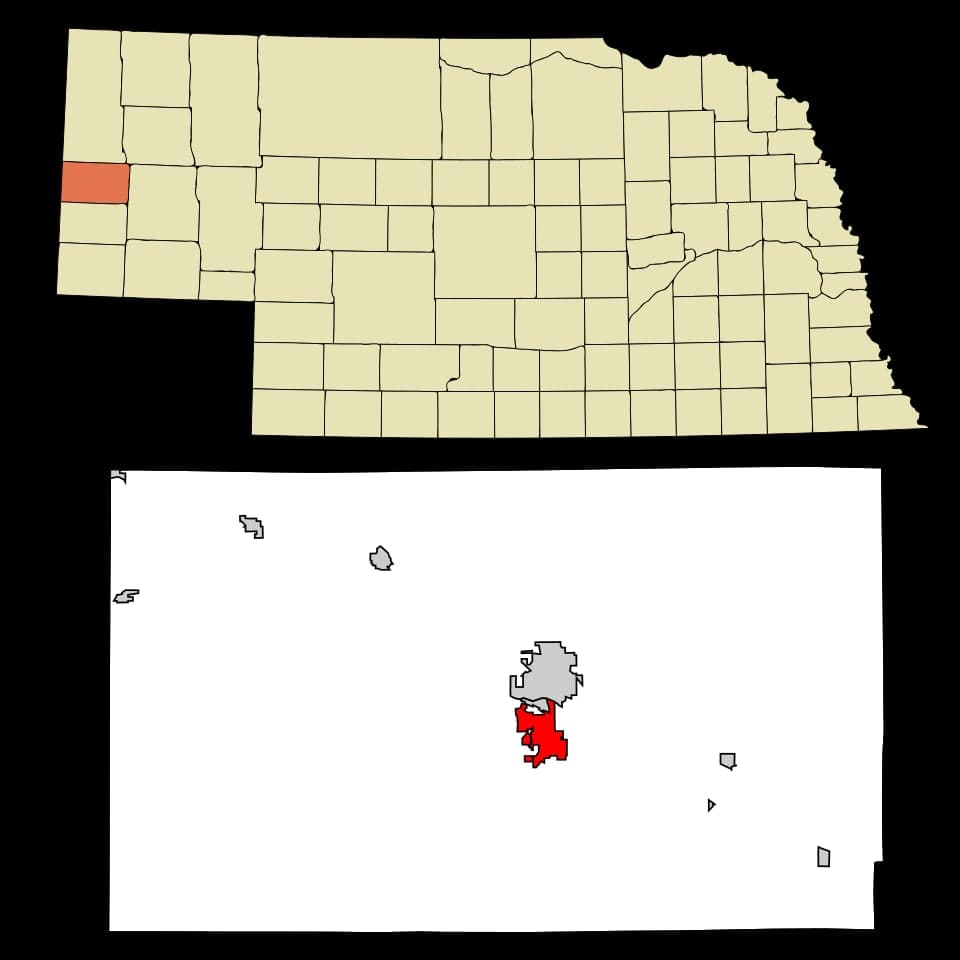
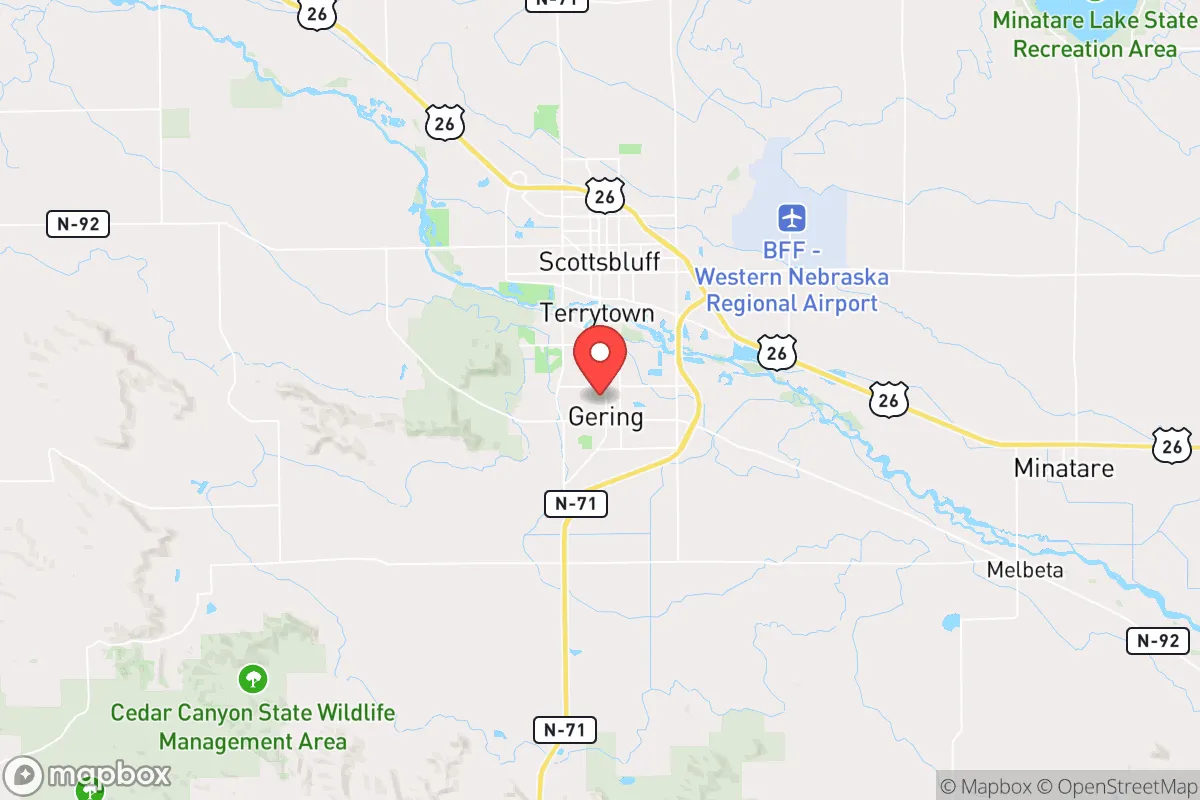
Photo: Wikipedia
Demographics of Gering, NE
Affluence Level in Gering, NE
A middle-class area roughly in line with national averages across income, home values, education, and employment.
People of Gering, NE
Gering, Nebraska, is a predominantly white, family-oriented community of 8,567 residents, where a significant Hispanic minority (25.0%) shapes much of the local culture and workforce. The city retains a strong agricultural and conservative character, with a low foreign-born population of just 1.3% and a college attainment rate of 28.4%. Its people are defined by a blend of deep-rooted pioneer heritage and a growing, younger Hispanic population that is revitalizing the local economy and schools. For a conservative-leaning individual or parent, Gering offers a stable, safe environment with a clear sense of community and traditional values.
How the city was settled and grew
Gering’s human history begins with the Homestead Act of 1862, which drew primarily Anglo-American settlers of German, Irish, and English descent to the North Platte Valley. The city was officially founded in 1887 as a railroad town on the Chicago, Burlington and Quincy line, serving as a shipping point for sugar beets, potatoes, and livestock. The original settlers clustered in the Old Town Gering district, centered around 10th and Q Streets, where the first frame houses and brick commercial buildings still stand. A second wave arrived in the early 1900s with the expansion of the Great Western Sugar Company, which brought a small number of German-Russian and Mexican laborers to work the beet fields. These workers settled in the South Gering area, near the railroad tracks and the sugar factory, creating a modest but distinct working-class neighborhood. By 1950, Gering’s population was nearly 100% white, with the Hispanic community numbering only a few dozen families, mostly seasonal laborers who returned to Texas or Mexico after harvest.
Modern era (post-1965)
The post-1965 era saw a gradual but significant demographic shift, driven by the expansion of irrigated agriculture and the meatpacking industry in the broader Scottsbluff-Gering region. The Immigration and Nationality Act of 1965 opened the door for more legal immigration from Latin America, and by the 1980s, a steady stream of Mexican and Central American families began settling permanently in Gering. These new residents concentrated in the West Gering neighborhood, west of 10th Street, where affordable housing and proximity to agricultural jobs made it a natural landing point. The Hispanic share of the population grew from under 5% in 1970 to 25.0% today, while the white share declined from 94% to 69.3%. The Black population remains tiny at 0.7%, and East/Southeast Asian residents account for just 0.5%, with no measurable Indian subcontinent population. Domestic in-migration from other parts of Nebraska and the Midwest has been minimal, as the region’s population has been relatively stagnant. The North Gering area, developed in the 1990s and 2000s, attracted white families moving into newer, larger homes, creating a subtle but real economic and ethnic divide between the older, more diverse South and West sides and the newer, whiter northern subdivisions.
The future
Gering’s population is trending toward a slow but steady increase in Hispanic share, driven by higher birth rates among Hispanic families and continued, albeit modest, immigration from Mexico and Central America. The white population is aging and declining slightly, as younger white adults often leave for college or jobs in larger cities. The Hispanic community is not tribalizing into a separate enclave; rather, it is assimilating into the broader community, with many second- and third-generation Hispanic residents living in East Gering and Central Gering alongside white neighbors. The foreign-born share remains low at 1.3%, indicating that most Hispanic residents are U.S.-born citizens. Over the next 10-20 years, Gering will likely become a majority-minority city, with Hispanics approaching 35-40% of the population by 2040. The city is homogenizing in terms of values—conservative, family-focused, and agrarian—even as its ethnic composition diversifies. For a newcomer, this means a stable, safe community where traditional American values are still the norm, but where Spanish is increasingly heard in schools and at community events.
Gering is becoming a more ethnically diverse but culturally cohesive community, where the pioneer spirit of its founders blends with the hardworking ethos of its Hispanic families. For a conservative-leaning individual or parent, this is a place where change is gradual, crime is low, and the sense of neighborly responsibility remains strong. The city offers a predictable, family-friendly environment with a clear identity rooted in agriculture and faith, making it a solid choice for those seeking stability over rapid urban growth.

* Values derived from national, state, county, city and local statistics and may differ in a specific area. Last updated: 2026-05-01T05:51:39.000Z
Narrative content on this page is AI-generated and may contain mistakes. Verify any details that matter before acting on them.
ReloMaps may earn a commission from affiliate links at no extra cost to you.

